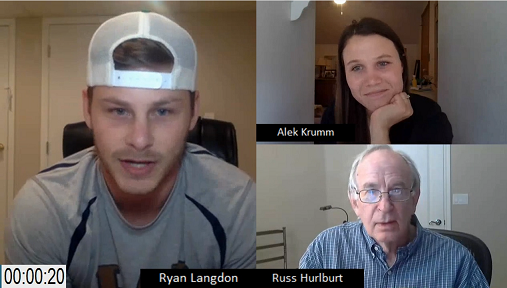
Ryan Langdon's January 28, 2020 blog about internal monologue sparked a firestorm of conversations around the globe. Ryan wrote, "I saw this tweet yesterday that said that not everyone has an internal monologue in their head. All my life, I could hear my voice in my head and speak in full sentences as if I was talking out loud. I thought everyone experienced this, so I did not believe that it could be true."
The tweet referred to work by psychology professor Russ Hurlburt, who based his claim on his research using Descriptive Experience Sampling (DES).
So does Ryan actually hear his voice in his head speaking full sentences as if talking aloud? We will used DES and reveal what we find, as we find it. Nothing is hidden, so you can judge the quality of the interviews for yourself.
We discussed six samples of experience, and we spent quite a bit of time clarifying with precision what is meant by “the moment of the beep” and practicing separating context from experience. Ryan voiced some self-theories, mostly about his own internal monologue, and we encouraged him to bracket those theories (though, as we know, that bracketing process has only just begun)....
In general—sampling day 1: All DES interviews are some combination of iterative training (so that future sampling days can be more skillful) and description of experience. The aim of the first sampling interview (or the first several sampling interviews) is almost entirely iterative training. First-day sampling interviews appear to be inquiries into experience, but their fundamental aim is to facilitate discussions of how to do DES more skillfully. DES recognizes that participants on their first sampling day are not skillful, so DES routinely discards first-day descriptions.
With Ryan in particular: This was a typical DES day 1 interview: there were some reasons to be confident that Ryan was describing his experience, but also some reasons to be skeptical of those descriptions.
Sample 1.1 [0:49]: Ryan is watching "Survivor" on TV. He is paying attention to the show, following along. Apparently (this is only day 1) there is nothing else present in his direct experience. [We were not successful (typical of day 1) in clarifying the distinction between the scene’s being emotional and Ryan experiencing emotion.]
Sample 1.2 [4:41]: [After beep 1, Ryan made a video recording talking about that experience. He’s now editing that video. In the video, Ryan has commented something like, "It [beep 1] wasn’t a very juicy thought." Simultaneously, he thinks that a dark, crazy, or otherwise juicy thought would have been better, that his viewers would have liked that more. As best we could say at our day-1 level of expertise, this is a specific idea clearly apprehended but not present in words, pictures, or other symbols. [That is, this appears to be what DES calls an "unsymbolized thought." Perhaps because of his prior belief in internal monologue, Ryan found it difficult to describe this unworded thinking.]
Sample 1.3 [12:31]: [Ryan is watching "Survivor" with a friend, paying attention but not particularly engaged. One of the challengers is striking flint to make a fire. Ryan says aloud to his friend, "If you scrape off too much magnesium from the flint, it won’t work anymore." The words seem to be rolling out of him; he has no experience of initiating or directing them.
Sample 1.4 [22:16]: [Ryan is watching "Survivor." Before the beep, a female contestant from Sri Lanka was answering a question about why she should stay on the show. ] At the moment of the beep, Ryan has just said aloud to his friend, "That was a good answer." [This interview illustrates the importance of being clear about the moment of the beep: Ryan initially said that his experience involved noticing / being interested in her accent, but we eventually established that that interest had come and gone prior to the beep.]
Sample 1.5 [36:57]: [Ryan is watching a Domino’s commercial depicting an overweight kid talking about how much he loves eating pizza.] Ryan innerly says in his own voice in a matter-of-fact/declarative tone, "His parents should stop buying him pizza." Ryan was pretty confident that his experience was of speaking (as opposed to hearing), [though that may be influenced by his self-theories regarding initiated and non-initiated inner speech. This and subsequent interviews will work to clarify that distinction.]
Sample 1.6 [44:01]: [Ryan is playing a video game on autopilot. He had, before the beep, sent a text message that read, "I was gonna text ya."] Now, at the moment of the beep, as best we could say, he innerly sees the word ya [because of time, we did not adequately explore the details of the visual experience]. At the same time, he innerly says or innerly hears "I’m gonna text ya" in his own voice [we continued to work on clarifying the details of the inner voice].
Ryan seems motivated to be transparent and to increase his skills of apprehending and describing experience.
We discussed six samples of experience, still (as is usual in DES) clarifying with precision what is meant by “the moment of the beep,” by "inner experience," and practicing separating self-theory from experience....
In general—sampling day 2: All DES interviews are some combination of iterative training (so that future sampling days can be more skillful) and description of experience. The aim of the second sampling interview is a combination of experience description and iterative training.
With Ryan in particular: This was a typical DES day 2 interview: there were some reasons to be confident that Ryan was describing his experience, but also some reasons to be skeptical of those descriptions.
Sample 2.1 [1:12]: [Ryan is studying,] (70%) innerly saying while reading, "embolic ischemia." Simultaneously, Ryan is trying, so far without success, to innerly see an embolic ischemia. The trying is present in his experience.
Sample 2.2 [10:48]: [Ryan is studying embolisms. He’s typing into a searchbar "and an embolis"] and innerly says "and an embolis" as he types. His speaking is in his normal speaking voice at its normal rate, and the speaking and typing are in sync [even if, in reality, the typing is slower than conversational speech].
Sample 2.3 [19:43]: [Ryan had been in communication throughout the day with his doctor, trying to get the doctor to order a prescription for him across state lines. Now, while waiting for a study guide to print out,] Ryan innerly sees and hears the doctor say to him, "I’ll do it [send the prescription] but I’m going to discontinue care [stop seeing Ryan as a patient]." Ryan sees his doctor fairly clearly but not high def: sees him from the side wearing a white and blue-ish checkered button-up shirt. Ryan hears the doctor speaking, but the heard voice is Ryan’s (that is, the doctor is speaking in Ryan’s own voice).
Sample 2.4 [27:26]: [Ryan is scrolling through Instagram, eyes aimed at a picture of a girl. He imagines himself telling us (the DES interviewers) about this moment, and then, coincidentally, the beep actually occurs.] Ryan innerly says in his own voice as if to us, "I was looking at a picture."
Sample 2.5 [44:25]: [Ryan is studying. He reads a question and then closes his eyes to see if he can answer the question without peeking at the answer written on the study guide.] Ryan innerly sees the shape of the study-guide paragraph where this answer is, about ¾ down the page. No words or details, just the general shape (including thickness) and location of the paragraph.
Sample 2.6 [56:47]: [Ryan had sent a long, thoughtful message to his doctor, who had sent back a curt, negative response. Ryan is considering how to respond.] He thinks of something he might say (what he described as a process of "stream-of-consciousness"/not effortful inner words), then considers how it sounds and realizes he sounds like an asshole, then thinks of something less asshole-ish to say, then notices how that is still pretty asshole-ish, then tries again, and so on. The beep interrupts a possible response. [As best we could say,] at the moment of the beep, Ryan innerly hears himself saying something like, "I really appreciate the generous amount of time you put into your response" [a sarcastic jab at the doctor.] [However, Ryan couldn’t be sure if those were the exact words and didn’t write down the words, so there is reason to wonder whether these exact words (or words at all) were even present.] Ryan was also feeling angry at the moment of the beep, a powerful energy in his chest.
Ryan seems motivated to be transparent and to increase his skills of apprehending and describing experience.
We discussed five samples of experience, still (as is usual in DES) clarifying with precision what is meant by "inner experience." Ryan confronted the fundamental question of how it is possible to have inner experience without internal monologue....
In general—sampling day 3: All DES interviews are some combination of iterative training (so that future sampling days can be more skillful) and description of experience. The aim of the third sampling interview is a combination of experience description and iterative training.
With Ryan in particular: In 2 or 3 of the 5 samples, there was some kind of directly experienced "before the footlights of consciousness" thinking that did not include words or visual images. Ryan wrestled with whether that was possible.
Sample 3.1 [2:06]: [Ryan is attending a lecture via Zoom.] At the moment of the beep, he’s thinking that his professor is probably rich and that he’s also probably older than he looks which makes sense because rich people often look younger than they are. This is a cognitive/analytical thought process not in words, pictures, or other symbols.
Sample 3.2 [7:02]: [Before the beep, Ryan had sent a photo of his cat to a friend via Snapchat.] Now Ryan is reading his friend’s reply, "I’m obsessed with his [the cat’s] nose," innerly speaking as he reads. Simultaneously, Ryan muses about whether he should reply that the cat is female, not male. This is a cognitive experience not in words, pictures, or other symbols.
Sample 3.3 [22:53]: [Ryan is attending a lecture via Zoom.] At the moment of the beep, he’s highlighting a sentence in his textbook, carefully trying to stay inside the lines of the words. [He doesn’t experience the seen words as semantic words; they are merely things arranged in a line to be highlighted.]
Sample 3.4 [27:50]: [Ryan is attending a lecture via Zoom. His professor has just explained that physicians generally refer to a lab test by speaking the letters "B-U-N," whereas nurses generally speak it as the word "bun."] At the moment of the beep, Ryan (a physician assistant trainee) imagines himself in a situation where he says to his preceptor, "Bun…I mean B-U-N. Sorry, I’m working on that," and feels embarrassed. He sees the hospital room as an undifferentiated white space, and he sees the preceptor as merely a white coat with no differentiated characteristics.
Sample 3.5 [41:18]: [Ryan’s eyes are aimed at his textbook picture of an EKG, but he’s barely seeing it, if at all] Instead, he feels hungry, a physical sensation in his stomach, and innerly sees (clearly) the parking lot of his grocery store. [In fact, the visual details of the seen parking lot correspond to the parking lot outside a wine shop Ryan frequents, not the grocery store he is contemplating. But this discrepancy is not noticed at the moment of the beep.]
Ryan wrestled throughout this day with the unworded nature of much of his experience. He believed that unworded experience is impossible and yet discovers himself engaged in it frequently.
We discussed five samples of experience. By comparing samples 4.1 and 4.3, we made substantial progress in clarifying with precision what is meant by "inner experience."...
In general—sampling day 4: All DES interviews are some combination of iterative training (so that future sampling days can be more skillful) and description of experience. The aim of the fourth sampling interview is a combination of experience description and iterative training.
With Ryan in particular: In the previous (3rd) interview, Ryan had wrestled with the question of whether it was possible to have directly experienced "before the footlights of consciousness" thinking that did not include words or visual images. There was one such instance today (sample 4.4), which was described without much difficulty.
Sample 4.1 [0:05]: [Ryan is considering asking a classmate, let’s call her "Caroline," to split up some note-taking work.] He (80%) innerly says to Caroline, "I’ll do the first half of this lecture if you do the second." He innerly sees Caroline, but barely—an inner seeing with little or no differentiation. [We discussed at length whether this inner seeing had been present, eventually concluding that it indeed was, even though its inchoateness made it extremely difficult to describe.]
Sample 4.2 [7:22]: [Skipped because the beep came very shortly after the first beep and Ryan was scrambling to take notes about the first beep.]
Sample 4.3 [8:45]: [Ryan is considering asking a classmate, let’s call him "Buddy," to split up some note-taking work in the event that Caroline (of beep 4.1) turned him down or plans otherwise fell through.] He innerly says to Buddy, "Would you still be interesting in splitting notes?" [Thus, this experience is nearly identical to beep 4.1 except that there is no accompanying visualization at beep 4.3.]
[We used the comparison between 4.1 and 4.3 to make the point that Ryan himself recognizes experience (recall the discussion of day 3). Sample 4.1 included the experience of seeing even though the thing seen was inchoate and the description of it was difficult.]
Sample 4.4 [17:52]: [Ryan is attending a Zoom lecture. They’re taking a break halfway through the lecture. Many of Ryan’s classmates have already turned off their cameras; their Zoom boxes have turned gray.] At the moment of the beep, Ryan is wondering how many students have left, how many of them are missing the professor’s potentially important answer. This is a cognitive thought process without words, pictures, or other symbols. He’s simultaneously expanding the Zoom window so he can see the attendee’s boxes.
Sample 4.5 [22:17]: [Ryan’s professor had moved quickly through a PowerPoint slide before Ryan coujld digest it.] Now, Ryan is scanning through the relevant book section looking for anything that might inform him of the slide he missed. [Presumably, when he sees it, he’ll stop and read.] There is no accompanying experienced thought, image, words, etc. [He is not hearing the lecture at this moment.]
Sample 4.6 [25:32]: [Ryan is attending a Zoom lecture on carotenosis, a disorder causing orange skin. Ryan is reminded of a recent visit with his grandmother, during which she showed him a lesion on her leg that he thinks may be actinic keratosis (AK).] At the moment of the beep, Ryan innerly sees his grandmother’s leg, clearly and realistically, apparently an accurate recreation of the previous actual seeing. Simultaneously, he innerly says to "Julia," his classmate with a knack for dermatology, "Do you think this is AK?" as if he were texting Julia a picture of his grandmother’s leg [he does not actually have such a picture].
We got some clarity today about what is and is not experience. Today's wrestling was mostly about how or whether to describe visual experience that is mostly inchoate.
We discussed six samples of experience. Inner or external speech occurred in four, including two that might be considered internal or external monologue. Visual imagery occurred in three, along a range of clarity....
In general—sampling day 5: All DES interviews are some combination of iterative training (so that future sampling days can be more skillful) and description of experience. The aim of the fifth sampling interview is mostly experience description and some iterative training.
With Ryan in particular: Ryan has become quite skilled at apprehending his experience. Today we explored the range of clarity in his inner visual imagery.
Sample 5.1 [0:04]: Ryan innerly says "in-nuh-sint" slowly [and types it on his phone apparently in sync].
Sample 5.2 [2:46]: [Ryan has read saphenous vein in a bulleted list.] Now, at the moment of the beep, he rereads it and says aloud "saphenous vein" with the intention of practicing its pronunciation. Simultaneously he vaguely innerly sees the diagram of a patient’s right leg.
Sample 5.3 [10:13]: [Ryan is taking an exam. A question presents a case and a multiple-choice answers of possible treatments.] He innerly says, "I have to figure out what it is first," [meaning he first has to diagnose it before he can select the treatment].
Sample 5.4[14:58]: [Sample was skipped because next beep happened almost immediately]
Sample 5.5 [14:58]: [The beep occurred very shortly after beep 5.4 while Ryan was trying to recall what was ongoing in his experience at beep 5.4.] He is saying aloud, "I don’t even fucking remember what happened!" [at beep 5.4] . Simultaneously he innerly sees his Twitter feed undifferentiatedly and with few details.
Sample 5.6 [23:41]: Ryan feels a dull pain in his upper back neck area and is, experientially, exploring the pain, noticing the sensations and their boundaries.
Sample 5.7 [29:06]: [Ryan is sitting outside listening to music.] He feels the radiant heat of the sun on his right arm, simultaneously hears the rhythm of the music, and simultaneously hears a loud plane flying overhead.
Informal Q/A [37:52]: Ryan asks what it is like for the interviewers to sample with him.
We continued to explore visual imagery (along a continuum of clarity) and inner speaking (mostly as part of visual imagery).
We discussed five samples of experience. One was a textbook example of unsymbolized thinking. Inner speech occurred in three, all of which were part of the accompaniment of typing. There was no inner seeing (mental imagery), which is surprising given the high frequency of inner seeing on previous days....
In general—sampling day 6: All DES interviews are some combination of iterative training (so that future sampling days can be more skillful) and description of experience. The aim of the sixth sampling interview is mostly experience description and some iterative training.
With Ryan in particular: Ryan has become quite skilled at apprehending his experience. Today we explored unsymbolized thinking--the experience of thinking without words, images, or other symbols.
Sample 6.1 [0:05]: [Ryan is watching a podcast where a guest claimed to have broken his ribs.] Ryan is thinking without words, pictures, or other symbols that some people are medically illiterate so you shouldn’t trust what people report about medical issues. [Ryan’s thinking is a classic example of what DES calls "unsymbolized thinking."
Sample 6.2 [3:27]: [Ryan is typing notes regarding his experience at beep 6.1.] He innerly says "It happened quickly" [and retrospectively can say that it was in sync with his typing.]
Sample 6.3 [10:10]: [Ryan is texting a friend about how with boxer’s fractures the fingers sometimes curl.] Ryan innerly says while typing, "My fingers did that." [Retrospectively Ryan can say that the speaking was in sync with his typing, which was faster than normal conversational pace.]
Sample 6.4[15:55]: [Ryan is editing a text. He doesn’t like his use of the word ploy and intends to swap it out for another word.] He innerly says "scheme." ["Scheme" is a potential replacement for ploy but he doesn’t experience that. At the moment, it’s just a word he has produced.]
Sample 6.5 [26:40]: [A bit before the beep, Ryan had received a notification that he had a new Instagram follower. He had innerly said "Daisy," the new follower’s first name.] Now, at the moment of the beep, he is looking at and sees Daisy’s complicated/obscure last name. [He does not innerly say or even attempt to say (e.g., sounding it out) the last name, apparently because he can’t or doesn’t know how to say it.]
Informal Q/A [33:08]: First they what happens when DES interviewers encounter phenomena that is foreign to them. They discuss Lena’s "sensing" and how that had emerged in her sampling. Then they discuss the phenomenon of unsymbolized thinking, using Ryan’s sample 6.1 as an example.