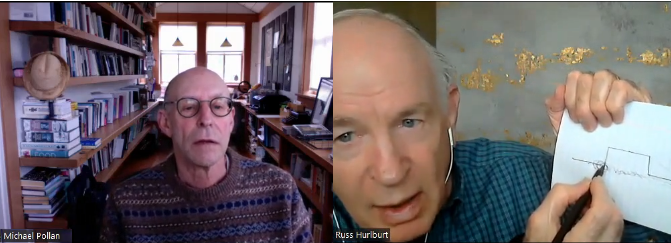
Part IX: Michael Pollan, a New York Times bestselling author
Michael Pollan is a six-time New York Times bestselling author of books such as How to Change your Mind and The Omnivore's Dilemma. A professor at both Harvard and the UC Berkeley Graduate School, Pollan is currently working on a book about consciousness, and as part of that project interviewed Russ. That led to his interest in trying descriptive experience sampling for himself; this is the result.
This is a fairly typical first sampling day—there was considerable discussion about what is experience, differentiating experience from context, limiting ourselves to the moment interrupted by the beep, and so on. ...
In general—sampling day 1: All DES interviews are some combination of iterative training (so that future sampling days can be more skillful) and description of experience. The aim of the first sampling interview (or the first several sampling interviews) is almost entirely iterative training. First-day sampling interviews appear to be inquiries into experience, but their fundamental aim is to facilitate discussions of how to do DES more skillfully. DES recognizes that participants on their first sampling day are not skillful, so DES routinely discards first-day descriptions.
Michael's samples:
Sample 1.1 [4:34; I’m standing in line at Cheeseboard.] I’m trying to decide whether to buy a new roll or use the heel of the bread that I have at home for a lunch sandwich. This apparently involves innerly seeing the roll and then the bread, but we are not confident. There are lots of other details: the smell of the cheese, the plaid pants of the woman in front of me, how close to stand to the people in the line (leftover Covid sensitivity), that the roll will be fresher but white flour, whereas the heel will be stale but whole grain. How much of that is in experience is hard to say.
Sample 1.2 [24:55; I’m sending an email to my sister Dana, answering her question about my pants size.] I’ve looked out the window past a photo of my father, taken at Thanksgiving a few months before he died. I’m thinking how good/healthy he looks (he died a few months later). I’m thinking that the beep is going to come right now. It’s hard to say what of that is in experience at the moment of the beep.
Sample 1.3 [38:35; At computer typing an email.] As I type I innerly hear the words I am typing “no wonder neither of us k___” [the beep hits at the beginning of the word, which would be “know”]. But we are not confident about how or whether the inner hearing is taking place.
Sample 1.4 [52:59; Rereading the email, about to press Send.] I have reread it from her point of view, trying to figure out whether it has the right tone, etc. I apparently have found it satisfactory, so I’m ready to send it. I’m not sure whether this experience is more about my readiness or still looking at it from her point of view.
Samples are from two days ago. DES prefers "fresh beeps," because of the problematics of memory issues in "stale" samples. Therefore everything about this day’s samples should be understood with a veil of skepticism. ...
In general—sampling day 2: All DES interviews are some combination of iterative training (so that future sampling days can be more skillful) and description of experience. The aim of the first sampling interview (or the first several sampling interviews) is almost entirely iterative training. First-day sampling interviews appear to be inquiries into experience, but their fundamental aim is to facilitate discussions of how to do DES more skillfully. DES recognizes that participants on their first sampling day are not skillful, so DES routinely discards first-day descriptions.
Michael's samples:
Sample 2.1 [2:08; Michael’s wife Judith is reading her book, Michael is beside her reading his book. Judith has started to read him aloud a sentence, presumably because he might find it interesting. At the moment of the beep, Michael is wondering Why? (is she reading this to me), perhaps with a bit of annoyance. It is not clear whether the word "why" is or is not present. It is apparently cognitive, but RTH is skeptical. Michael’s account is subjunctified and inconsistent, perhaps because the sample took place two days ago.
Sample 2.2 [7:30; Michael and his wife are on the couch reading their books. Michael is reading To the Lighthouse by Virginia Woolf, reading a very long sentence.] At the moment of the beep he has come across the word "sop" and is having some sort of Huh reaction that that word seems somehow out of place in the flow of the rest of the sentence. This reaction seems something like precognitive, [but RTH has some skepticism arising from the fact that the beeps are stale].
Sample 2.3 [14:55; Michael is looking out the window and] wondering what he would be thinking if the beep went off right then. RTH is not sure whether this thinking is in words, and if so whether the words are innerly heard, spoken, or implied. There is also the possibility that something of the live oak scene is in Michael’s experience, but we don’t become confident about that. [There is a longish discussion about fresh beeps and the difference between hearing and speaking.]
Sample 2.4 [36:23; Michael is meditating, and a worrisome recollection of a heart palpitation from last night arises.] Michael either imaginarily feels the heart palpitation sensations, or he recalls cognitively what the characteristics of those palpitations were. [We were not able to sort out that distinction—we spent a fair amount of iterative-training time discussing this.] Michael was worried about this palpitation; worry was apparently emotional (but was not described more than that).
Sample 2.5 [53:10; Michael is opening his phone to call his 94-year-old mother who has been to a doctor’s appointment. As he opens the phone, he sees some texts from his siblings who have been involved with the visit.] He thinks, "Better look at these texts first," (or perhaps just "Better look"; or perhaps a reaction without words—RTH is never confident the Michael grasps the distinction.)
Repeatedly throughout the interview we discussed the issue of whether or to what degree the context or surround of a situation is directly apprehended.
The first three samples are from today; the next two are from yesterday. We continue the discussion of the difficulty in distinguishing between description of phenomena and context. ...
In general—sampling day 3: All DES interviews are some combination of iterative training (so that future sampling days can be more skillful) and description of experience. The aim of the third sampling interview is a combination of experience description and iterative training.
Michael's samples:
Sample 3.1 [1:16; I had just received a text that indicates that my 94 year old mother thinks I am coming to visit next week, which is not true, and which I take to be a sign of her dementia.] I feel sadness and frustration [we spend a long time trying to sort through how this is experienced, without making much progress.] I’m also typing a reply that says the info is wrong—I am coming next month [but is it not clear how or whether this is directly experienced.]
Sample 3.2 [21:36; A few minutes before, I had put in a call to my mother, which hadn’t gone through. I had left a message. Now, at the moment of the beep, my phone is vibrating and I see her name in the From window. I’m in a rush to answer it, and I don’t have the bandwidth both to answer it and to attend to my experience. So we skip this beep.]
Sample 3.3 [22:36; Just beginning my day at work; I’ve had coffee, I’m opening the folder that has yesterday’s drafts; my first task will be to edit/clean/revise that work.] I read the first sentence, which is "What was I thinking?" [This is apparently a taking in of the sentence without articulating it in any way.] I have a sense of trepidation / anticipation [we spend a long time trying to sort through how this is experienced, without making much progress. Perhaps it is mental; perhaps it is just what I always feel when I open the folder at the beginning of the day].
Sample 3.4 [40:48; I’m in the kitchen preparing a fish for dinner. I’ve salted it and I’m on the way to the refrigerator.] At the moment of the beep I innerly say "Pepper!" in my own exclamatory voice. [I have forgotten to pepper the fish.]
Sample 3.5 [1:00:36; I’m reading a dry linguistics text about awareness of your body in space, but I have left that reading behind to re-experience an uncomfortable scene from 15 years ago, where I had been the moderator of a panel, and a person had just arrived who I wasn’t prepared for—no chair, no introductory text, etc.] At the moment of the beep I innerly see a stage with people milling around and a horseshoe of chairs. The seen stage is dark wood [I think the actual stage was more modern]. I feel a shiver of embarrassment (but it is not clear whether the shiver is directly apprehended or presumed to be a characteristic of embarrassment).
Michael collected 6 samples yesterday and six today; he suggested discussing today’s samples as being fresher. We did so. We continue the discussion of the distinction between description and context....
Michael's samples:
Sample 4.1 [4:08; I’m meditating, and my mind has wandered to an article I’m writing about some scientists, and both the scientists and the editor are being slow to do what needs to be done.] At the moment of the beep I am thinking about what to say in an email to Tony, one of the scientists, about how to hurry him up, to be professional but vaguely threatening. This is a thought-y experience without words. Simultaneously I feel annoyed and irritated, which may involve a bodily warmth and tightening. [RTH is skeptical about all these aspects, as he is not convinced that we are adequately discriminating directly apprehended experience from self-theory and context.]
Sample 4.2 [19:05; Walking with wife to get coffee] Speaking aloud to wife "When I was walking yesterday…," (the beginning of a telling about recalling what it was like to walk during Covid—streets were empty, Covid hadn’t affected the trees and flowers, etc.). [I know what I am talking about, but it apparently isn’t directly present at the moment of the beep.]
Sample 4.3 [49:05; I’m getting into my car and see the workmen digging the stump out of a neighbor’s yard.] At the moment of the beep I think am I gonna have to listen to this all day? [We have a substantial conversation about how this thinking is present.]
The first five samples are from today; the remaining are from yesterday. It is remarkable that Michael, after many discussions across the four previous sampling days, still mixes together context and directly apprehended experience....
Michael's samples:
Sample 5.1 [0:56; During morning meditation, Michael’s mind has wandered to his upcoming schedule, in particular, to his 4:00pm scheduled walk with his friend. It has been raining, and Michael contemplates where to walk, considering trails that will be muddy, wet, etc. This contemplation has included an inner seeing of a muddy trail, and a subsequent inner seeing of an asphalt trail, viewed from an impossible perspective from the side.] At the moment of the beep Michael thinks, without words or visual imagery, we should go to Inspiration Point.
Sample 5.2 [10:13; Walking with Judith, who is talking about buying cushions for dining room chairs.] I say aloud (in experience) "with some foam in them, so they give some lift." Simultaneously I feel in my imagination some bodily sense of the slumping deflation of sitting in a chair that’s too low. (We try to be specific about the characteristics of that feeling, but the conversation is pretty discursive.)
Sample 5.3 [23:20; I was at my computer and had just looked at my gmail to-do list, seeing that a transcript had arrived.] I think, not in words or pictures, I should really edit that transcript.
Sample 5.4 [28:55; I am reheating coffee in the microwave] As I head for the pantry, I experience (without voice or picture) the word "snack" (which may have a somewhat disapproving tone, although RTH wondered whether that was inserted during the discussion rather than at the moment of the beep).
Sample 5.5 [41:47; a sample from yesterday. I’m stepping outside to take a walk with Judith. She’s already outside. I don’t know exactly where she is.] At the moment of the beep I’m surprised to find her coming toward me from the right, where our front door is. She has an armload of mail and a package from Amazon. I’m perplexed, just the experience like a question mark.
Sample 5.6 [47:02; I’m editing a paper, trying to decide whether to cut the clause "we’re constantly translating our thoughts into words."] At the moment of the beep I experience a binary analytical process, that could be expressed as cut /not cut, but there are no words (including "cut"). (I’m not sure whether the words of the clause are present at the moment of the beep.)
Sample 5.7 [55:26; not discussed] Like 5.6, making a binary decision about whether to clean up the grammar of a transcript.
Sample 5.8 [56:04; Michael is moving a piece of toast, which he has just buttered, from the cutting board to a plate.] He feels hotness in his fingers (from the crust) and a (apparently cognitive) sense of surprise [that the toast would still be that hot].
This project arose as the result of Michael’s writing a book about consciousness. This interview is the debrief about what we found, as well as asking some factual questions necessary for the book editing. It is discursive, so here is a very rough outline....
Topics (loosely defined:
Part 1: [0:49] About RTH’s history
Part 2: [5:26[ The current status and critiques of DES (comparing DES to other sampling methods, questionnaires, etc.; limitations of DES; inner speech)
Part 3: [13:01] Has RTH has worn the beeper himself? (Advantages and disadvantages)
Part 4: [21:35] Why is DES difficult? (DES vs. AI; how to know whether DES interviewer is skilled; William James)
Part 5: [33:50] Questions about moments (and more William James)
Part 5: [39:36] Questions about fMRI studies
Part 6: [45:11] Questions about people who do not have inner experience (Is age a factor? Does Michael have inner experience? About unsymbolized thinking)
Part 7: [1:03:18] Did we get the essential Michael? (More about age.)
Part 7: [1:11:21] What about your bulimia studies?
Part 8: [1:17:18] Shall we put these interviews on the web?