Do I really have internal monologue?
(Reality TV about inner experience)


Part X: Mel May: Comparing an outsider's DES to the originator's DES

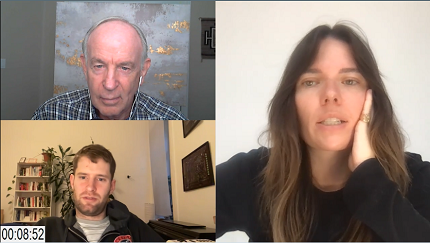
In this extraordinary set of interviews, we have the opportunity to compare DES-as-read-about-and-implemented-by-an-outsider (Julian Bass-Krueger) to DES-as-written-and-practiced-by-its-creator (Russ). We enlisted Mel May, who had volunteered to be a DES participant....

Julian Bass-Krueger and Russ have never met. Julian had become interested in DES in about 2017 and several times over the years had contacted Russ, who had given him some suggestions. Julian became a Master’s student in cognitive science at the University of Vienna, completing a thesis using DES as he had learned it from Russ’s books, articles, and web materials. The thesis also included an extension of DES that Julian called dDES (dynamic DES). In 2020, Julian sent some of his results to Russ, who responded critically--Russ was skeptical of Julian's results and doubted that dDES could be successful.

In 2023, Julian contacted Russ inquiring about supervision, and Russ suggested the possibility of conducting joint interviews of a DES participant and then candidly discussing any issues that might arise. That might provide the opportunity to compare DES-as-read-about-and-implemented-by-an-outsider (Julian) to DES-as-written-and-practiced-by-its-creator (Russ) which might be a win-win: Julian might learn something about DES, and Russ might learn something about what he should do to make his DES materials more effective.

At about the same time, Mel May, a video producer, contacted Russ saying she loved the videos in the 'Do I have inner monologue?' series and would like to produce some sort of media piece that would be much shorter than the 80 or so hours that are on the site.

Russ suggested to Julian that we might enlist Mel as a DES participant; and Russ suggested to Mel that she might wish to experience DES from the inside. Each thought that was a good idea, and this series of interviews was born.

The interviews were conducted by Russ Hurlburt and Julian Bass-Krueger. Their back-and-forth commentary provides significant insight into how to investigate inner experience--like a series of DES masterclasses.

Date

Interview

Description

September 26

Interview -1 (first meeting)
Video
Transcript with commentary

This is the initial meeting between the three participants. Russ had sketched out the possibilities to Julian and to Mel separately, but no specifics had, as yet, been agreed to....

The conversation was not scripted, and so wandered around the topics of interest. They introduced themselves and their interests in the procedure. Mel said she believed that her experience mostly involved unsymbolized thinking, and that she thought that people were very different from each other. We agreed to videotape everything, but not to release it without unanimous approval. Russ said he might want to put it on this website; Mel and Julian each had interests in producing a shorter form account of what might happen. They agree that Russ will send Mel a beeper, and that eventual Russ and Julian will interview Mel about her beeped experiences. Other than that, the details will need to be worked out.

Here, for reference, is a rough outline of topics covered:

  • [0:40]: About recording
  • [2:09]: About Julian
  • [4:27]: About Mel
  • [8:52]: Russ's plan
  • [15:27]: Mel’s plan
  • [19:36]: Procedure
  • [24:25]: The contract
  • [26:05]: About the beeper
  • [33:24]: More about the contract

October 5

Interview 0 (DES introduction)
Video
Transcript with commentary

The beeper has arrived, and they discuss how to use it....

They begin with Russ giving a short history of the construction and operation of the beeper. They end with some discussion of the philosophy behind DES investigations. In between are the DES instructions themselves.

The instructions are not scripted. Here is a rough outline of topics covered:

  • [0:07]: Beeper operation
  • [12:19]: Beeper history
  • [17:21]: DES sampling instructions
  • [24:07]: Conversation about DES

October 10

Interview 1
Video
Transcript with commentary

This is Mel's first sampling day. We discussed four of the six samples she collected and issues about the DES process that arose. ...

In commentary inserted in the transcript, Russ distinguishes, metaphorically, between diamonds (bits of pristine experience) and glass (generalities, theories, self-concept), saying that DES is about diamonds and tries to avoid glass. And we begin discussion of what will become a recurrent theme: ‘DES is not about the words’. There is substantial commentary about genuineness in the DES process. Furthermore, these samples begin the discussion of whether Mel has nothing in her experience at the moment of some beeps, which will turn out to be another recurrent theme.

In general—sampling day 1: All DES interviews are some combination of iterative training (so that future sampling days can be more skillful) and description of experience. The aim of the first sampling interview (or the first several sampling interviews) is almost entirely iterative training. First-day sampling interviews appear to be inquiries into experience, but their fundamental aim is to facilitate discussions of how to do DES more skillfully. DES recognizes that participants on their first sampling day are not skillful, so DES routinely discards first-day descriptions.

Mel's samples:

  • Sample 1.1 [2:48]: [Mel was in the process of doing kitchen tasks. She had watered the plants and] at the moment of the beep was about to grab kitchen spray and wipe the kitchen. (She may or may not have directly experienced this about-to process.)
  •      Discussion of DES: Diamonds vs. glass [0:10]
  •      Discussion of DES: It’s not about the words [4:21, 10:28, 11:35, 12:53, 20:06, 47:21,57:10]
  •      Discussion of DES: Not instructing Mel [12:39, 17:18, 32:55, 47:21, 48:55, 50:01, 1:05:48, 1:11:35, and the COMMENTARY ABOUT SAMPLE 1.4 ARISING AFTER THE INTERVIEW]
  • Sample 1.2 [20:50]: Mel was vacuuming. Nothing about the physical act of vacuuming (sound, sight, kinesthetics, etc.) was particularly experientially present . (There may have been a relaxed contentedness about it, but this may have just been Mel describing her mood or context during the overall period.)
  • Sample 1.3 [34:34]: [Mel was on the couch drinking tea.] This act wasn’t so present in her experience. (There may or may not have been a contentment aspect—a light relaxedness. But this may have been Mel’s way of characterizing the absence of negative feelings, or her impression of her general mood at the time.)
  • Sample 1.4 [45:20]: [Mel was reading a book about creativity.] At the moment of the beep, she was rereading / absorbing the meaning of a passage / or was not experiencing anything. [This may have been more her way of describing her general reading process than a description of experience at this moment.] (Mel wasn’t particularly focused on any one word, or the meaning of the text in particular. The experience was probably more automatic. This was similar to the automaticity of her vacuuming or cleaning experience, though the 'absorbing' component of reading may lend the reading a different quality.)
  • Conversation after sample discussions [1:04:20]: Don't tell participants what to do; words don't matter; discriminating between experience and all else.
  • Commentary arising after the interview [in the transcript but not on video]: On 'Mel described herself'.

October 17

Interview 2
Video
Transcript with commentary

This is Mel's second sampling day. She described many samples where nothing or nearly nothing was experientially present; we worked to clarify what she intended by those descriptions. ...

In general—sampling day 2: All DES interviews are some combination of iterative training (so that future sampling days can be more skillful) and description of experience. The aim of the second sampling interview is a combination of experience description and iterative training.

Mel's samples:

  • Sample 2.1 [0:56]: [Mel was looking at a picture of a Steadicam online and was, broadly speaking, forming what to write in an email.] There was something of this present in her experience. (This process wasn’t clear and articulated. There were no words present. There wasn’t a clear thought with clear content. There wasn’t the visual experience of looking at the picture. But there was some experience present.)
  •      Discussion of DES: Subjunctification [4:47]
  •      Discussion of DES: Theory / abstraction [4:47, 9:41]
  •      Discussion of DES: Presuppositions [4:47, 21:34]
  •      Discussion of DES: Meta-experience [6:45, 10:12]
  •      Discussion of DES: Russ uses the first person when describing Mel [12:46, 25:30]
  •      Discussion of DES: Not about the words [13:22, 21:34]
  •      Discussion of DES: Ignorance [13:22, 21:34, 33:00]
  • Sample 2.2 [14:07]: [Mel was writing an email related to the Steadicam and was halfway through a sentence]. She had some experience apparently in some way related to the emailing, but there wasn’t any clear even slightly differentiated content. That is, her experience was more than nothing, but not much more and not more in any straightforwardly discernable way. [The level of nothingness was much less in 2.2 than in 2.1: In 2.1 there was definitely something experienced, even though it was entirely inchoate. In 2.2, there was not nothing experienced, but not as much as in 2.1.]
  • Sample 2.3 [21:36]: [Mel was on her phone and had just closed Instagram]. There was nothing in her experience. [We questioned her carefully but found no signs of any aspect of experience. Mel referred to her experience as being "dormant." She carefully and seemingly confidently distinguished between the more-than-nothing experience of 2.1 and the nothing of the present sample.]
  • Sample 2.4 [28:30]: [Mel was making a cup of tea and walking to fill up the kettle]. Mel was not experiencing anything. [There was apparently no distinction between the nothing of 2.3, 2.4, 2.5, and 2.6. Those samples are, however, more completely nothing than either samples 2.1 or 2.2.]
  • Sample 2.5 [33:45]:[Mel was getting changed and pulling off her hoodie] There was nothing in her experience. [There was apparently no distinction between the nothing of 2.3, 2.4, 2.5, and 2.6. Those samples are, however, more completely nothing than either samples 2.1 or 2.2.]
  • Sample 2.6 [44:25]: [Mel had made lunch and was about to sit down to eat it. She was also chatting with her sister and was probably mid sentence] There was nothing in Mel’s experience (including, apparently, the talking). [In the interview Mel was not sure whether she or her sister were talking; either way, it apparently didn’t make its way into Mel’s directly apprehended experience. There may have been no distinction between the nothing of 2.3, 2.4, and 2.5, and the present sample.]
  • Conversation after the sample discussions [53:32]: Focus directly on the experience, not on the context, etc.

October 31

Interview 3
Video
Transcript with commentary

This is Mel’s third sampling day. We discussed five samples, of which four were shades of nothing or close to it. There was one experiences thought (the unsymbolized thinking of sample 3.1)....

In general—sampling day 3: All DES interviews are some combination of iterative training (so that future sampling days can be more skillful) and description of experience. The aim of the third sampling interview is a combination of experience description and iterative training.

Mel's samples:

  • Sample 3.1 [7:45]: [Mel was looking at movie times on her phone and specifically for the movie Killers of the Flower Moon.] She was wondering: should I see that movie this afternoon. The main emphasis was whether she should see it this afternoon as opposed to on a different day. The content of the thought was clear, but there were no words, images, or feelings accompanying this thought. [Visually looking at the phone was not in her experience.] [This is an example of what DES calls unsymbolized thinking.]
  • Sample 3.2 [20:22]: [Mel was applying to a New York residency card form online, reading and filling in information.] Nothing was in Mel’s experience (even though she was actively reading and filling in the form).
  • Sample 3.3 [25:00]: [Mel was still filling in the NY residency ID form and reading the screen.] Nothing was in her experience.
  •      Discussion of DES: Is sample X like sample Y questions [26:22]
  • Sample 3.4 [39:01]: [Mel was looking at her bank statement online]. Nothing was in her experience. [There was some discussion of differentiating different degrees of nothingness across samples; this one may have been an even more nothingy nothingness than the previous two. But ultimately we weren’t sure and left further clarification up to the iterative process.]
  •      Discussion of DES: the iterative process [43:10]
  •      Discussion of DES: too much about the words [47:37]
  •      Discussion of DES: about nothing in experience [55:47]
  • Sample 3.5 [57:56]:[Mel was shuffling through her mail.] The shuffling was was autopilot-y (which is apparently a bit more than nothing and may have included a seeing aspect).

More interviews coming...

For more information:
Russell T. Hurlburt, Ph.D.
Descriptive Experience Sampling online materials

©2024 Russell T. Hurlburt
Updated May 25, 2024