Part X: Mel May: Comparing an outsider's DES to the originator's DES
In this extraordinary set of interviews, we have the opportunity to compare DES-as-read-about-and-implemented-by-an-outsider (Julian Bass-Krueger) to DES-as-written-and-practiced-by-its-creator (Russ). We enlisted Mel May, who had volunteered to be a DES participant....
Julian Bass-Krueger and Russ have never met. Julian had become interested in DES in about 2017 and several times over the years had contacted Russ, who had given him some suggestions. Julian became a Master's student in cognitive science at the University of Vienna, completing a thesis using DES as he had learned it from Russ's books, articles, and web materials. The thesis also included an extension of DES that Julian called dDES (dynamic DES). In 2020, Julian sent some of his results to Russ, who responded critically—Russ was skeptical of Julian's results and doubted that dDES could be successful.
In 2023, Julian contacted Russ inquiring about supervision, and Russ suggested the possibility of conducting joint interviews of a DES participant and then candidly discussing any issues that might arise. That might provide the opportunity to compare DES-as-read-about-and-implemented-by-an-outsider (Julian) to DES-as-written-and-practiced-by-its-creator (Russ) which might be a win-win: Julian might learn something about DES, and Russ might learn something about what he should do to make his DES materials more effective.
At about the same time, Mel May, a video producer, contacted Russ saying she loved the videos in the 'Do I have inner monologue?' series and would like to produce some sort of media piece that would be much shorter than the 80 or so hours that are on the site.
Russ suggested to Julian that we might enlist Mel as a DES participant; and Russ suggested to Mel that she might wish to experience DES from the inside. Each thought that was a good idea, and this series of interviews was born.
The interviews were conducted by Russ Hurlburt and Julian Bass-Krueger. Their back-and-forth commentary provides significant insight into how to investigate inner experience--like a series of DES masterclasses.
NEW: The "post-sampling analysis" section at the end of Mel's sampling provides an unvarnished look into how DES seeks to assure high-fidelity descriptions of experience.
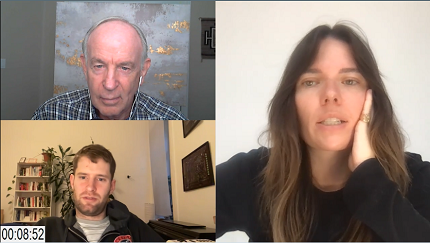
This is the initial meeting between the three participants. Russ had sketched out the possibilities to Julian and to Mel separately, but no specifics had, as yet, been agreed to....
The conversation was not scripted, and so wandered around the topics of interest. They introduced themselves and their interests in the procedure. Mel said she believed that her experience mostly involved unsymbolized thinking, and that she thought that people were very different from each other. We agreed to videotape everything, but not to release it without unanimous approval. Russ said he might want to put it on this website; Mel and Julian each had interests in producing a shorter form account of what might happen. They agree that Russ will send Mel a beeper, and that eventual Russ and Julian will interview Mel about her beeped experiences. Other than that, the details will need to be worked out.
Here, for reference, is a rough outline of topics covered:
The beeper has arrived, and they discuss how to use it....
They begin with Russ giving a short history of the construction and operation of the beeper. They end with some discussion of the philosophy behind DES investigations. In between are the DES instructions themselves.
The instructions are not scripted. Here is a rough outline of topics covered:
This is Mel's first sampling day. We discussed four of the six samples she collected and issues about the DES process that arose. ...
In commentary inserted in the transcript, Russ distinguishes, metaphorically, between diamonds (bits of pristine experience) and glass (generalities, theories, self-concept), saying that DES is about diamonds and tries to avoid glass. And we begin discussion of what will become a recurrent theme: 'DES is not about the words'. There is substantial commentary about genuineness in the DES process. Furthermore, these samples begin the discussion of whether Mel has nothing in her experience at the moment of some beeps, which will turn out to be another recurrent theme.
In general—sampling day 1: All DES interviews are some combination of iterative training (so that future sampling days can be more skillful) and description of experience. The aim of the first sampling interview (or the first several sampling interviews) is almost entirely iterative training. First-day sampling interviews appear to be inquiries into experience, but their fundamental aim is to facilitate discussions of how to do DES more skillfully. DES recognizes that participants on their first sampling day are not skillful, so DES routinely discards first-day descriptions.
Mel's samples:
Sample 1.1 [2:48]: [Mel was in the process of doing kitchen tasks. She had watered the plants and] at the moment of the beep was about to grab kitchen spray and wipe the kitchen. (She may or may not have directly experienced this about-to process.)
Discussion of DES: Diamonds vs. glass [0:10]
Discussion of DES: It's not about the words [4:21, 10:28, 11:35, 12:53, 20:06, 47:21,57:10]
Discussion of DES: Not instructing Mel [12:39, 17:18, 32:55, 47:21, 48:55, 50:01, 1:05:48, 1:11:35, and the COMMENTARY ABOUT SAMPLE 1.4 ARISING AFTER THE INTERVIEW]
Sample 1.2 [20:50]: Mel was vacuuming. Nothing about the physical act of vacuuming (sound, sight, kinesthetics, etc.) was particularly experientially present . (There may have been a relaxed contentedness about it, but this may have just been Mel describing her mood or context during the overall period.)
Sample 1.3 [34:34]: [Mel was on the couch drinking tea.] This act wasn't so present in her experience. (There may or may not have been a contentment aspect—a light relaxedness. But this may have been Mel's way of characterizing the absence of negative feelings, or her impression of her general mood at the time.)
Sample 1.4 [45:20]: [Mel was reading a book about creativity.] At the moment of the beep, she was rereading / absorbing the meaning of a passage / or was not experiencing anything. [This may have been more her way of describing her general reading process than a description of experience at this moment.] (Mel wasn't particularly focused on any one word, or the meaning of the text in particular. The experience was probably more automatic. This was similar to the automaticity of her vacuuming or cleaning experience, though the 'absorbing' component of reading may lend the reading a different quality.)
Conversation after sample discussions [1:04:20]: Don't tell participants what to do; words don't matter; discriminating between experience and all else.
Commentary arising after the interview [in the transcript but not on video]: On 'Mel described herself'.
This is Mel's second sampling day. She described many samples where nothing or nearly nothing was experientially present; we worked to clarify what she intended by those descriptions. ...
In general—sampling day 2: All DES interviews are some combination of iterative training (so that future sampling days can be more skillful) and description of experience. The aim of the second sampling interview is a combination of experience description and iterative training.
Mel's samples:
Sample 2.1 [0:56]: [Mel was looking at a picture of a Steadicam online and was, broadly speaking, forming what to write in an email.] There was something of this present in her experience. (This process wasn't clear and articulated. There were no words present. There wasn't a clear thought with clear content. There wasn't the visual experience of looking at the picture. But there was some experience present.)
Discussion of DES: Subjunctification [4:47]
Discussion of DES: Theory / abstraction [4:47, 9:41]
Discussion of DES: Presuppositions [4:47, 21:34]
Discussion of DES: Meta-experience [6:45, 10:12]
Discussion of DES: Russ uses the first person when describing Mel [12:46, 25:30]
Discussion of DES: Not about the words [13:22, 21:34]
Discussion of DES: Ignorance [13:22, 21:34, 33:00]
Sample 2.2 [14:07]: [Mel was writing an email related to the Steadicam and was halfway through a sentence]. She had some experience apparently in some way related to the emailing, but there wasn't any clear even slightly differentiated content. That is, her experience was more than nothing, but not much more and not more in any straightforwardly discernable way. [The level of nothingness was much less in 2.2 than in 2.1: In 2.1 there was definitely something experienced, even though it was entirely inchoate. In 2.2, there was not nothing experienced, but not as much as in 2.1.]
Sample 2.3 [21:36]: [Mel was on her phone and had just closed Instagram]. There was nothing in her experience. [We questioned her carefully but found no signs of any aspect of experience. Mel referred to her experience as being "dormant." She carefully and seemingly confidently distinguished between the more-than-nothing experience of 2.1 and the nothing of the present sample.]
Sample 2.4 [28:30]: [Mel was making a cup of tea and walking to fill up the kettle]. Mel was not experiencing anything. [There was apparently no distinction between the nothing of 2.3, 2.4, 2.5, and 2.6. Those samples are, however, more completely nothing than either samples 2.1 or 2.2.]
Sample 2.5 [33:45]:[Mel was getting changed and pulling off her hoodie] There was nothing in her experience. [There was apparently no distinction between the nothing of 2.3, 2.4, 2.5, and 2.6. Those samples are, however, more completely nothing than either samples 2.1 or 2.2.]
Sample 2.6 [44:25]: [Mel had made lunch and was about to sit down to eat it. She was also chatting with her sister and was probably mid sentence] There was nothing in Mel's experience (including, apparently, the talking). [In the interview Mel was not sure whether she or her sister were talking; either way, it apparently didn't make its way into Mel's directly apprehended experience. There may have been no distinction between the nothing of 2.3, 2.4, and 2.5, and the present sample.]
Conversation after the sample discussions [53:32]: Focus directly on the experience, not on the context, etc.
This is Mel's third sampling day. We discussed five samples, of which four were shades of nothing or close to it. There was one experiences thought (the unsymbolized thinking of sample 3.1)....
In general—sampling day 3: All DES interviews are some combination of iterative training (so that future sampling days can be more skillful) and description of experience. The aim of the third sampling interview is a combination of experience description and iterative training.
Mel's samples:
Sample 3.1 [7:45]: [Mel was looking at movie times on her phone and specifically for the movie Killers of the Flower Moon.] She was wondering: should I see that movie this afternoon. The main emphasis was whether she should see it this afternoon as opposed to on a different day. The content of the thought was clear, but there were no words, images, or feelings accompanying this thought. [Visually looking at the phone was not in her experience.] [This is an example of what DES calls unsymbolized thinking.]
Sample 3.2 [20:22]: [Mel was applying to a New York residency card form online, reading and filling in information.] Nothing was in Mel's experience (even though she was actively reading and filling in the form).
Sample 3.3 [25:00]: [Mel was still filling in the NY residency ID form and reading the screen.] Nothing was in her experience.
Discussion of DES: Is sample X like sample Y questions [26:22]
Sample 3.4 [39:01]: [Mel was looking at her bank statement online]. Nothing was in her experience. [There was some discussion of differentiating different degrees of nothingness across samples; this one may have been an even more nothingy nothingness than the previous two. But ultimately we weren't sure and left further clarification up to the iterative process.]
Discussion of DES: the iterative process [43:10]
Discussion of DES: too much about the words [47:37]
Discussion of DES: about nothing in experience [55:47]
Sample 3.5 [57:56]:[Mel was shuffling through her mail.] The shuffling was was autopilot-y (which is apparently a bit more than nothing and may have included a seeing aspect).
Mel seems to experience a range of nothingness: From full nothing ("as if asleep"), to autopilot-y (a task is being engaged in), to a bit of something that is happening being passively present. We are still trying to work that out....
There is substantial conversation about meta-experience, and about presuppositions and how presuppositions cannot be defeated by generalities but only by particulars.
There is substantial discussion about "absorption," and it seems that when Mel is absorbed in a conversation, it doesn't matter whether her friend Milly is talking or Mel herself is talking—the experience is the same.
In general—sampling day 4: All DES interviews are some combination of iterative training (so that future sampling days can be more skillful) and description of experience. The aim of the fourth sampling interview is a combination of experience description and iterative training.
Mel's samples:
Sample 4.1 [2:32]: [Mel was looking in the mirror; there was music playing.] She was in a positive/happy/light vibe/state that was somehow experienced (but was less than a specific feeling). (She may have peripherally experienced the music, or the vibe/whatever may have been the experience of the music.) [Her eyeballs were aimed at herself in the mirror but without experience.]
Discussion of DES: too much about the words [8:30, 14:09]
Sample 4.2 [16:11]: [Mel was about to head out of her apartment and was looking at herself in the mirror and touched her hair.] She was not experiencing anything. [During the sampling there was substantial discussion about too-much-about-words and that words should always be understood as pointers useful in a manner of speaking.]
Discussion of DES: too much about the words--syat [20:08]
Sample 4.3 [20:29]: [Mel was in a cafe having a conversation with a friend Milly. Milly was talking]. Mel was absorbed in the conversation. (Mel not experiencing anything else—no cafe sounds, no bodily sensations, no meta-experience of herself as being absorbed.)
Discussion of DES: meta-experience and over-theorizing [25:48, 34:38, 39:12]
Sample 4.4 [36:46]: [Mel and Milly were still talking. Milly was talking at the moment of the beep; the content was dating in NYC]. Mel was absorbed in the conversation. (Mel not experiencing anything else—no cafe sounds, no bodily sensations, no meta-experience of herself as being absorbed.) [This experience was indistinguishable to her from the previous sample.]
Discussion of DES: presuppositions, delusions[41:17]
Sample 4.5 [41:37]: [Mel was still mid-conversation with her friend Milly. This time Mel was talking.] Mel was absorbed in the conversation. (Mel's experience was perhaps indistinguishable from the previous two, even though here Mel was talking.)
Conversation after sampling discussions [48:26]: Meta-awareness, exercise for the reader (words vs. experience), iterative process, Russ wore the beeper for a year, Russ wore the beeper one time since then, diamonds vs. glass
CONVERSATION AFTER SAMPLE DISCUSSIONS
[48:17]: That we have not resolved Mel's absorption, and the importance of the iterative process
[49:46]: About presuppositions about meta-experience and consciousness
[49:46]: More about it's-not-about-the-words
[51:01]: Mel says that today's conversation seem more authentic
[54:21]: More about the necessity of the iterative process
[57:38]: Mel wondering whether her experiences are different from others'
[1:00:29]: Russ's history of wearing the beeper for a year and creating DES
[1:03:27]: On the importance of bits of specific experiences (diamonds vs. glass)
[1:05:41]: What causes experience? Nature? Nurture? Why are people's inner experiences so different?
[1:12:45]: More about diamonds and glass
EMAIL EXCHANGES AFTER THE INTERVIEW
Sample 4.3 and the meta issue
About the use of pseudonyms for sample 4.3 and the impediments to fidelity
About sample 4.5 and experience being not much more than nothing
We are still sorting through the distinctions between nothing, empty, autopilot, and something in experience. There were two samples today where experience was clear, which leads to the conclusion that when the beep occurs when something is experienced, Mel is willing and capable of describing it, even if that experience is somewhat embarrassing. ...
In general—sampling day 5: All DES interviews are some combination of iterative training (so that future sampling days can be more skillful) and description of experience. The aim of the fifth sampling interview is a combination of experience description and iterative training.
Mel's samples:
Sample 5.1 [1:55]: [A few days before, Mel had purchased a tote bag; when it arrived, she had taken a pic of it to send to her sister. Now, Mel was waiting for coffee, looking through her camera roll, and had arrived at the tote-bag pic.] She was admiring the (pictured) tote bag.
Discussion of DES: meta-experience [2:20, 2:46, 3:08, 7:58]
Sample 5.2 [8:42]: [Mel was walking down the street, somehow imagining a conversation with Matty Healy, singer of the group The 1975, as if she met him on the street; she would be seeing The 1975 in concert in a few days.] She was somehow contemplating that she might say to him, I love the performance art and cultural commentary you're doing at the moment. It was not clear whether this was in words or was conceptualized very specifically so that those exact words (and no others) conveyed the concept. It was not in a voice (inner or outer), and not visual.
Discussion of DES: iterative training [12:13]
Discussion of DES: bracketing presuppositions [13:11]
Discussion of DES: on transcripts, fidelity [14:58]
Discussion of DES: on Russ criticizing Mel [22:00]
Sample 5.3 [22:46]: [Mel was in her apartment scrolling through Twitter]. She was scrolling on autopilot, experiencing nothing in particular.
Discussion of DES: too much about the words (as abstract entities; footlights of consciousness) [27:06]
Sample 5.4 [29:57]: [Mel was putting away laundry with music playing.] Folding the laundry and listening to music were both part of her experience, but nothing was prominent. (The music was The 1975, a favorite group whose concert she would attend in a few days, but the specifics of the music were not salient. Some tactile aspects of the laundry may or may not have been present.)
Sample 5.5 [37:08]: [Mel was packing her suitcase preparing for a trip to see The 1975; as she packed, she was singing along to The 1975, which she had playing on her speakers.] She was "bopping along" with a happy vibe. (Her experience was not empty, not nothing; there was something of the happy vibe that was present to her (more present than sample 5.1) but not very sharp or clear. It didn't have an experienced bodily aspect. The packing, music, and singing are only slightly (if at all) experienced).
Discussion of DES: too much about the words [42:21]
Discussion of DES: meta-experience [44:40]
Sample 5.6 [45:36]: [Mel was looking in a mirror about to pluck her eyebrows and singing along to music; the current lyric was "change and pressure."] Mel was probably experiencing singing with a slight positive/happy vibe.
We are still sorting through the distinctions about nothing, and presuppositions regarding it....
In general—sampling day 6: All DES interviews are some combination of iterative training (so that future sampling days can be more skillful) and description of experience. The aim of the sixth sampling interview is a combination of experience description and iterative training.
Mel's samples:
Sample 6.1 [0:04]: [Mel was looking at a recent photo on her phone of her and her friends in Melbourne.] She was absorbing/soaking in what she was looking at.
Discussion of DES: on meta-experience, skepticism, presuppositions [0:50, 1:14, 2:03, 2:30, 2:41, 10:59, 14:14, 16:52, 23:32]
Sample 6.2 [18:48]: [Mel was talking to her sister, who was speaking.] Mel was absorbed/taking in the conversation.
Discussion of DES: not about the words [20:32, 28:35]
Sample 6.3 [25:06]: [Mel was putting away clothes]. She was not experiencing anything (or barely anything).
Discussion of DES: Thought experiment (pretending) [28:21]
Sample 6.4 [31:31]: [Mel was looking at Instagram on her phone, which displayed a picture.] She was seeing the picture, taking it in slightly [but not nearly the level of absorption as described in 6.1].
Sample 6.5 [35:40]: [Mel was standing, typing a message on her phone.] She felt a sore, throbbing, tingling sensation in her glute muscle region. It was not particularly strong. The typing and its content was at most a small part of her experience (it may have been that the words were merely coming out of her fingers).
Sample 6.6 [53:28]: [Mel was cooking, about to turn the frying pan on.] She was not experiencing anything.
We continue to discuss important issues in DES as we sort through Mel's nothingness and absorption....
In general—sampling day 7: All DES interviews are some combination of iterative training (so that future sampling days can be more skillful) and description of experience. The aim of the seventh sampling interview is a combination of experience description and iterative training.
Mel's samples:
Sample 7.1 [5:54]: [Mel was writing an email]. She was wondering "what questions do I have?" (That exact phrase may have been present, but perhaps it was that the concept was present so explicitly that even though the words were not directly apprehended, only those words would be appropriate. Either way, it was not innerly spoken or heard. The phrase itself was clear but the overall experience was somewhat diffuse. The experience was more about the phrase than about specific content coming to mind at this moment.)
Sample 7.2 [21:40]: [Mel is texting. The words are skillfully coming out of her thumbs, but this is happening "on autopilot" with no experienced sense of the words, content, or the action.] She has no directly apprehended experience.
Sample 7.3 [25:39]: [Mel is lying on her bed]. She feels heavy (mostly in her head, torso, and legs). The overall impression is that her whole body is being pushed (pulled?) down. She is also hearing her brother and mom talking down the hall. This is less present than the heaviness.
Sample 7.4 [37:58]: [Mel was having dinner with her sister.] She was absorbed in what her sister was saying [which may or may not be aptly described as being absorbed in the conversation (see day 4); we didn't adequately clarify that about sample 7.4].
Sample 7.5 [44:40]: [Mel is lying on her bed looking at her phone]. She feels mild pain in the bottom of the back of her neck. It's an achy, muscular pain in a palm-sized region (that doesn't have a super clear shape). The pain is constant (it's not pulsing like a throbbing pain).
Sample 7.6 [52:19]: Mel is looking in a mirror, putting moisturizer on her face and feeling pain in her neck. The pain is the most present. It's the same (or very close) pain as the previous beep. It's a tight, knotty, ache the base of the neck.
She's also experiencing putting the moisturizer on. This is probably more about the action of applying it than the sensation of the moisturizer.
She's also seeing herself in the mirror. She's not focused on any particular detail.
Mel has three samples that occur while watching the movie Saltburn. That gives us the opportunity to focus on the experience of being carried along by a movie and to discuss the role of presuppositions and hazards of confirmation bias when trying to understand that phenomenon. At the end of the interview, there is long set of email discussions about basic tenets of describing experience....
Mel's samples:
Sample 8.1 [0:02]: Mel felt bloated, a tight heavy pressure sensation around/within the lower part of her stomach/abdomen. (The region was about the size of her open hand). [Mel was reading text on her laptop screen but it's unclear whether or to what extent or how this is experiential. Neither the specific words themselves nor their meaning were present.]
Sample 8.2 [9:09]: [Mel was watching the movie Saltburn on her laptop.] At this moment she was carried along by the movie. [She wasn't particularizing any aspect. She certainly wasn't singling out any particular thing from the movie. And nothing stuck out enough for her to feel useful to describe to us.]
Sample 8.3 [12:01]: [Mel was watching the movie Saltburn on her laptop.] At this moment she was carried along by the movie. [This sample is the same as or very similar to sample 8.2.]
Sample 8.4 [18:51]: [Mel was watching the movie Saltburn on her laptop.] At this moment she was carried along by the movie. [This sample is the same as or very similar to sample 8.2 and 8.3.]
Sample 8.5 [19:53]: [Mel was watching Saltburn on her computer, and it was buffering] and was thinking: "For God's sake what's going on with this Wi-Fi?! " (This exact sentence was present. She wasn't innerly or outerly hearing it, or speaking it, or seeing it, but the words of that sentence, not just the concept, were present.) She experienced that sentence both all at once and also with the words unfolding across the sentence. Frustration may have been a part of this.
She was also feeling her heart race, which may have come from excitement as the movie was reaching a climax and may have come from being interrupted.
Sample 8.6 [35:06]:[Mel was watching the movie Saltburn.] She was very absorbed in the movie (more absorbed than in samples 8.2, 8.3, and 8.4). [Perhaps as a result of the depth of absorption she was somewhat startled by the beep and couldn't remember what her experience had been at the moment of the beep; perhaps as a result of the depth of absorption she had greater-than-usual difficulty processing/reacting to the beep.]
Email discussions after the interview
--On the nounification and thing-ification of experience
--On universalist vs. descriptive endeavors
--It's not about the words
--The content of experience
--Describing vs. theorizing about experience
--What warrant is necessary for something to be included in a description
This series of interviews is designed iteratively to improve our ability to describe moments of Mel's experience with fidelity. But it is also designed to contribute (possibly) iteratively to Julian's ability to align himself with Mel's (and others') experience. For example, at the end of the discussion of sample 9.1 there is an exploration of how the desire to be right interferes with the ability to hear Mel with fidelity...
Mel's samples:
Sample 9.1 [0:37]: [Mel was bent over her suitcase about to zip it up. Her feet were spread wide apart]. She felt in her feet her body's pressure, weight, and wide stance. At the end of this sample (9:09) is a long discussion about the interviewer's feeling of being right and how that interferes with the ability to hear Mel with fidelity.
Sample 9.2 [9:19]: [Mel was writing on her computer and had decided she wasn't satisfied with a sentence. She's staring at the screen, in the process of reconsidering what to write.] She's active-featureless-pondering what to write; that is, she understands herself to be actively considering/contemplating what to write, but no new sentence or hints thereof, no thoughts about a sentence, no specifics about the old sentence are present.
Sample 9.3 [29:21]: [Mel is pressing delete on her phone] She is satisfiedly (?) watching the letters successively disappear. (This experience is mostly visual. Whether it is a satisfied watching isn't certain. She's maybe also experiencing the sensation of her thumb pressing down, but this isn't certain.)
She's also thinking: "Take Chey." [this is the first part of the sentence, that she's leaving in and not deleting] (The experience is those exact words, but they are not innerly spoken or heard and the words do not unfold over time.)
Sample 9.4 [50:01]: [Mel is scratching her chest while leaning over her laptop looking at an invoice.] She experiences the coarse scraping of her fingernails on the skin of her chest (a chest sensation) as well as feeling the skin on her fingertips (a fingertip sensation).
Slightly less present in her experience, she is actively focused on the number 487 (on the invoice). (The number registered as a number—not merely as an arrangement of pixels—but there wasn't any semantic meaning associated with this number—whether it was high or low, for instance. [The number was actually $487.12, but it was not clear whether at the moment of the beep she understood the number as a dollar amount or whether she understood the ".12" as being part of the number.]
Sample 9.5 [1:03:45]: [Mel has just finished writing the description for the previous sample. She's sitting cross-legged]. She feels a tingling sensation in her feet. (The sensation may extend a bit past them, as if the borders of her feet aren't clear; we were not confident. The tingling is not painful or pleasurable; there's an impression of lightness and weightlessness to it.)
Sample 9.2 Commentary arising after the interview: about featureless vs. contentless
and how theory interferes with description.
Sample 9.3 Commentary arising after the interview: about meta-experience
and how an interest in or confusion about meta-experience interferes with description.
These samples give Russ and Julian the occasion in the transcript comments to discuss the presupposition that if the eyes are there must be visual experience; perceptual awareness; judging fidelity; more about words and nounification; plausibility vs. fidelity; reality vs. experience; and delusion....
Mel's samples:
Sample 10.1 [1:53]: [I am on my bed on my laptop.] Nothing or very little is in my experience. (Visually seeing the computer screen is maybe present).
Sample 10.2 [15:21]: [I am on my bed looking at my laptop.] Seeing this computer screen is only slightly (if at all) in my experience. (It's so far at the periphery that it's hard to tell if it's there.) Also at the fringes of experience is hearing my mom say something from down the hall (her words are clearly available but I'm not paying attention to them or attaching meaning to them).
Sample 10.3 [26:45]: [I'm looking at my computer at a redesign for my website. Two horizontal lines in adjacent paragraphs are not lining up.] I'm visually focused on this.
Not separate from this visual component, I feel confusion/disappointment/annoyance/frustration (it's unclear if this is one feeling, or multiple, or if it alters over time. There's no felt bodily location.)
Sample 10.4 [55:39]: I am frustratedly yelling (aloud) "why is that doing that!" about the website screwing up (this is loud emphatic speaking rather than screaming) and feeling frustrated, mostly mentally except perhaps experiencing tension in my body (not in any one specific area that I can pin down).
Comments arising during the writing of the description of sample 10.3
We explored Mel's deep absorption. In doing so, we made the distinction between validity and fidelity. There was substantial discussion of the moment of the beep (still iterative training after 11 days)....
Mel's samples:
Sample 11.1 [0:20]: [I am walking, looking at my phone.] I feel pain in my fingers and hands, both an uncomfortably tight, taut, stretched skin and a deeper internal throbbing (dull and perhaps slightly slowly oscillating). This is the same in both of my hands, from the wrist up and especially in the fingers and the webbing between them.
I am moaning (in response to the pain). (The moaning is part of my experience, but the extent to which it is deliberate is not certain).
Sample 11.2 [41:15]: [I was walking towards my dog], seeing her and greeting her by saying "Coco." I was experiencing this in a see-dog-say-"Coco" automatic kind of way, but nothing was especially strong.
Sample 11.3 [45:35]: [I was having a conversation with my dad, sister, and her friend.] I was, apparently, absorbed in the conversation, not specifically aimed at one aspect (but was not at all confident about how to describe this experience [and RTH accepts that there is room for skepticism]). [Mel said, initially, that she could not remember what her experience was. RTH came to believe that this was not so much a memory issue as a how-to-talk-about-this-sample or what-does-inner-experience-mean issue. The interview was more about iterative training than about apprehending the details of this particular sample.]
Sample 11.4 [1:01:46]: [We skipped this sample because the beep occurred when thinking about what to write about sample 11.3. Samples that are about other samples are often too complicated to describe.]
Sample 11.5 [1:02:34]: I was editing video of my grandpa talking. I was completely, deeply, totally absorbed in this—seeing and listening to him. (I wasn't caught by anything particular that he was doing or saying, but was intensely taking it in, open to the profoundness of his talk). [The level of absorption was substantially greater than that of 11.3.]
Most of Mel's samples today included some sort of sensory awareness (bodily or auditory); alongside there are discussions of how to interview about sensory awareness. There is also some degree of inchoateness or nothingness. Along the way there are discussions of what Russ calls 'glass' questions and why they are problematic in DES. At the end of the transcript there is a long discussion of it's not about the words--it is whether the words rest lightly on the feelings being described....
Mel's samples:
Sample 12.1 [0:05]: [I was reading a book where a character was drinking away her depression/loneliness]. I empathetically felt lonely / depressed (felt clearly but not bodily). This was the main thing present to me.
I felt relaxed—felt my heavy / soft /malleable body pressing into the ground. This wasn't in any specific part of my body, more overall.
Sample 12.2 [20:43]: [I was lying on the ground, with my eyes open pointing at the ceiling.] I did not have anything directly in my experience.
Sample 12.3 [23:10]: [I was rummaging through a package of easter eggs in the cupboard.] I was caught by the crinkly crunchy sound of the plastic wrap.
Sample 12.4 [30:38]: I hear my sister saying "there are still tickets on the website." (I hear with absorbed understanding--I'm not reacting in any particular way; for example, I'm not thinking ahead--oh we should buy them while they're still there. I'm simply absorbing what she is saying.)
I also feel the tingly pleasant warmth of the sun on my legs, knee down.
(It's hard to say if either of these things—the hearing or the tingly warmth—is more present.)
Sample 12.5 [38:22]: [I'm lying down outside with my face pressed against a pillow.] On the side of my face, I feel slight uncomfortable pressure (of my face smushing against the pillow).
I also feel tranquil. [We did not do a good job of exploring this, except to discover that] it was an experienced relaxation, (not merely a sense of emptiness).
Sample 12.6 [45:32]: [I'm looking at my phone, typing an email with my thumbs.] Some aspect of this may be somehow present to me, but if so, it is inchoate. I don't experience any aspect of it in any particular way (I'm not thinking about what to say; I'm not noticing my thumbs, either visually or kinesthetically; nothing visual stands out about the phone; etc.).
Slightly, I also feel a cool breeze on my legs.
(The emailing takes up more of my experience. Even though it doesn't have any direct characteristics, it still is more part of this moment than is the cool breeze.)
At the end of the transcript (after 59:05) there are several long backs-and-forths.
Today's samples, which will be the last of the DES sampling, have characteristics that are similar to those we have seen on previous sampling days: nothing (or essentially nothing), sensory awareness, unsymbolized thinking. ...
Mel's samples:
Sample 13.1 [0:05]: [Mel was copy/ pasting something on her laptop.]. She felt an itchy, tingly, pin-pricky sensation on the back of her neck (it was more surface-skin-level than deep). The copy/pasting is (perhaps) somehow barely in her experience—more than nothing, less that some particular thing, which Mel calls autopilot.
Sample 13.2 [4:47]: Mel thought: What do I have at 3? (This was predominantly or entirely unsymbolized. There was no mental image to it. There were no innerly spoken words. However, it was that specific phrase. Other phrases like "what's my appointment at three o'clock?" did not fit with Mel's experience. This phrase may not have been present in any way besides tightly describing the concept that was in Mel's in experience.)
Mel also had the sensation of needing to pee. This was a dull, bloated sensation around her bladder region. (The thought was about 70% of Mel's awareness, and the needing to pee sensation 30%.)
Sample 13.3 [13:28]: [Mel is sitting, looking into the distance in her lounge room]. Nothing (or very little) is in her experience.
Sample 13.4 [15:00]: [Mel is in her living room, maybe walking around between actions]. Nothing (or very little) is in her experience.
Sample 13.5 [16:43]: [Mel is reading a text on her phone that says "feel better."] Mel is registering those words. (Experience of visually seeing and reading them is hardly present, if at all. Mel is not innerly speaking the words or hearing them spoken. She is registering them though. She has not attached particularly strong meaning to them but they're not completely meaningless either.)
After completing sampling with Mel, the investigators and Mel met for the idiographic sample review meeting (sometimes informally called the green meeting), where investigators reawakened their independent grasps of each of the sampled moments of experience....
Together, they reviewed each sample (starting from the end and working backwards) and compared their individual impressions of it; together they generated a brief (typically 10-ish words) "caption" that captured the important aspect(s) of the phenomena present in that sample as each investigator understood it—that is, the caption could include differing opinions, if the several investigators had differing impressions. (Typically, captions are written in green font—hence the name green meeting). This idiographic sample review (as is typical in DES) spanned 4 or 5 hours of discussion spread across two meetings.
This green meeting was unusual in two ways. First, green meetings are meant to take place within a few days of conclusion of sampling; this one was almost a year later. Second, green meetings usually involve all the investigators; this one involved all the investigators plus the participant (Mel).
Because the meeting is long, we transcribed only the first half of it. You can watch and listen to the video of the entire meeting.
This is the second day of the green meeting (see the description at February 24)....
Because the meeting is long, we transcribed only excerpts from it. There are two videos--one of just the excerpts (which matches the transcript) and one of the entire Green Meeting Part 2, where you can watch and listen to the video of the entire meeting.
Following the green meetings, Julian, Russ, and Mel each independently wrote, within 24 hr, an independent informal characterization that summarized their take on the salient phenomena that had emerged across all Mel's samples. Those were aligned in the characterization comparison document....
Like the contemporaneous sample descriptions and the idiographic review before it, the goal of the independent informal characterization was for each investigator to encapsulate what each, as an individual, took to be the notable phenomena of Mel's sampled experience—the goal was not to strive for consensus. Functionally, this meant that one investigator's description could be prose paragraphs; another investigator's characterization could be a list of common or notable phenomena; and so on.
After Julian, Russ, Julian, and Mel completed their own informal characterization, an idiographic salient characteristics column was appended to the comparison document—this would contain all the characteristics that the investigators (individually or collectively) might be useful in characterizing Mel's idiographic inner experience.
In typical DES studies, the next step after the green meeting is the rectification meeting. However,...
the difficulty of characterizing the shades of nothingness in Mel's experience caused the investigators to meet to discuss how to proceed. We called that the characterization meeting.
DES calls the process of refining phenomena descriptions rectification...
An idiographic Microsoft Excel sheet was created that listed all Mel's salient characteristics/phenomena (the entries in the appended column described in the previous step) (as columns) and each of Mel's sample descriptions (as rows). Each investigator then independently rated each sample on each idiographic characteristic: 1 = present, 0.5 = possibly present / not sure, and left the cell blank = not present. This document served as the starting point of the Rectification Meeting.
During that meeting, we considered each sample, focusing primarily on those samples/phenomenon where investigators' ratings had disagreed, with the aim of continuing the refinement of phenomena. Sometimes this resulted in the alteration/refinement of a description of the phenomenon. Sometimes this resulted in an individual investigator coming to recognize that they had a unique and possibly presuppositional understanding of the phenomenon, which they worked to change. Sometimes this resulted in an individual investigator realizing that they had made a mistake in the rating process. Sometimes this resulted in an individual investigator coming to alter their own understanding of how the salient phenomenon should be applied. And so on.
Notably, this process was not about deriving counts or ratings of phenomena, even though numerical ratings are used. It was instead centrally focused on refining each investigator's grasp and understanding of the phenomena.
Because the meeting is long, we transcribed only the first half of it. You can watch and listen to the video of the entire meeting.
Mel's inner experience, as observed through 65 DES samples across five months, is striking in its consistency.
The most prominent feature of her experience is the pervasive absence of particularized content. In the majority of her samples, Mel was going about her day without explicitly apprehending any specific internal or external aspect—there was nothing (or nothing in particular) in her experience. She was skillfully navigating her world—filling out forms, conversing, texting, watching films—through a kind of ambient absorption.
When her experience was particularized, it was most often sensory awareness—primarily bodily sensations of weight, pressure, or tingling. Less frequently, Mel reported feelings or unsymbolized thinking.
Notably, Mel never experienced herself as inner speaking or seeing a visual image.
While such experience might seem sparse or even deficient, we think that view is mistaken. Much as a good mirror reflects without adding its own distortions, Mel's experience suggests that she attends to the world around her without inserting her own characteristics.
Mel's participation across the 13 sampling days revealed a deepening ability to discern and differentiate subtleties in her inner life, even when that life seemed to hover near nothingness.
Overall, Mel's experience offers a compelling counterpoint to the prevailing assumption that consciousness is always filled with inner chatter or vivid imagery.
Formal description: When all the steps of the process (13 sampling days, green meetings, characterization meeting, rectification meeting) had been completed, we prepared a written summary of Mel's experience. We passed that document back and forth for editing, etc., until we each were satisfied that we had described Mel's experience (as evidenced in the samples we discussed) adequately, with this result.
We happily acknowledge that this is a snapshot at a particular point in time—Mel's experience at different times or under different circumstances may be very different. That is, we are not claiming to have arrived at the essence of Mel, or the complete Mel.
After completing all of Mel's and Kerry's sampling and post-sampling processes, all investigators and participants met for a final debrief session....
Recall that Mel (Part X) had recruited her friend Kerry (Part XI) because Kerry believed herself to be a constant (or nearly constant) inner speaker, and therefore had very different experience from Mel herself—DES had shown Mel's own inner experience to be very quiet.
Now Mel and Kerry get to talk with each other, compare their inner experience, share what impact their DES participation had had on them, and ask Russ whatever questions they had about their DES and their participation.
From Russ's point of view, the same rule applied to him now as had applied to Mel and to Kerry during their participation: he could decline to answer any question for whatever reason, but if he answered a question, he should commit himself to being forthright and as complete as the questioner desired.