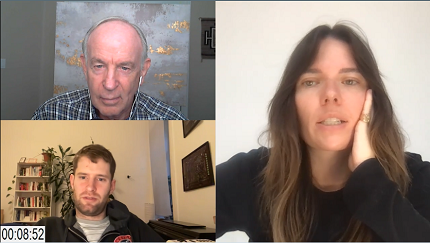
In this extraordinary set of interviews, we have the opportunity to compare DES-as-read-about-and-implemented-by-an-outsider (Julian Bass-Krueger) to DES-as-written-and-practiced-by-its-creator (Russ). We enlisted Mel May, who had volunteered to be a DES participant....
Julian Bass-Krueger and Russ have never met. Julian had become interested in DES in about 2017 and several times over the years had contacted Russ, who had given him some suggestions. Julian became a Master’s student in cognitive science at the University of Vienna, completing a thesis using DES as he had learned it from Russ’s books, articles, and web materials. The thesis also included an extension of DES that Julian called dDES (dynamic DES). Julian sent his thesis to Russ, who responded critically--Russ was skeptical of Julian's results and doubted that dDES could be successful.
In 2023, Julian contacted Russ inquiring about supervision, and Russ suggested the possibility of conducting joint interviews of a DES participant and then candidly discussing any issues that might arise. That might provide the opportunity to compare DES-as-read-about-and-implemented-by-an-outsider (Julian) to DES-as-written-and-practiced-by-its-creator (Russ) which might be a win-win: Julian might learn something about DES, and Russ might learn something about what he should do to make his DES materials more effective.
At about the same time, Mel May, a video producer, contacted Russ saying she loved the videos in the 'Do I have inner monologue?' series and would like to produce some sort of media piece that would be much shorter than the 80 or so hours that are on the site.
Russ suggested to Julian that we might enlist Mel as a DES participant; and Russ suggested to Mel that she might wish to experience DES from the inside. Each thought that was a good idea, and this series of interviews was born.
The interviews were conducted by Russ Hurlburt and Julian Bass-Krueger. Their back-and-forth commentary provides significant insight into how to investigate inner experience--like a series of DES masterclasses.
Date |
Interview |
Description |
|---|---|---|
September 26 |
Interview -1 (first meeting) |
This is the initial meeting between the three participants. Russ had sketched out the possibilities to Julian and to Mel separately, but no specifics had, as yet, been agreed to.... The conversation was not scripted, and so wandered around the topics of interest. Here, for reference, is a rough outline of topics covered:
|
October 5 |
Interview 0 (DES introduction) |
The beeper has arrived, and they discuss how to use it.... The instructions are not scripted. Here is a rough outline of topics covered:
|
October 10 |
Interview 1 |
This is Mel's first sampling day. We discussed four of the six samples she collected. ... In general—sampling day 1: All DES interviews are some combination of iterative training (so that future sampling days can be more skillful) and description of experience. The aim of the first sampling interview (or the first several sampling interviews) is almost entirely iterative training. First-day sampling interviews appear to be inquiries into experience, but their fundamental aim is to facilitate discussions of how to do DES more skillfully. DES recognizes that participants on their first sampling day are not skillful, so DES routinely discards first-day descriptions. Mel's samples:
|
More interviews coming... |
For more information:
Russell T. Hurlburt, Ph.D.
Descriptive Experience Sampling online materials

©2024 Russell T. Hurlburt
Updated April 3, 2024