Part XIII: Gualtiero Piccinini—a philosopher of mind
Russell T. Hurlburt1 and Gualtiero Piccinini2 1 University of Nevada, Las Vegas 2 University of Missouri
Gualtiero Piccinini is an Italian-American philosopher known for his work on the nature of mind and computation. Russ and Gualtiero's back-and-forth commentary provides significant insight into how to investigate inner experience....
Gualtiero is Curators' Distinguished Professor in the Philosophy Department at the University of Missouri and is interested in how to integrate psychology and neuroscience. Years ago, he had reviewed Russ's 2007 book with Eric Schwitzgebel, saying that "it offers a new model of productive interdisciplinary cooperation."
Now, spurred by graduate students' questions about unsymbolized thinking, Gualtiero contacted Russ. Gualtiero was currently working on a book about consciousness, and Russ and Gualtiero jointly decided it might be useful for Gualtiero to serve as a DES participant.
The interview transcripts are interlaced with discussions / debates about inner experience and DES in an extension of the "new model of productive interdisciplinary cooperation."
The interviews were conducted by Russ Hurlburt. University of Missouri graduate student Lauren Graf was present for all interviews.
As is typical, alongside the samples, they discussed cleaving to the moment of the beep, cleaving to experience, and bracketing presupppositions.
In general—sampling day 1: All DES interviews are some combination of iterative training (so that future sampling days can be more skillful) and description of experience. The aim of the first sampling interview (or the first several sampling interviews) is almost entirely iterative training. First-day sampling interviews appear to be inquiries into experience, but their fundamental aim is to facilitate discussions of how to do DES more skillfully. DES recognizes that participants on their first sampling day are not skillful, so DES routinely discards first-day descriptions.
Gualtiero's samples:
Sample 1.1 [5:34]: [I was typing "e.g." in the middle of typing a paragraph, and was] seeing the letters "e.g." on the screen [perhaps in the act of checking that it was typed correctly]. (This experience was of the letters "e.g.", [not the for example semantic significance of the letters].)
Sample 1.2 [19:41]: [The beep startled me because it was too loud, but that loudness was not problematic on future beeps]. [I was reading emails, and] was seeing the white "...". The experience was of the dots themselves, (not of the ellipsis significance of the dots).
Sample 1.3 [29:08]: [I was asleep, napping, and the beep woke me up in] the middle of a train of thought that --something-- is impossible. What the --something-- was not apprehendable, but whatever it was, I was thinking that it not possible. The not possible thinking was clearly present to me (i.e., was directly apprehended) but without words (e.g., it's impossible is just as adequate a rendering of the thought as is not possible) or other symbols.
Sample 1.4 [45:06]: [I'm typing "presence" and the beep lands after the "pre."] I see the "pre" typed on the screen and simultaneously in some indistinct way am somehow cognizing about propositional thought having its own phenomenology. (I can say that phenomenology of propositional thought was the general realm of the ongoing thought, but the specifics were not present at the moment of the beep.)
Sample 1.5 [55:28]: [I'm typing "presence" and the beep lands after the "pre."] I see the "pre" typed on the screen and simultaneously in some indistinct way am somehow cognizing about propositional thought having its own phenomenology. (I can say that phenomenology of propositional thought was the general realm of the ongoing thought, but the specifics were not present at the moment of the beep.)
They start with a conversation about inserting comments into the transcript. ...
They discuss sample 2.6 first, because Gualtiero had fallen asleep, and sleep is an interest of Gualtiero's.
In general—sampling day 2: All DES interviews are some combination of iterative training (so that future sampling days can be more skillful) and description of experience. The aim of the second sampling interview is a combination of experience description and iterative training.
Gualtiero's samples: (Note: they discussed sample 2.6 first)
Sample 2.6 [3:39]: [I was asleep and when the beep woke me] I apprehend myself as thinking about something without words but maybe with faint images (but I can't remember what the content is).
Sample 2.1 [11:21]: [I'm walking across the deck, and] I see [as the center of my attention] a small leaf [or maybe some other plant material] on the deck—its round curled-ness. I also see the deck surrounding the leaf [but RTH is skeptical about this]. I'm also thinking about something without words or images (but I lost the content by the time I wrote down notes).
Sample 2.2 [34:47]: [I was walking on the deck with my dog Cinnamon] and hearing myself say (aloud) sbagliatus, which is a made-up word of endearment for Cinnamon. (The beep caught me mid-word.) I was also seeing the deck, and feeling my body (a kinesthetic awareness) as it moved across the deck. [RTH is skeptical about these last two aspects.]
In general—sampling day 3: All DES interviews are some combination of iterative training (so that future sampling days can be more skillful) and description of experience. The aim of the third sampling interview is a combination of experience description and iterative training.
Gualtiero's samples:
Sample 3.1 [4:30]: [Gualtiero was curious to try it while asleep; beep occurred about an hour after going to sleep.] I was thinking, without words or other symbols, some thought (that was available to me on waking but had disappeared by the time (measured in seconds) required to find the pen and notebook).
Sample 3.2 [13:03]: [Slightly before the beep I had seen a phone app that explained a 0% balance transfer opportunity—I thought I should do that. I then had navigated to a banking page that displayed some of my financial details—HELOC balance, etc.] At the moment of the beep I was (85%) visually seeing in a rather diffuse way the phone screen—it was displaying the financial info but I was not grasping the semantic content (HELOC balance, etc.). (That is, this was a seeing-what's-visually-there experience, not a processing the displayed information semantic experience.) Simultaneously I may have been (I'm not sure—somewhere between 0% and 15%) having some sort of "cognitive echo" of the thought that I should do the deal. (I had thought that a few seconds before, and now I can't be confident about whether I was remembering thinking it or rethinking it, or whether it was context.)
Sample 3.5 [25:55]: [Taken out of order because it is most interesting to Gualtiero because he understands himself as having aphantasia.] (I was relaxing, eyes closed, maybe in a twilight sleep). I (clearly, in motion) innerly see Dean (a radiologist friend) moving about her X-ray equipment, perhaps pushing buttons, etc. (It is definitely clearly seen; he cannot recall whether it is in color.)
Sample 3.3 [36:19]: [Reading Russ's response to my comment in Transcript 2.] I am seeing the visual display of the red-lined comments. (This is not about the semantics of those comments, not about what Russ and written or how I felt about it.) I see the visual display of the comments. [This is similar to the app seeing of sample 3.2.]
Sample 3.4 [42:28]: [I'm looking at the thermostat button that says Heat.] I see Heat against the gray background of the thermostat. This is mostly a visual taking in (more like the shape of the word than the semantics of the word). [I understand the context, and perhaps have some semantic understanding of the situation, but it is not at all or perhaps slightly present.] (Simultaneously I am singing aloud, but I don't know whether that is in my experience at all.)
Selected commentary:
[7:37, 32:45] Unsymbolized (unsigned) thinking
[32:45] Intentions are mentalisms
[33:29] DES fMRI study: On-demand inner experience is not the same as pristine inner experience
At the outset there is a 20-minute conversation about beeps while sleeping. ...
Since the last interview, Gualtiero has worn the beeper as he goes to sleep for the night. On some occasion the beep awakened him as he was thinking about something, but he can't remember what. On one occasion, he heard the beep with a gradual volume rise (unlike the usual square onset) indicating to him that he did not hear the beginning of the beep—that he was unconscious before he heard the beep. On another occasion, he heard the beep, then no beep, then the beep, indicating to him that (because the beep is actually continuous) he must have been in and out of conscious experience. RTH says that there are potentially electrical/mechanical explanation for some of these, but that he accepts the likelihood of Gualtiero's explanations.
In general—sampling day 4: All DES interviews are some combination of iterative training (so that future sampling days can be more skillful) and description of experience. The aim of the fourth sampling interview is a combination of experience description and iterative training.
Gualtiero's samples:
Sample 4.1 [22:55]: [I was sleeping for the night last night, and this report covers two awakenings, first by the iPhone time-to-sleep alarm and second by the DES beep. The experiences at each seemed to be the same.] I awoke understanding myself to have been thinking something about the trial (I had been in small claims court that day), and whereas I believe myself to have been thinking something specific about the trial, I can't recall what it was.
Sample 4.2 [28:46]: [This morning, 6:36am. I am sitting on the floor, propping myself up with one hand.] I am singing made-up faux-Italian words. Simultaneously I feel my fist pushing down against the softly padded (by a sweatshirt) floor.
Sample 4.3 [38:59]: [5 minutes later; I'm washing my hands in the sink] I (60%) both see and feel the water against my moving hands. [I recognize myself to be the mover of the hands, but I have no separate experience of the agency]. Simultaneously I am (30%) singing faux-Italian words [the words are not the same as 4.2, and the melody is not the same, but I feel like I am singing in the same way as 4.2]. Simultaneously I experience an echo of a previous thought (I don't recall the exact content, but it was in some way about DES or what I had to do today (which included a DES interview)]. (This is a recollection of having thought it, rather than a thinking it again.)
Sample 4.4 [53:05]: [6:51 (ten minutes later) there seems too much to track. RTH believes that Gualtiero had inadvertently brushed the volume wheel and initiated the beep, so we skipped this beep.]
Sample 4.5 [56:07]: [I am squatting.] I am shifting my weight to the left, and feel it happen. Simultaneously, I see the visual scene pass by as I turn. [Russ is skeptical about this detail.] Simultaneously I am talking to my dog Cinnamon, saying something to her in a mock-disgusted way. I experience the mock disgust, but I do not experience the words. [The words seem mostly or entirely unintentional, experienced rather similarly to the mock-Italian words of samples 4.2 and 4.3.]
Prior to discussing samples, they have a longish conversation about the DES process requiring Gualtiero to selectively report experience....
They started with two samples while sleeping. Near the end of the interview, they have a long conversation about whether it is a good idea (or possible) to bracket all presuppositions.
In general—sampling day 5: All DES interviews are some combination of iterative training (so that future sampling days can be more skillful) and description of experience. The aim of the fifth sampling interview is a combination of experience description and iterative training.
Gualtiero's samples:
Sample 5.1 [17:24]: [asleep, two nights ago. Awakened to a chirp (didn't hear the beep or perhaps some number of previous chirps).] Apparently nothing in experience. [RTH is skeptical about any report because there is lots of opportunity (measured in minutes) for experience to be disturbed by the apprehension process.]
Sample 5.2 [20:18]: [asleep last night. Awakened while the beep was ongoing (didn't hear the beginning of the beep).] Apparently nothing in experience. [RTH is skeptical about any report because there is lots of opportunity (measured in seconds) for experience to be disturbed by the apprehension process.]
Sample 5.3 [24:32]: [Doing tai chi warm-up routine, in pushup position, moving left hand to touch right foot, almost touching.] Two parts to experience: (1) proprioceptive and visual experience of left hand moving to touch right foot. (Exactly what was the proprioceptive experience was hard to say—is it "body in space" sensation or "almost touching" sensation or both? How much is visual and then inferred? Is the intention directly apprehended?) (2) Saying "Barbo" (a corrupted Italian word meaning "bearded") to Cinnamon. (This speaking seems unintentional, especially by comparison to the exercise.)
Sample 5.4 [44:57]: [Doing exercise warm-up.] (1—65%) I feel increasing pressure in my left hip; and (2—35%) I am thinking, or recalling thinking (an "echo"?) about my charitable donations—in the ballpark of preferring to donate to the Ukraine help-the-soldiers fund than the Gaza food relief, that the Ukrainians are helping themselves; that the Gaza aid is about survival. All these aspects are somehow present, not in words, not any specific aspect. (This is in the realm of unsymbolized thinking, perhaps closer to cognitive awareness.)
[With respect to the earlier selective-reporting discussion: GP seemed confident that the bodily sensations were localized specifically and pretty exclusively to the left hip, even though the entire body was involved in the strain of the action.]
Selected commentary:
[6:28, 32:54, 34:37, 51:19] DES aims at specific moments
This interview provides the occasion for an important discussion about the bracketing of presuppositions—see the comments throughout but especially at 50:32....
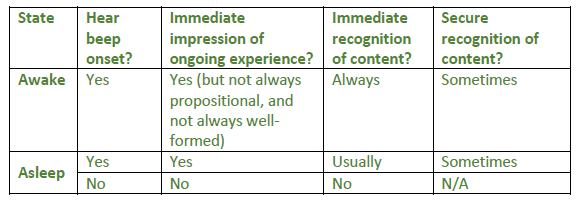
The interview started with longish discussion of samples while sleeping samples. Here is a characterization of what Gualtiero has found so far while asleep:
In general—sampling day 6: All DES interviews are some combination of iterative training (so that future sampling days can be more skillful) and description of experience. The aim of the sixth sampling interview is a combination of experience description and iterative training.
Gualtiero's samples:
Sample 6.1 [18:22]: [I was reading to prepare for this webinar.] Two strands of experience. (1) I felt my visual attention shifting from reading the words "formal logical" [at the end of one line on the page] to the word "proof" [at the beginning of the next line]. (This was apprehended as a shift of attention of the (meaningful) words, not of the position on the page or the proprioceptive characteristics.) (2) I was trying to think of what more to say [about human intelligence versus large language models, but that was not immediately present to me]. (I was searching, awaiting the results.)
Sample 6.2 [34:52]: [I was writing my notes about the previous beep.] (1) I was seeing (experientially) the space on the paper just after "LLM" [which was where I was intending to write next] (and perhaps, minorly, the page around that space). (2) I was searching my mind for how to improve what I was thinking about saying. [6.2 differs from 6.1 in that 6.2 seems more anchored to a particular specific thinking, whereas 6.1 is more trawling for information about a general topic.]
Sample 6.3 [42:47]: [I was doing crunches on the floor.] My experience was diffuse, four-ish equal-ish strands: (1) I was hearing the S sound at the end of the word sbaglius (a made-up Italian-ish word that I had said to Cinnamon) [RTH thinks this was a sensory-awareness-type experience of the sound of the letter, but the interview was not conclusive—it might have been just the end of the word]; (2) I felt myself doing the crunch; (3) I was hearing the work-out video; and (4) I was seeing the room around me.
Selected commentary:
[4:33] Summary of Gualtiero's sleep findings
[28:18, 50:32] On discriminating directly apprehended experience from all else; the SNL Home Headache Test sketch
[50:32] The warrant for skepticism; DES is not mind-reading
They have been observing that many of Gualtiero's samples involve experience that is (a) complex and (b) diffusely (non-figurally) bodily. There are more samples like that on this day....
The interview started with a brief conversation about Gualtiero's sleep study. Russ agreed that he would send Gualtiero a new 60 min beep with a 30-min square wave beep.
In general—sampling day 7: All DES interviews are some combination of iterative training (so that future sampling days can be more skillful) and description of experience. The aim of the seventh sampling interview is a combination of experience description and iterative training.
Gualtiero's samples:
Sample 7.1 [8:16]: [I am exercising] Three aspects: 1. I hear the squeak [of Cinnamon's toy as she squeezes it, but that is not in my direct experience];l 2. I see my legs against the floor [as best we can say, this is a figure-less visual taking in of the eyeballed scene—it does not make the legs (or either leg) the figure; 3. I experience the echo of a just past thought "we can't live like this" in Italian. [Russ can't recall, and probably never knew, whom Gualtiero meant by "we" or what "like this" referred to.]
Sample 7.2 [24:09]: [I am doing a tai chi form and] I (85%) feel the presence of my body, throughout my body, in motion. [This is not of a particular aspect of my body but of the presence of my entire body.] Simultaneously I (15%) see the room around me. [This is not the seeing of a particular object in the room, but the visual taking in of the room that is falling on my retina.]
Sample 7.3 [31:03]: [I was on a Zoom meeting with a colleague] Two aspects: 1. I heard being said "one of the first things I noticed." [I don't know whether I was saying that or the colleague was—maybe I knew at the time, but I'm not sure.] 2. I see the two faces next to each other [on the screen, but I don't know whether I saw the Zoom rectangles, the computer, etc.]
Sample 7.4 [39:25]: Three parts: 1. I am tasting peach. [I had licked my fingers after making a smoothie.] 2. I have a visual / proprioceptive experience of my body moving toward the counter. 3. I have the echo of having thought something a second or so earlier. [I don't know whether I knew the content at the moment of the beep and subsequently forgot it, but I didn't know the content when I wrote the notes.]
Sample 7.5 [54:58]: Two parts: 1. A visual experience of three receipts on the table in front of me. [We didn't determine whether there was a figure or whether this was a figure-less taking in of what the eyeballs are aimed at.] 2. I had an echo-y sense that there had been several thoughts, or maybe a chain of thoughts, that had been ongoing a second or so before the beep. [By the time I took notes, I couldn't remember the content.]
Selected commentary:
[18:41] Iterative training
[21:32, 30:29] Visual apprehension without a particular figure
[22:18, 23:16, 31:03, 59:16] Distinguishing between the directly apprehended and all else
[33:58] Bracketing all presuppositions is necessary
The interview started with a brief conversation about Gualtiero's sleep study. ...
Russ had sent Gualtiero a 60-min delay followed by 30 min of square wave 700-Hz beep (.5 sec on, .5 sec off). Gualtiero had discovered that it took him a while to hear the beep, but when he did hear the beep's square wave for the first time, he found that he had been experience a series of thoughts, apparently entrained to the on/off beep pattern. He did not know what those thought were, but experienced them as being in a series. RTH speculates that this is the result of partial intermittent activation of his nervous system by the beep—not enough to be apprehended as a beep but enough to cause some sort of thought-y activity.
At the end of the session, they have a conversation about the likelihood that the upcoming sampling with Evan is likely to be enlightening for Gualtiero.
Gualtiero's samples:
Sample 8.1 [0:19]: Seeing a video of a woman (including attributes such as elegance, long light brown hair, high heels) in front of a sports car and other people. He sees all this stuff without particularizing any aspect or aspects.
Sample 8.2 [12:14]: I'm reading with comprehension an article on my phone about a fabric that was invented to reflect laser beams. (Nothing else in particular is in my experience.)
Sample 8.3 [16:14]: I'm watching an Instagram video and hearing with comprehension what the guy is saying. [The guy is Asian with black hair, and he is saying "how to" as part of a sentence, but none of that is made a particular part of my experience.]
Sample 8.4 [21:46]: [I'm editing a book project that I had written.] I'm reading the word "DOING" in all caps on a computer screen, which is apparently both a visual [RTH finds that somewhat ambiguous] and a semantic experience. Simultaneously I have the residue or echo of a previous thought, which was about adding the need for analysis to what was already written on the page.
Sample 8.5 [38:10]: [I'm editing the same project as 8.4.] I'm alternating back and forth between the word "CONTROL" (in all caps) and the words "(OF BODY)" while thinking / considering (without words) whether I needed the "OF BODY)" qualifier (a consideration of how that word had already been used in the document).
Sample 8.6 [48:50]: [I am scrolling on my phone] and I see a customer-service popup window scrolling down the screen. [He has no experience of himself as performing the scrolling action.]
Selected commentary:
[1:13] People are multiprocessors
[31:04] Clarifying ambiguity
[33:09] Distinguishing the directly apprehended from all else
[1:01:15] Why sampling with someone else is valuable
He had frequent cognitive experience without the content being directly apprehended; half of these were 'echoes' of previous thoughts.
He spoke aloud frequently, and most of these were not intentional—the words just 'rolled out' and were often faux-Italian made-up words.
He had frequent sensory experience, often bodily experiences that were relatively diffuse.
He had no inner speech.
He had no visual imagery except one clear image when dozing.
After the eighth sampling day, we discontinued sampling with Gualtiero primarily because RTH and Gualtiero thought it would be wise for RTH and Gualtiero to conduct joint DES interviews with a separate participant (Evan). Thereafter, Russ wrote a description of Gualtiero's experiences as revealed in the samples and passed that description to Gualtiero, who made some editorial suggestions that Russ did not find controversial; the result is the document linked here. However, they reached an impasse in the description of one aspect. The linked document leaves both sides of the impasse explicitly stated—with what Russ wrote about it printed in green and what Gualtiero wrote printed in blue. We agreed to sample again after an interlude, an exercise that might (or might not) shed some light on the impasse.
?
More to come?
We intend to do more sampling, and when/if we do, we will post it here.