A few months ago, Amber G., an undergraduate student at my university whom I had never met, asked to meet with me to discuss some aspects of Descriptive Experience Sampling (DES), as part of her application to become a graduate student. In the process, I asked her if she'd like to participate in this website project.
The interviews were conducted by Russ Hurlburt (the originator of DES) and Cody Kaneshiro (a graduate student knowledgeable about the DES process but with relatively little experience as a DES interviewer). Following most of the interviews, Cody and Russ (but not including Amber) discussed interview technique. Those masterclass-type conversations might be useful to anyone considering conducting inner-experience interviews, so we provide them here, uncut.
Amber collected 6 samples; we discussed 5. We discussed whether thoughts/words could be present without an inner voice and the distinction between innerly hearing a song and knowing the characteristics of the song....
In general—sampling day 1: All DES interviews are some combination of iterative training (so that future sampling days can be more skillful) and description of experience. The aim of the first sampling interview (or the first several sampling interviews) is almost entirely iterative training. First-day sampling interviews appear to be inquiries into experience, but their fundamental aim is to facilitate discussions of how to do DES more skillfully. DES recognizes that participants on their first sampling day are not skillful, so DES routinely discards first-day descriptions.
Amber's samples:
Sample 1.1 [1:36]: [Amber was making baked ziti, putting shredded mozzarella on the ziti]. The words "what’s another few cents for the bigger bag [of shredded mozzarella]" were present. Those exact words were directly apprehended, but they were not (either internally or externally) heard, spoken, or seen. (No part of the putting-of-the-cheese-on-the-ziti, or anything else, was directly in her experience at the moment of the beep.)
Sample 1.2 [14:50]: [Amber was watching a TV episode Happy! on her iPad. The show had just mentioned something that had occurred in the previous season.] [There is a masterclass discussion of this sample.] Amber was innerly seeing a character dressed in a dirty red Santa suit with many (10? 15?) indeterminately seen black blobs attached to this torso, arms, and body. Amber innerly heard the blue unicorn character (which she didn’t innerly see) say "attack!" [The blue unicorn was directing the black blobs to attack the Santa-character, but as best she could recall, the blue unicorn had not said "attack!" in the actual show]. Nothing else was in her direct experience at the moment of the beep
Sample 1.3 [27:52]: [Amber was reading a complex Discord group message from the group administrator.] At the moment of the beep, Amber was mentally confused. This mental confusion was specific—an expected confusion (rather than a surprising confusion)—and was directly present but did not involve specific words, or internal/external speech, hearing, visual, or bodily phenomena.
Sample 1.4 [33:14]: [Amber was logging on to a website and humming I’m Tired by Labrinth and Zendaya out loud]. At the moment of the beep, Amber may have been innerly hearing Labrinth sing "now the tide is rolling in" with the accompanying background music [as if she were innerly hearing a recording of the song], but may have merely been understanding that that is the portion of the song that Labrinth sings. [No part of the humming, computer use, or anything else was present in her experience.]
Sample 1.5 [46:18]: [Amber was looking at a checklist that she was filling out as part of her lab duties. An item on the checklist was not aligned nicely]. At the moment of the beep, Amber was mentally worried [about whether she was reviewing the checklist correctly, or that she was messing up the checklist]. The worry was present without words, images, internal or external speaking or hearing, or any via any other representation. [No part of the checklist or anything else was present in her experience.]
We discussed all 6 of Amber’s Day 2 samples. We spent considerable effort trying to sort out how or whether words can be innerly present but not innerly spoken, heard, or seen. ...
In general—sampling day 2: All DES interviews are some combination of iterative training (so that future sampling days can be more skillful) and description of experience. The aim of the second sampling interview is a combination of experience description and iterative training.
Amber's samples:
Sample 2.1 [0:38]:[Amber was reading "normal systolic blood pressure is = 120 mm Hg" in an ebook on her iPad.] At the moment of the beep, Amber was innerly apprehending the word "one-twenty" (not the number "120"). [Amber struggled with describing how "one-twenty" had been present, although she was confident that the word was not innerly spoken, seen, or heard.] Nothing else was present in her experience.
Sample 2.2 [13:52]: [Amber was reading her textbook. She now understood that the main point of the passage was "histamine antagonists and receptors," and she was now going back to highlight that.] At the moment of the beep she was scanning the page of the textbook, eyes darting randomly—that is, she was not systematically scanning the page from the top down. There were no specific words present in her experience [neither innerly nor outerly]. She was scanning, and little or nothing was in her experience. [She understood that when she got to something like "histamine antagonists" or "histamine receptors" she would stop the scanning and underline.]
Sample 2.3 [18:13]: [Amber had looked at a picture on twitter, and just prior to the beep, she tapped to close. The picture was in the motion of disappearing (going down and then up to the left (rather like the Nike Swoosh on its side). The moment of the beep occurred at the tail of this swooshy disappearance.] At the moment of the beep, Amber was seeing the tail end of the motion. [The fact that it was a picture, or that it was a closing, was not part of Amber’s experience; her experience was of the motion]. Nothing else was present in her experience.
Sample 2.4 [23:04]:[Amber was in a video call journal club, talking about a research article that they had all just read. Amber was just about to tell the group about the limitations of the paper, which she had found very interesting. Then, just before the beep, another lab member had said the same thing that Amber was poised to say. In reaction,] at the moment of the beep, Amber felt panic [which if expressed in words, which it was not, would be something like "Oh no! Shoot! What now?!?",] and she felt her eyes darting [towards the article which she had open on the monitor]. This was a single experience of panic (entirely mental with no bodily or physical sensations) and eyes darting (entirely a physical sensation with no mental aspect).
Sample 2.5 [29:54]: [Amber was still in her lab meeting, where a graduate student was describing an upcoming study investigating football players and concussions/TBI. Amber had asked if the study would investigate only football players, and the graduate student said that they would likely also recruit students from the boxing club. Amber did not know that her university had a boxing club, and so was surprised]. At the moment of the beep, Amber felt surprise as an external sensation a few inches outside and above the back left side of Amber’s head [approximately at the 7 o’clock position] that physically lifted up her face and neck. Simultaneously there may have been (Amber could not be sure) a cognitive recognition of interest; if it existed, it did not involve words or any other symbols. The external-sensation-and-face-lifting-up and the cognitive recognition of interest were content free—the experience was of interest, not of interest in the boxing club. Nothing else was present in her experience.
Sample 2.6 [38:58]: [Amber was watching Law and Order, SVU, where, Olivia (the main character) got a FaceTime call on her iPhone. Olivia and another character walked into a separate room and answered the call, screen-casting it onto a large TV, which resulted in large black rectangles on the left- and right-hand sides of the screen.] At the moment of the beep, Amber (~80%) thought "that’s kinda funny" (reflecting that they would screen-cast the call instead of simply looking at the phone). The specific words "that’s kinda funny" were present, but Amber was unable to say how those words were present except that they did not involve inner or external speaking, hearing, or seeing. Simultaneously, Amber was (~20%) watching the TV show. [RTH thinks the experience of still watching the TV might be mostly presuppositional.]
Prior to beginning sampling, Amber had expressed an interest in sampling on a Wednesday, because her academic work has many meetings scheduled then (so, she reasoned, she would be collecting samples during times she would be "reacting" to her external environment). Amber prefaced today’s interview by noting that her Wednesday sample experiences were more complex than previously. However, our interview suggested that today's experiences were not more complex than other days....
In general—sampling day 3: All DES interviews are some combination of iterative training (so that future sampling days can be more skillful) and description of experience. The aim of the third sampling interview is a combination of experience description and iterative training.
Amber's samples:
Sample 3.1 [1:18]: [Amber was in a lab meeting where lab members were talking about their upcoming summer and fall plans. It was a nervous conversation: many lab members were leaving/graduating responsibilities of remaining lab members were about to change dramatically.] At the moment of the beep, Amber felt frustrated, a clearly apprehended and quite specific mental feeling phenomenon (with no bodily sensations or experience of cognition). [The specific frustration was the kind that might be expressed by a particular kind of sigh, but no sigh was actually apprehended at the moment (Amber did not know whether an actual sighing occurred at the moment of the beep).
Sample 3.2 [7:51]: [Amber was still in her lab meeting, which continued to be a frustration situation. The conversation continued, but it was not in her direct experience.] At the moment of the beep, nothing was in her experience. [This was not a careless failure to apprehend phenomena; immediately after the beep she was surprised to find that she had not apprehended anything at the moment of the beep.]
Sample 3.3 [12:12]: [Amber was in a group conversation where people had been noting that there was a lot of "positive talk" around. Amber took the conversation to be disingenuous. At the moment of the beep, her friend Mary (not her real name) was talking, but Amber was not hearing her at the moment of the beep.] At the moment of the beep, Amber was (~80%) feeling discomfort/awkwardness/confusion—this was a single feeling with three aspects. The feeling was clear and specific (the kind of discomfort/awkwardness/confusion that would go along with squinting her eyes in critical disbelief [but at the moment of the beep she did not experience squinting eyes [she did not know whether she was actually squinting]. Simultaneously, Amber was ~20% out-of-focusedly seeing Mary, whose features (and the background) were not sharp. Amber meant out-of-focus literally, not a metaphorically.
Sample 3.4 [23:25; there is a Masterclass video about this sample]: [Amber was in a conversation with her team, and before the beep had been feeling stressed by it.] At the moment of the beep Amber was recognizing that the stress she had felt was not a one-time thing but had happened many times before was the result of the group’s power-imbalance. This recognizing was a cognitive/analytical sort of experience (present without words, visual phenomena, or any other symbols) about a series of feelings (but was not itself a feeling experience).
Sample 3.5 [35:59]: [Amber was in a conversation with other students about their respective plans for graduate school and whether they would have GA assignments]. At the moment of the beep, Amber was thinking that there were many things she herself just did not know about graduate school. [This thinking was a mental, analytical experience (similar to her experience in sample 3.4)—it was present without words or other symbols. This thinking was clearly understood to be a consideration of different topics/aspects of grad school life, but did not involve a specific set of topics.]
Sample 3.6 [46:42]: [Amber was in her lab meeting. Prior to the beep, her friend "Sam" (not his real name) had said the word "protocol" as part of a sentence. Amber finds Sam’s pronunciation emphasizes the first syllable (pro-to-cal), which Amber has always found interesting. Amber was also preparing a salad and was just about to put dressing on it]. At the moment of the beep, Amber was ~70% seeing her right-hand reach for the salad dressing. The seeing was clear [not out-of-focus as in sample 3.2] and was a visual seeing of her-hand-in-action. (Her experience did not involve the performance of that action—that is, her experience was of seeing a reach, not of reaching). Simultaneously, Amber was (~30%) producing/replicating Sam’s "pro-to-cal." (This replication did not involve an auditory experience [was not inner or external hearing]. It may or may not have been an inner speaking [we were unable to come to a final determination]. The experience was of the production of pro-to-cal, but we could not establish the details of that production.)
A few hours after interview 3, Russ and Cody met to discuss issues that had arisen. They focus on Sample 3.4 and discuss the importance of heading toward the phenomena.
We discussed all 6 of Amber's samples. Her experience was fairly complex, with a variety of visual-experience samples as well as unsymbolized thinkings....
In general—sampling day 4: All DES interviews are some combination of iterative training (so that future sampling days can be more skillful) and description of experience. The aim of the fourth sampling interview is a combination of experience description and iterative training.
Amber's samples:
Sample 4.1 [1:18]: [There is a masterclass discussion of this sample.] [Yesterday her lab mate had told her that he keeps his computer monitor up high because it reduces neck pain.] At the beep there were three equal but not particularly engaging experiential aspects: Amber innerly saw, from a first-person perspective, yesterday’s conversation as a blurry image: her roommate sitting at his desk turned back towards Amber. Simultaneously, Amber was feeling a pain / tension in the back of neck tension. Also simultaneously, Amber was thinking without words or other symbols that it was a coincidence that she had neck pain just after yesterday’s conversation. None of these aspects was entirely clear or strongly present.
Sample 4.2 [10:26]: [Amber was watching Law and Order, SVU. In the show, the main character (Olivia) was interviewing a young victim who had asked a question about Olivia’s personal life; Olivia had deflected it to the investigation at hand.] At the moment of the beep, Amber was innerly speaking, "that was a good left turn" with no vocal or auditory characteristics. [Amber’s "left turn" was reference to a phrase that Olivia had said in a previous episode].
Sample 4.3 [17:20] [Amber had multiple computer screens open: she had just received a text on one of her devices, and simultaneously, she was opening Canvas on her phone.] At the moment of the beep, Amber was seeing the Canvas page [in reality, the screen was of the Canvas login page, but she was seeing the Canvas screen, not the Canvas-login-screen]. Nothing of the seeing-of-the-phone or anything else was present to Amber at the moment.
Sample 4.4 [21:41] [Amber returned to watching Law and Order, SVU on her iPad. In the show, a female detective had just received a text]. At the moment of the beep, Andrea was watching TV: she was zoomed-in a portion of the screen where the detective standing up [from sitting in a chair]. [In reality, there were other things going on in the scene, such as another male detective off on the right-hand side of the screen; however, Amber did not see anything other than the female detective standing up. Amber’s interest was not particularly in the standing-up-ness; that just happened to be what was happening on the show on the part of the screen that she was watching.] This seeing was accurate, in color, and in motion. Nothing else [the show’s sound/music, and so on] was present to Amber.
Sample 4.5 [25:42]: [Amber was looking at a Twitter video with the caption "why don’t I remember this?"]. At the moment of the beep, Amber was wondering [in a cognitive/analytical, unworded/unsymbolized manner] if this was her friend Jasmine’s video. Simultaneously, Jasmine herself was cognitively/analytically present (the person Jasmine, not the word "Jasmine") [somehow more present than the overall wondering]. Also simultaneously, the cognitively/analytically presence of the video is present
Sample 4.6 [34:19: [Amber was watching Law and Order, Organized Crime. One of the characters (Jet) was bringing a gift to a male friend’s house, and had called out "Adam." Amber had thought to herself, "is his name Adam Malachi?" and just before the beep, had realized (in a ribbing, self-critical sort of way) that she was very wrong and that his name was definitely not Adam Malachi]. At the moment of the beep, Amber was mentally laughing to/at herself—this was present as an affective, lifting-of-mood experience [that is: this laughing-to/at-herself did not involve any physical or sensory aspects.
A few hours after interview 4, Russ and Cody met to discuss issues that had arisen. They focus on Sample 4.1 and discuss the use of the word thinking: sometimes thinking has a cognitive meaning, sometimes not.
Of Amber's 6 samples, there were two examples of creative seeing, where what is experienced as seen does not conform to what is actually present in the real world....
In general—sampling day 5: All DES interviews are some combination of iterative training (so that future sampling days can be more skillful) and description of experience. The aim of the fifth sampling interview is a combination of experience description and iterative training.
Amber's samples:
Sample 5.1 [0:32]: [Amber was reviewing PowerPoint slides while studying for a class. Just before the beep, Amber noticed that she had crossed out the words "next slide"]. At the moment of the beep, Amber was wondering why she had crossed out "next slide"—this wondering was specific [the center of this wondering was about why she had crossed out "next slide." It’s not merely that she was wondering why "next slide" had been crossed out], and present without words or via any other symbols, images, or hearings. [This is a textbook example of unsymbolized thinking.]
Sample 5.2 [2:57]:[Amber was watching Law and Order SVU. In the scene, the main character (Olivia) had gotten a cut on her neck, and Fin was pressing a napkin to the cut to stop the bleeding. Just before and during the beep, Olivia and Fin continued to talk]. At the moment of the beep, Amber was seeing a still image of Fin holding the napkin on Olivia’s cut. [In reality, the scene involved movement—the characters were moving their mouths and talking, for instance—but at the moment of the beep, Amber’s experience was a still seeing of Olivia and Fin. The experience was of watching TV—not of seeing an image. [This is an example of creative seeing: experienced as seeing the external world, but what is seen does not correspond to the external world.]
Sample 5.3 [13:08]: [Amber was watching Law and Order SVU, a scene showing an extreme close up of Elliot’s face]. At the moment of the beep, was watching TV, seeing Elliot’s face as displayed on the TV. Simultaneously, she also heard Elliot talking but she did not hear the words he was saying.
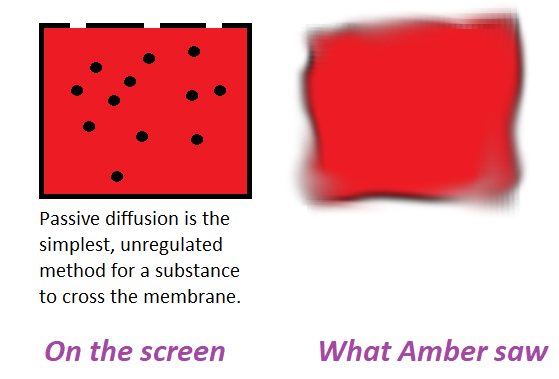
Sample 5.4 [19:56]: [Amber was reviewing PowerPoint slides about passive diffusion. The current slide showed a red square with black dots and some text (sketched at left)]. At the moment of the beep, Amber was (60%) cognitively contemplating the relationship between passive diffusion and concentration gradients [this was an inchoate, nonspecific contemplation, unlike 5.1, which was specific]. Simultaneously, Amber was (40%) seeing, blurrily, the slide’s red square, but she did not see the black dots or the text (sketched at right). The seeing was literally blurry [that is this was a creative seeing of the real slide].
Sample 5.5 [32:08]: [Amber was watching Law and Order SVU. At the moment of the beep, the show depicted a person lying in a hospital bed while others spoke off-camera]. At the moment of the beep, Amber was intently looking at the person lying in a hospital bed—that is, she was carried along by the TV but was intently looking at the scene [an almost physical staring-down-ness]. [Nothing else (such as the sounds of the show) was present in her experience.]
Sample 5.6 [36:35]: [There is a masterclass video about this sample] [Amber was watching Law and Order SVU where Olivia and Elliot were standing next to each other facing their captain, who is offscreen and is speaking. Simultaneously, Amber was holding an iPad in her right hand awkwardly in the crook between her index finger and thumb.] At the moment of the beep, Amber was seeing (75%) the TV except the seen scene was still [in actuality, the scene was in motion]. Simultaneously, Amber felt (10%) weight between her right index finger and thumb [that came from the iPad]. Amber was also simultaneously hearing (5%) the captain’s voice. [This was similar to 5.3: she clearly heard the captain’s voice (it was not merely that she was hearing sound), but she did not hear words or otherwise apprehend what the captain was saying].
A few hours after interview 5, Russ and Cody met to discuss issues that had arisen. They focus on Sample 5.6 and particularly the distinction between the real world and experience.
Of today's six samples, one was a creative seeing similar to day 5. Perhaps similarly creative was a slowing down of an inner hearing to match Amber's walking rhythm....
In general—sampling day 6: All DES interviews are some combination of iterative training (so that future sampling days can be more skillful) and description of experience. The aim of the sixth sampling interview is a combination of experience description and iterative training.
Amber's samples:
Sample 6.1 [1:19]: [Amber was making lunch and listening to music as she cut an onion. Just before the beep, Amber had cut the tip from the onion]. At the moment of the beep, Amber was seeing the top part of the onion [that is, Amber was simply seeing the onion she was cutting. Nothing else, including the music, was directly in her experience.]
Sample 6.2 [9:16]: [Amber was sending a text to a friend. Just before the beep, she had been searching for an emoji to send with her text, and she perhaps had either found the specific emoji she was looking for or she perhaps was about to or had just clicked on the specific emoji]. At the moment of the beep, this searching/finding was slightly present in her experience. [Nothing else was present in her experience. That is, her experience was slightly more than nothing, but not much more.]
Sample 6.3 [14:17]: [Amber was putting dishes away]. At the moment of the beep, Amber was walking between sink and cupboard as part of putting away her dishes. This is a repetitive sequence: pick-a-dish > walk > place-a-dish > walk > pick-a-dish > walk > place-a-dish > walk > etc. [It wasn’t clear how much of that was actually before the footlights of consciousness.]
Sample 6.4 [18:38]: [There is a master-class discussion of this sample.] [Amber was outside walking.] At the moment of the beep, Amber was simultaneously producing and innerly hearing Taylor Swift singing some portion of No Body, No Crime, with the slowed-down so that the rhythm of the song matched Amber’s footsteps [but with no change in the pitch]. [Nothing else was in her experience at the moment of the beep.]
Sample 6.5 [31:32]: [Amber was watching a video on her iPad while doing the dishes. At the moment of the beep, she grabbed a dish from the dish rack, which caused the other plates/dishes in the rack to shift and clatter]. At the moment of the beep, Amber was (80%) hearing the dishes clatter. Simultaneously, Amber (20%) saw on the iPad a still frame of a man walking [this was a creative seeing: in reality, the man walking continued on in-motion within the video]. [Nothing else was in her experience (including the grabbing-of-the-dish).
Sample 6.6 [36:31]: [Amber was in conversation that was considering , how much time was necessary for a task ]. At the moment of the beep, Amber was thinking about how long things take. This was a very non-specific wondering [e.g., there was no particular task being wondering about, no specific schedule], and it was present without any words, images, or hearings. [Nothing else (including the conversation) was present.
Of Amber’s six samples, two involved the experience of words without semantic meaning....
In general—sampling day 7: All DES interviews are some combination of iterative training (so that future sampling days can be more skillful) and description of experience. The aim of the seventh sampling interview is a combination of experience description and iterative training.
Amber's samples:
Sample 7.1 [0:11]: [Amber was on her phone and had pressed on a hyperlink. The webpage was loading—it was a black screen with a blue progress bar at the top of the screen]. At the moment of the beep, Amber was seeing the loading page—that is, she saw a black screen and a blue progress bar. In particular, she was noticing that the progress bar was exactly halfway.
Sample 7.2 [2:55]: [Amber was on her computer closing tabs and checking her email. Just before the beep, she had seen that she had received a new email. She was now in the act of heading to new email), moving her cursor diagonally down and to the right across her screen.] At the moment of the beep, she saw the cursor move across the screen [but was not attending to the act of moving it; that is, this was a visual experience].
Sample 7.3 [7:32]: [Amber was reading and had gotten distracted. Just before the beep, her eyes were darting back to the words on the page where she had left off]. At the moment of the beep, Amber was simultaneously seeing and reading the words "few white lies," somehow taking these words in a way that was more than just seeing them but less than semantically understanding them. She was somehow taking on these three words as a single unit. These seen items were understood to be words, but the words were not semantically meaningful.
Sample 7.4 [15:14]: [Just before the beep, Amber had said aloud the word "alternate" (in which "alternate" was part of a longer sentence.] At the moment of the beep, Amber was (90-95%) feeling stressed, which involved tightness in her chest. Simultaneously, Amber was (5-10%) hearing herself say "alternate" [as though hearing a recording of herself speaking. Notably, this hearing-herself-say-"alternate" was present even though, in reality, she had already finished saying "alternate" by the time the beep sounded]. Amber heard only the word "alternate," not the rest of the sentence.
Sample 7.5 [26:31]: [Amber was in conversation, speaking aloud about a highway that’s always closed.] At the moment of the beep, Amber was (90-95%) innerly seeing the highway tunnel, seen from a perspective off to the side and above the road [that is, from a perspective that she had never herself had taken]. She sees the tunnel’s double entrance set into a mountainside with plants/foliage growing around. This inner seeing was clear, in color, with no borders. Simultaneously, Amber was (in her experience, 5-10%) rubbing her eye. Nothing else, including the speaking she was performing] was present.
Sample 7.6 [34:36]: [Amber was watching a Jimmy Kimmel Live interview of an actor in Top Gun: Maverick, who was talking about how Tom Cruise had trained himself to hold his breath for 8 minutes and 40 seconds]. At the moment of the beep, Amber was (50%) indeterminately watching TV—the seen TV was directly present to Amber but the content was indeterminate. Simultaneously, Amber was (50%) "thinking about" Tom Cruise’s breath holding. [Amber’s verbal description was of a dry, analytical thought process/recognition, but her body language seemed consonant with a Wow! Amazing! reaction. We were unable to resolve this.]
A few hours after interview 7, Russ and Cody met to discuss issues that had arisen. They focus on Sample 7.6 and the distinction between what Amber says and her behavior as she says it.
Of today’s six samples, three involved creative seeings (two eliminated text and one eliminated motion and was seen too close up). ...
In general—sampling day 8: All DES interviews are some combination of iterative training (so that future sampling days can be more skillful) and description of experience. The aim of the eighth sampling interview is a combination of experience description and iterative training.
Amber's samples:
Sample 8.1 [0:26]: [Amber had just sighed and she was turning towards a screen she was holding]. At the moment of the beep, Amber was relaxing her shoulders [that is: her shoulders were slumping downwards and was the closing/end of the sigh]. Simultaneously, Amber saw the whiteness of the screen [although the screen in reality had text on it, she did not see the text]. Nothing else was in her experience at the moment of the beep.
Sample 8.2 [5:51]:[Amber was walking down her hallway carrying a bunch of items. Her hallway has a light at one end of it (which was on just before the moment of the beep) and at the end of the hallway is a room (which, just before the moment of the beep was dark)]. At the moment of the beep, Amber was (90%) feeling an interruption—a stopping of bodily process/homeostasis/existence. This experience was likely bodily [that is: it was not a feeling or cognitive process]. Simultaneously, Amber was (10%) seeing darkness—a center point of darkness that got lighter moving away from the center.
Sample 8.3 [19:17]: [Amber was watching This is Us. At the same time, Amber was being distracted by other noises/things going on in the house]. At the moment of the beep, Amber was (90%) carried along watching TV—she was watching the scene, but the seeing was not that clear. Simultaneously, Amber was aware that she was not focused (on the TV or anything else). There was another 10% of her experience that was somehow not apprehended, likely due to her in-reality distractedness.
Sample 8.4 [29:36]: [There is a master-class discussion of this sample.][Amber was watching This is Us, a scene involving Kate.] At the moment of the beep, Amber was seeing the two shades of blue—of Kate’s dress and of the color of the walls in the scene—visually noticing that the blues are similar [this was not a cognitive/analytical experience].
Sample 8.5 [34:32]: [Amber was on the computer: just before the beep, she had selected a group of files.] At the moment of the beep, Amber was seeing the group of highlighted blue bars. This seeing was of plain blue bars [and not of the titles written in text on each bar; that is, this was a creative seeing]. Simultaneously, Amber felt her eyebrows scrunch [in reality, she was scrunching her eyebrows, nose, cheeks, and forehead, a sort of scowl Amber makes when she is thinking; however there was no thinking content in her experience].
Sample 8.6 [39:15]: [Amber was eating a baked potato, in the process of trying to get sour cream out of a small container that also contained a dollop of whipped butter]. At the moment of the beep, Amber was (approximately 80%) seeing the tines of the fork lift the butter and sour cream underneath it. This seeing was still and exaggeratedly close-up [she saw the fork/butter/sour cream closer than it actually was in reality. There was no background (that is, this was not a figure/ground thing where the figure was central and the ground was present but somehow less vibrant or focused; the surround was simply not seen at all). That is, this was a creative seeing.] Simultaneously, Amber was (20%) tasting baked potato. Nothing about the moving-of-the-fork was present in her experience.
In general—sampling day 9: All DES interviews are some combination of iterative training (so that future sampling days can be more skillful) and description of experience. The aim of the ninth sampling interview is a combination of experience description and iterative training.
Amber's samples:
Sample 9.1 [3:00]: [Amber was eating a California roll; the contents of the roll were being pushed out the back. Just before the beep, Amber had turned the roll to look it]. At the moment of the beep, Amber sees the inner filling spilling out of the roll—this is an accurate) seeing-of-sushi. [Amber’s opening statement suggests that this was a creative seeing that obliterated the ground, but the interview failed to follow up; on that.]
Sample 9.2 [8:19]: [Amber was in the middle of picking an olive off a slice of pizza]. At the moment of the beep, Amber feels an edge between her right thumb and index finger [in reality, this is the edge of the olive slice, but the olive-ness is not part of her experience]. [Nothing else is present in her experience, including any seeing of the pizza.]
Sample 9.3 [11:24]: [There is a master-class discussion of this sample.][Amber had been watching The Office with her dad, who had asked Amber why Jim and Pam’s daughter was named Cece. Amber had explained that the name was inspired by Jenna Fisher’s real-life niece. Just prior to the beep, Amber had said "niece" (the last part of a longer sentence, something like "It was Jenna Fisher’s niece," but Amber did not recall the entire sentence); Amber was also in the middle of eating ramen]. At the moment of the beep, Amber sees (70%) her dad, a seeing disrupted by the seeing of ramen noodles. She sees her dad sitting in a chair [she sees a freeze-frame, whereas, in reality, her dad was making small movements]. [As Amber lifts a chopstick of ramen noodles towards her mouth,] she sees ramen enter her field of view from the bottom, disrupting her seeing of her dad. [The disruption is not merely a transition from an experience with one figure to an experience with another figure; instead, the ramen disrupts the creatively still seeing of the dad.] It was a disruptive visual transition, [but Amber did not affectively respond to the disruption]. [She sees just the ramen noodles enter her vision, not the chopsticks that held the noodle (even though the chopsticks were there to be seen from her perspective.] [This this was two creative seeings: a still seeing of her dad, and a chopsticks-less seeing of the ramen.] Simultaneously, 30% the word "niece" is present without any semantic/definitional meaning (it is understood as being a word, but with no connections to the context). [That is, "niece" is not understood to be the last word of a sentence, and the description of a particular person or relationship, etc. Amber’s experience is of the bare word "niece."] [Moreover, none of the previous content/words of her just elapsed, spoken-aloud sentence is experienced at the moment of the beep].
Sample 9.4 31:32]: [Amber was walking to unplug her iPad from its charger. In reality, the iPad was in a pink case that had two feet (half-inch black circles) on the case (it originally had four feet, but two had fallen off), and the iPad had been charging upside down (so that the charging cable was at the top) and was leaning half against the wall while the other half was hanging out past the edge of the wall]. At the moment of the beep, Amber sees her iPad leaning against the wall. [This is experienced as the seeing of an existing object—but the seen iPad differs from the actual iPad in at least four ways: first, she sees the iPad with four feet rather than the two it actually has); second, she sees the iPad straight up and down against the wall (rather than leaning against the wall); third, she sees the iPad leaning against a continuous wall (rather than the iPad straddling the edge of a doorway opening; and fourth, she sees basically a pink rectangle rather than the curved edges of the actual iPad.]
Sample 9.5 [46:51]: [Amber had pasted a google drive URL into the search bar of her computer’s internet browser. Just before the beep, as the page was launching, Amber began to unintentionally read the URL]. At the moment of the beep, Amber is reading "drive.google." Amber is somehow reading the entire phrase [not sequentially: drive-dot-google], without comprehension [that is, the reading is just the words, without any semantic meaning] and is present without any innerly or externally spoken hearing or speaking. Simultaneously, Amber’s attention is focused on the word "drive"—this is a mental experience [not visual, innerly spoken, etc.], and "drive" is present without any semantic meaning.
Sample 9.6 [54:16]: [Amber was on a FaceTime call.] At the moment of the beep, Amber is (90%) intentionally blocking out things competing for her attention so that eventually something will be her quite narrow focus (at the moment she does not know what that is). This is an active process [it is not merely that one thing is naturally or effortlessly becoming the figure of her experience. It is that she is actively eliminating things so that eventually something will be the figure of her experience]. Simultaneously, Amber was (10%) seeing an indeterminate picture on her phone—she sees a vague image of a person on her phone screen as well as the body of her phone [but did not see her hand holding the phone, nor the background behind her hand, and so on].
In general—sampling day 10: All DES interviews are some combination of iterative training (so that future sampling days can be more skillful) and description of experience. The aim of the tenth sampling interview is a combination of experience description and iterative training.
Amber's samples:
Sample 10.1 [1:36]: [Amber was starting to say "sometimes," which was referencing a joke in a video that they had watched a few minutes before where someone says, "sometimes, my genius is frightening"]. At the moment of the beep, Amber experiences herself as (90%) speaking "sometimes" in a preparatory way. [The beep interrupted Amber in the middle of preparatory saying "sometimes" ("som—BEEP"), but her experience was of the entire saying of "sometimes." Moreover, her experience was of "sometimes" and did not involve the rest of the phrase, nor did involve saying "sometimes" to another person: this experience was simply of Amber silently saying as if out loud "sometimes" regardless of the presence of the other. It was as if she were saying "sometimes" in preparation for actually saying "sometimes, my genius is frightening" at the appropriate time in a conversation.] Simultaneously, Amber is (10-%) smiling—she directly apprehends the physical sensation of smiling.
Sample 10.2 [11:59]: [Amber and her friend were playing Minecraft Dungeons. Just before and at the moment of the beep, Amber was slouching and bobbing her leg as she watched her friend navigate the settings menu of the game. Amber had just critically/frustratedly said "what are you doing?!" out loud to her friend]. At the moment of the beep, Amber is impatient—a mental, affective experience. Simultaneously—and as a part of the impatience—the words "what are you doing" are present in her experience [but are not spoken, heard, or seen, and do not involve the critical/frustrated tone/bite that was part of her spoken-aloud speaking]. Simultaneously, Amber is (5%) seeing the maroonish-brown screen—a (creative) simplification of what is actually on the screen [in reality, the screen has a maroonish-brown background with other colorized boxes (i.e., the game’s settings), but Amber does not see anything besides maroonish-brown].
Sample 10.3 [28:57]: [Amber was scrolling through her Twitter timeline, which at the time was displaying a post from Zendaya that included a picture of Mariska Hargitay. At the side of the post is the small circular "profile" picture of Zendaya.] At the moment of the beep, Amber sees a gray circle [this is a creative seeing of the profile picture: Amber has "obliterated" Zendaya from the picture and does not see her at all, and instead sees the circle of the background gray (that is, Amber has extended the background gray to fill the entire circle including where Zendaya’s head actually is)]. [Simultaneously, the screen is displaying a picture of Hargitay from the knees up wearing a coat, but in the process of scrolling, the top quarter of the picture had been cut-off, leaving Hargitay only from the neck downward). At the moment of the beep, Amber sees the bottom two/thirds of the picture of Hargitay, which itself is three-quarters on the screen [that is, Amber is creatively seeing a truncated part of an already truncated image (thus, Amber’s seeing does not correspond to what is displayed to her)]. Amber is focused mostly on the bottom flare of Hargitay’s coat. The seeing of the gray circle is slightly more prominent in Amber’s experience [Amber noted that her attention was shifting from the picture of Hargitay to the gray circle at the moment of the beep].
Sample 10.4 [41:48]: [Amber was passing her phone to someone to show them a video.]. At the moment of the beep, Amber sees her phone in the bottom-left corner of her visual field moving away from Amber. She sees the phone’s screen—a red field with black circles (which is a creative seeing of the actual phone). [The circles are a simplification of the actual display, which actually are displaying an array of circles with text on them.] Amber sees red field/black circles from an extreme angle.
Sample 10.5 [50:27]: [Amber had Family Guy playing on TV in the background while she was working on her computer. Leading up to the moment of the beep, Amber was in the process of switching from one incognito Google Chrome tab to another tab]. At the moment of the beep, Amber hears (65%) "you have a baby?!" spoken by a female Family Guy character. [As a fact of the universe, this is actually a delayed hearing—in reality, "you have a baby?!" had been spoken a second or two before the moment of the beep, but Amber’s experience was of hearing "you have a baby?!" spoken at the moment of the beep)]. Amber hears this with comprehension. Simultaneously, Amber sees (35%) the thin gray portion of space above a single tab. She sees only part of one tab [likely only the top part of the tab] (even though there are three or four open tabs. Thus this seeing is a creative simplification of what is actually displayed on the screen. That is: Amber does not, in any way see the rest of the chrome window, the other tabs she had open, and so on].
Sample 10.6 [1:01:35]: [Amber was watching a Youtube video on TV about an artist promoting features of a card game he had developed and was now selling. Just prior to (and during) the beep, there were animations of creatures that the artist had made for the game popping up on the screen]. At the moment of the beep, Amber sees a gold bug-like thing [she does not see anything else, such as the artist, the rest of the animated created, or anything in the background. They have been obliterated]. Thus this is a creative seeing.
As would be typical in DES, Russ and Cody would write an idiographic description of Amber's experience as sampled across the tem sampling days. Here, as part of Amber's training, Amber herself participated in the writing....
The salient-characteristic description process begins with a 'sample review', in which Russ, Cody, and Amber revisited all Amber's samples as part of the way of allowing salient characteristics to emerge. That review required two sessions; for transparency, we present the videos of these conversations here and here (we do not intend to provide their transcripts--too much work for too little gain).
Following the sample review, Russ, Cody, and Amber at first independently and then together agreed on a tentative list of salient characteristics. Then Russ, Cody, and Amber independently returned to each sample and rated it for the presence/absence of all the salient characteristics. Then Russ, Cody, and Amber met in a procedure DES calls 'rectification'--the discussion of all samples where any two of investigators' ratings were discrepant. The video of the rectification meeting is here. Sometimes a discrepancy can be resolved by recognizing that one or the other was mistaken in their rating. Sometimes the discussion led to their recognition that they had somewhat different understandings of the the salient characteristic, in which case the characteristic itself was revised until they could agree.
All that is typical DES procedure except that in typical DES, the participant is not present for the sample review.
The written characterization is here; on outline of that document is:
Thinking-experience spectrum, including
A range of degree that a thinking process was directly apprehended as ongoing at the moment of the beep (ranging from not at all to directly apprehended)
A range of degree that the content of thinking was directly apprehended (ranging from none to directly apprehended)
Sensory awareness
Words present, including
No inner speech
The experience of words without the experience of their semantic meaning
The experience of individual letters or parts of words
A discussion of whether Sadie should be considered 'face blind' or 'cognitive-emotional-experiential-content blind'