Russell T. Hurlburt
University of Nevada, Las Vegas
Peter Hoskin is the culture editor for Prospect, the British general-interest magazine that covers politics, economics, and current affairs. Pete was previously on the staff at The Spectator and The Daily Mail. ...
His interest in Russ's work led him to try out descriptive experience sampling for himself with the aim of writing about that experience; see his article in Prospect.
This is the first sampling day, and Pete (like nearly all DES participants) is not skilled at sticking to the moment or to experience....
In general—sampling day 1: All DES interviews are some combination of iterative training (so that future sampling days can be more skillful) and description of experience. The aim of the first sampling interview (or the first several sampling interviews) is almost entirely iterative training. First-day sampling interviews appear to be inquiries into experience, but their fundamental aim is to facilitate discussions of how to do DES more skillfully. DES recognizes that participants on their first sampling day are not skillful, so DES routinely discards first-day descriptions.
Pete's samples:
Sample 1.1 [2:44]: [I just caught sight of myself in a mirror in my sweatshirt. The bag over my shoulder was folded unflatteringly, sticking out over my stomach. I pulled it down and] thought Uuhhh, hope I'm not putting on weight.
Sample 1.2 [12:42]: [I'm walking though London, seeing buildings built on top of rivers, and remembering that I had read a book that mention this.] At the moment of the beep I am thinking what book is that? Was it about London?
Sample 1.3 [33:44]: I have two inner seeings. One is the WhatsApp screen with the messages that I sent to David. The other is one of the Love and Rockets (comic book) cover.
Selected commentary:
[0:00]: Russ clarifies that his inserted comments are provisional, interpretive, and open to disagreement or revision.
[8:23]: Russ notes that Pete's willingness to report an embarrassing thought suggests openness and likely honesty.
[16:51]: Russ suggests Pete may be inferring the presence of words rather than directly experiencing them, emphasizing uncertainty.
[32:48]: Russ explains that being "unconvinced" means neither believing nor disbelieving, but aiming for clearer, convincing descriptions.
[33:13]: Russ identifies the exchange as a good illustration of the core DES process and emphasizes that confidence should stem from Pete's own clarity.
[34:03]: Russ interprets Pete's pause as active effort to describe experience accurately, viewing it as positive engagement.
[36:38]: Russ senses possible unease in Pete when describing simultaneous images and notes the need to address it.
[37:52]: Russ explicitly acknowledges noticing Pete's earlier unease and the need to improve mutual understanding.
[45:57]: Russ observes that Pete is doing a good job describing a difficult "there-but-not-there" experiential state.
[53:36]: Russ explains he is encouraging important distinctions but remains unconvinced due to first-day limits, emphasizing iterative skill-building.
Three features of Pete's samples begin to emerge. First, inner visual imagery appears with a range of clarity. Second, some sort of almost-physical-ness of experience (see the cone-shaped region of sample 2.4). Third, experience consists of multiple simultaneous strands. ...
In general—sampling day 2: All DES interviews are some combination of iterative training (so that future sampling days can be more skillful) and description of experience. The aim of the second sampling interview is a combination of experience description and iterative training.
Pete's samples:
Sample 2.1 [0:48]: I innerly see a browser displaying an article (that I had written (and was published a couple of years ago). The seeing is a black landscape-shaped rectangle; the seen browser seems to float above the left side of the blackness. I see perhaps 80% of the browser—the outer 20% has faded to black. I know myself to be seeing that exact article, even though it is not seen clearly enough to read it, there is no masthead, etc.
At the top of the article is a picture—I don't see the picture clearly, but it is clearly a turquoise-y color which doesn't seem quite right. I have just begun some kind of semi-cognitive is that the right picture process.
Sample 2.2 [11:40]: I innerly see a browser window that contains a picture of three oil pumpjacks against an orange-y sunset. The browser window is only about 40% seen [that is, a narrower focus than in 2.1], and is seen to the left side of a black expanse [similar to 2.1]. The pumpjack picture is seen very clearly in detailed color and motion [much more clearly than the turquoise in 2.1.] [There had been a reason for seeing this image, but that is not present at the moment of the beep.]
Sample 2.3 [15:59]: [I'm playing a computer game with my 5-year-old son. He has made a play that illustrates that he doesn't understand the game.] I feel a combination of frustration and a should-I-help supportiveness. This seems like one feeling with two aspects, and is experienced diffusely bodily—that is, it is not in any specific region of my body (stomach, heart) but it seems more correct to say it is bodily rather than mental or any other experiential mode.
Sample 2.4 [32:06]: I 70% experience a tunnel-vision or cone-shaped region (where the large end of the cone is my face or the front of my head, and the small end is a portion of the replay portion of the game screen that I wish to inspect—the cone-shaped region feels almost physical but not quite, I feel almost as if I bodily lean into or tunnel into this region. [That is, this is much more than merely focusing on one aspect of the screen—the tunneling aspect has some directly apprehended quality.] I 20% see the screen. Simultaneously I am 10% wondering am I annoying the other player (by focusing too long on the replay and thus holding up the game). [This wondering is more mental or in my head than 2.3,] (like perhaps I have put words to it, even though I don't know what those words were).]
Sample 2.5 [44:55]: [I'm sitting at my desk and I'm minorly considering whether to pick up my phone and look up a football score, and in doing so] I 40% innerly see my desk with all its stuff and the phone off to the left. [That is, I see in my imagination what my real eyes are seeing, but I recognize the experience as being imaginary.] [Furthermore, I do not experience myself as seeing my real desk with my real eyes, even though that stuff is doubtless falling on my retina.]
Simultaneously, I 60% innerly see the BBC Sports webpage (as my phone would display it). [I don't see the BBC masthead, etc.], (but I understand that it is the BBC site). I very clearly see the website-displayed picture of the current game, see two players bumping aggressively into each other, two players that I immediately recognize [I am a football nerd]. (However, even though the players are seen as recognized, I do not recognize them. That is, I see them clearly, and in seeing them I recognize them, but also in seeing I do not recognize them.) [This does not seem strange in the moment.]
Simultaneously there is a very faint thinking should I check it (but I can't say how that presents itself).
Sample 2.6 [53:15]: [I'm editing an article and finding the article disappointing. My eyeballs are aimed at a particular word (which had confirmed my disappointment) but I wasn't seeing it or registering it at this moment—the word and the article was entirely incidental.] At the moment of the beep I feel a cynicism/skepticism/disappointment (that if put into words would be something like is that right?!? Is it really?!?) and I innerly say (or ejaculate) "hmmm!" (which expresses or reflects that feeling). (The feeling seems bodily but not in any specific place in my body—that is, it does not seem mental.)
Selected commentary:
[0:00]: Russ clarifies that his inserted comments are provisional, interpretive, and open to disagreement or revision.
[11:40]: Russ notes that precise technical terminology (e.g., "pumpjacks" vs "derricks") is not important as long as mutual understanding is achieved.
[13:55]: Russ interprets Pete's confident distinction between seeing a webpage and seeing an image as evidence that Pete is apprehending experience rather than fabricating it.
[16:01]: Russ suggests Pete's difficulty reflects uncertainty about what counts as "inner experience" in DES.
[30:02]: Russ emphasizes that iterative practice is necessary for achieving faithful descriptions of experience.
[42:43]: Russ observes that Pete is learning to make finer distinctions about his experience, which is central to the iterative DES method.
[47:11]: Russ highlights that inner seeing can violate real-world perceptual rules (e.g., recognizing specific individuals without identifying them), and stresses the importance of bracketing such assumptions.
[52:35]: Russ notes that having multiple simultaneous inner seeings in the same visual space is not problematic, despite being impossible in external perception.
[58:42]: Russ remarks that his summary omitted the fact that the "hmmm" was an inner (not external) vocalization.
Inner speaking appears, sometimes with clearly available words (e.g., sample 3.3), but sometimes where Pete experiences himself as innerly speaking but there are no words present (e.g., sample 3.2). Pete continues to have inner visual imagery in a range of clarity....
The multiple experience are now understood to be (at least sometimes) asynchronous in the sense that one experience can be waning in intensity while another increases in intensity (see sample 3.4).
In general—sampling day 3: All DES interviews are some combination of iterative training (so that future sampling days can be more skillful) and description of experience. The aim of the third sampling interview is a combination of experience description and iterative training.
Pete's samples:
Sample 3.1 [0:19]: [I'm at my computer and] innerly saying "scroll, scroll" in sync with my fingering the scroll button on my mouse. (This is a commentary-type speaking, not a command or instruction.) I experience the fingertip sensation of the scrolling perhaps more than the innerly speaking, but it seems like one action/speaking. There is also a sense of speed / rush; (this is not bodily and not mental, almost as if the rushedness is around me rather than in me). (I am also seeing the scrolling windows on the screen, but this is a very minor, if at all, part of this experience.)
Sample 3.2 [9:32]: [A parcel has been delivered and I need to pick it up at the corner shop.] I am innerly speaking something to the effect that I need to pick up the parcel, but there are no words involved. That is, I experience myself as speaking, and I have some inchoate sense of what I am saying, even though I do not experience words being spoken. Simultaneously I experience myself as innerly seeing the shop, both its inside and its outside, but neither one seen at all. That is, I experience myself as seeing, and I understand myself to be seeing two aspects of the shop, even though I do not experience either one.
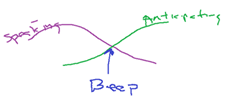
Sample 3.3 [19:22]: [I am walking toward my office where I will write a review of a book on Artificial Intelligence.] I innerly speak "He does in paragraphs what others have struggled to do in books" in my naturally inflected inner voice. That is, except that there is no external sound or perceived action, I am speaking as if naturally speaking to another person.
Simultaneously, I am anticipating or at the beginning of some sort of cognitive examination of how many books on AI I have read, and what were they, and were they good—that is, I am in the beginning of examining whether the "what others have struggled to do in books" actually reflects what I think.
(My sense is that both these aspects are present at the moment of the beep, but the strength of the speaking had peaked slightly before the beep and is now waning, while the anticipatory examination was on the rise, as schematized in the figure.)
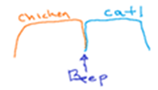
3.4 [32:10]: I experience myself as at the transfer point between two experiences: (1) I innerly see (from a first-person perspective) myself (mostly my hand) holding rolling pin pounding a chicken breast, an experience in color and motion as if seeing myself actually doing that; and (2) I turn and externally see my cat Nicole while saying "Cat!" in the voice of my 2-year-old son [who calls Nicole "Cat"].
(My sense is that I am at the border between two experiences as schematized in the figure.)
Sample 3.5 [46:57]: [I am reading in an AI book about reinforcement learning, and as I read] I illustrate with an inner seeing of a flowchart with red, yellow, and green squares / hexagons against a black background. The redness, yellowness, green-ness, and blackness are somehow a central aspect (or perhaps the central aspect) of this experience. I see this as if it is from a textbook—it seems professionally drawn in that way—and I inchoately see the legend (something like "Figure 1", but I don't see it clearly enough to read it. (There is no semantic detail in the seeing (that is, the blocks are not labeled.) (I understand that the flowchart does not actually represent what I am reading about.) (This seeing seems to occupy my entire visual field—there is no end to the blackness.)
Sample 3.6 [56:00]: [I am reading in an AI book that is describing the work of Ray Kurzweil, and as I read] I innerly see a photo of Ray Kurzweil as if from a 1970s academic prospectus (a bit dated, a bit faded) (I see just Kurzweil, not the page around it). (I somehow understand that this is not a correct or recent photo.)
Selected commentary:
[0:00]: Russ reiterates that his inserted comments are provisional interpretations, open to revision, disagreement, or correction by Pete.
[9:32]: Russ explains that describing "spoken thoughts without words" reflects the need to bracket the natural attitude (epoché), since experiential phenomena do not follow external-world rules.
[10:44]: Russ notes approvingly that Pete is confidently describing seemingly impossible experiences, indicating progress in bracketing assumptions.
[13:14]: Russ again highlights Pete's confidence in describing experiences that violate ordinary expectations.
[13:51]: Russ explains that his "lecture" is meant to support Pete in bracketing presuppositions about inner experience (epoché).
[16:48]: Russ praises Pete's ability to bracket the natural attitude and describe experiential phenomena that would be impossible in the real world.
[18:44]: Russ reflects that people are often mistaken about their own inner experience, and notes that Pete's assumptions are beginning to break down through DES; he attributes this to non-confrontational guidance and careful joint inquiry.
[19:51]: Russ continues his explanation about separating aspects of inner experience (speaking vs. words), reinforcing the need to bracket natural assumptions.
[20:23]: Russ explicitly emphasizes that he is not imposing interpretations, but allowing Pete's experience to emerge—reinforcing the non-confrontational method.
[20:48]: Russ clarifies that DES samples need not be brief; experiences can be temporally extended even though the beep marks a moment.
[23:33]: Russ argues that Pete's report of unworded thinking is credible evidence of accurate introspection, noting its consistency, specificity, and conflict with Pete's prior assumptions.
[29:50]: Russ continues the lecture on bracketing the natural attitude, explaining how temporally compressed inner speech can still feel normally paced.
[38:49]: Russ observes that Pete's current difficulty is not about identifying experience but about articulating unusual experiential categories, indicating substantial progress.
[53:34]: Russ identifies Pete's focus on colors as an example of "sensory awareness," where sensory qualities themselves become the primary object of attention.
[57:54]: Russ notes that Pete clearly distinguishes between what is directly experienced and what is merely known about the experience.
Pete's experiences today all have two simultaneous strands, and all involve inner visual imagery....
Pete has instances of experiencing himself as innerly seeing something without that something being seen (see 4.2).
In general—sampling day 4: All DES interviews are some combination of iterative training (so that future sampling days can be more skillful) and description of experience. The aim of the fourth sampling interview is a combination of experience description and iterative training.
Pete's samples:
Sample 4.1 [0:15]: [I had been thinking about the cartoon work of David Squires (a cartoonist that I like).] There are two strands of experience:
--I (sense myself as innerly seeing) Squires, as if in self-portrait—Squires drawn in the Squires style. This is an experience of seeing Squires, but the seen Squires is perhaps not actually seen. I sense myself to be seeing him drawn in his style, but I don't actually innerly see him
--I feel myself move my leg (around an object in my path) in a wooo! movement out and around. (This is mostly the experience of my leg moving in a swooping pattern, but there may also be some preverbal whoa! sense to this experience.)
(I experience this as the intersection of two experiences: The inner-seeing portion is currently more intense but is waning, whereas the leg portion is currently less intense but is waxing.)
Sample 4.2 [13:51]: Two strands in my experience:
--I innerly see a vibrating hand against a black background that filled my visual space. (The hand vibrates at perhaps 30hz, that is, faster than a tremor.) I (innerly) see this clearly.
--[I am looking out my window and] somehow registering the view. (This registering is somehow a deliberate noting or explicitizing the objects that I see—a tree, a window, a wall; but this is not a sequential noticing. That is, there is a this-and-this-and-this-ness of the seeing. This is not a cognitive or analytical noticing, but rather a specifying perceptual interest.
Sample 4.3 [26:09]: Two strands:
--[I'm listening to a podcast, and] I have a sense of one of the podcast guests—a white man with brown hair, roughly my own age—but this is mostly a seeing without a thing seen.
--I feel some sense of kinship—a rush of a hundred or so unspecified shared memories—like the guest and I have experienced roughly the same things. (Maybe this includes playing Sega games in the 90s, but that seems more like a post-hoc explanation rather than an at the moment of the beep experienced detail.)
Selected commentary:
[0:00]: Russ reiterates that his inserted comments are provisional, interpretive, and open to revision, disagreement, or correction.
[0:33]: Russ notes that audio glitches in the recording make it difficult to hear clearly and easy to talk over each other.
[32:30]: Russ highlights that Pete has carefully described an experience that seems impossible in the natural world—clearly seeing without anything actually being seen—illustrating that experiential phenomena do not follow natural-world rules.
[38:43]: Russ clarifies that he has not articulated things well, and refines the key phenomena: seeing without something seen, speaking without words spoken, and recalling without specific events recalled; he notes these are often assumed impossible but are likely common and require careful methods like DES to observe.
Inner visual imagery is still salient, sometimes multiply, and sometimes as an inner copy of something seen externally....
The inner copy is understood to have traveled along an almost-physical path from the external to the internal world (see samples 5.2. and 5.5).
Pete also experiences his attention as shifting in a physical way, e.g., physically feeling his focus slide toward his physical ear when he is about to hear something (see 5.2).
Pete's samples:
Sample 5.1 [0:23]: [I was erasing a line in my notebook,] mostly focusing on the downward movement of the pencil eraser. This is a feeling of the movement, not a seeing of it, not an attention to the erasing. That is, I was somehow present in the movement of the end of the pencil.
Simultaneously I feel a very gentle emotion of was that a bad thing to have done? This was a diffuse bodily emotion (not specific like my heart sank, but somehow bodily anyway).
Sample 5.2 [9:37]: [I was at my computer with a word document open, which displays my son's name.] I see the word "Elliot" on the computer screen, and simultaneous see it inside my forehead, as if the screen's "Elliot" had been projected and thereby expanded along a cone into being seen inside. (That experience is waning.)
Simultaneously I feel a physical shifting towards my right ear, where I am (beginning to hear) Elliot say "Can it say, can it say...". Mostly this is a meta-experience of my physical focus shifting towards my physical ear (not merely a shift of attention, but of an aiming towards my ear). There is also some rising anticipation or awaiting how he is going to complete that sentence [it turns out to be "Pokemon"].
Sample 5.3 [25:22]: [I am thinking about an article I will write about mass murderers.] There are three elements:
(1) I am innerly speaking "Anders Breivik, Anders Breivik" three or four times. [In reality it doubles happens very fast, but in my experience it is at normal speed.]
(2) I innerly see a skewed narrow strip of a screed or Internet manifesto posted by a mass murderer. This is a clear seeing, but I don't read the words. The strip is a surface of blackness, much like a redaction, that displays a portion of what I know to be an internet post (that is, the post is wider than what I can see of it). I see the blackness of the redacting cover—that is, the blackness is not merely background but a foreground element that blocks the view of the entire manifesto. This seeing is felt (experientially) to be in my head, front left, in the direction where I am actually looking.
(3) I feel some sense of frustration that the manifesto I am seeing/looking for is not by Anders Breivik—that is, there is conflict between what I am saying and what I am seeing/wanting. I feel that as a diffuse bodily it's not right. (This is not a cognition or analysis, but a feeling of it.)
Sample 5.4 [38:56]: [My wife and I are talking about her father (Steve) who had visited and left a box on the microwave.] I have two simultaneous seeings, one imageless and the other clear and in motion:
(1) I see Steve without actually seeing Steve. I am clearly seeing, and I understand that way I am seeing is something like a standard portrait view of him, but I don't actually see that view. That is, this is an imageless seeing.
(2) I see Steve moving through the kitchen towards the microwave. This is a clear seeing where I see the elements of the kitchen and Steve moving through them, but Steve is seen more clearly or distinctly than the rest of the scene.
Sample 5.5 [48:33]: [I am reading about Thomas Paine and his book Rights of Man.] I see the words "Rights of Man" on the computer screen and simultaneously innerly see it inside my forehead, as if projected through some cone-like region between the screen and my head. This is two separate, simultaneous seeings of the same words—the inner words are bigger but otherwise in the same font, etc..
Simultaneously I innerly see the car park in Lewes where I had once parked in the town that was important in Paine's history. I see it clearly (and in color), as from an elevated position above the corner of the car park looking out onto the car park.
Sample 5.6 [59:43]: [I'm at my computer. My eyeballs are aimed at the left side of my wide monitor, where I have been reading. But I have a football (soccer) match playing on the right side, and the announcer has just said the name of a player that I like, "Archie Gray."] At the moment of the beep I feel my physical attention shift to my right ear. (That is, this is a meta-experience, noticing my attention shifting, not merely the shifting of attention. Furthermore, this is to my physical ear, not merely a metaphorical focus on what I am hearing.
Selected commentary:
[0:00]: Russ reiterates that his inserted comments are provisional, interpretive, and open to disagreement, revision, or correction.
[2:46]: Russ notes that he slightly misstates Pete's description, correcting "did I do the right thing?" to Pete's actual phrasing: "was that a bad thing to have done?"
[5:15]: Russ comments on Pete's use of the word "thought," explaining that in DES contexts it often refers broadly to salient inner experience (e.g., imagery, feeling, sensation) rather than strictly cognitive or analytical thinking, and suggests Pete likely does not mean a cognitive/analytical process here.
Pete has multiple strands of experiences; he feels his attention physically shift to his eyes when he is about to see something(see 6.1, similar to 5.2 shift toward his ear). ...
Pete has additional instances of imageless seeing (see 6.5).
[The beeper headphone wire is apparently broken, so Pete accumulated only five samples.]
Pete's samples:
Sample 6.1 [0:12]: [I was looking at an email.] There are two strands of experience:
--I am very present in my eyes (as I see the email). This is experienced as being attentionally moving down to my physical eyes (that is, the eye-ness is not merely a metaphor for seeing, rather like the whoop), but it does not feel like a physical sensation in the eyes. I also see the words that my eyes are aimed at; I see this as semantically meaningful text, but I am not reading it at the moment of the beep.
--I innerly see "Jack" (who sent the email); I see mostly his face inside a more-or-less circular region, (but I understand this to be in a rectangular Zoom window, although I don't see the rectangle). I see him just as I did a few days earlier on an actual Zoom call. (I experience this seeing as being in the front of my cranium.)
Sample 6.2 [16:42]: [On the screen was the cover of an (older) book by Lucy Hughes-Hallett.] I have two strands of experience:
--I am innerly saying "Lucy Hughes-Hallett" in a sing-songy way, enjoying the pleasant sound of her name. Also, I feel or almost feel that in my throat and tongue, as if my mouth is about to say "Lucy Hughes-Hallett"outerly [which it doesn't].
--I innerly see the cover of her latest book [which is about the Duke of Buckingham]. I see it both clearly and indistinctly—I clearly see the title (including the word "Buckingham") and the yellow letters and an old-timey image of the Duke. [I see it clearly enough that later I check to find that the title is not Buckingham but is The Scapegoat. It is not that the cover is blurry, and not that the cover is not seen; it is somewhere in between: I see the cover clearly but also not completely articulated. I experience my seeing as being clear, but I don't fully see the object.]
Sample 6.3 [25:59]: [I'm at my computer working, and my son is behind me. He has asked something like why I have several pens, and at the beep I am in the act of responding something like "Because they come in packs". But my experience is not of speaking those words or of answering that question. It is difficult for Pete to describe this aspect of his experience—it is such a "plain" experience.] There are two strands of experience:
--I am monitoring, or supervising, or parenting, or interacting with my son. [None of those words convey the "plainness" of this experience. This is not experienced as a speaking-to my son, although that is in fact the behavior that is taking place.]
--I am becoming aware of the shades of black, from orange-y black to purple-y black. This is an experience of seeing without seeing, of my creating some sort of downward movement of shades of black, more-or-less as if I am scrolling through them. I have a sense of agency in the movement—I am making it happen—but not a particular sense of how that happens (I do not experience a literal scrolling, for example). That is, I feel myself to be downwardly presenting to myself a series of shades of black, but I don't actually (including innerly) see those shades. (This seems to be an increased realization of this variety of blacknesses.)
Sample 6.4 [41:24]: [I was plugging the headphone plug into the beeper jack.] There are two strands to my experience:
--I am present in my fingers, expecting the click of the plug as the detent spring engages the groove of the plug. (This expecting is not cognitive—it is my fingers awaiting that click.)
--I feel a warm satisfaction about the long-term reliability of old technology. I feel this mostly in the back of my head, possibly a rising upwards toward the back of my head.
Sample 6.5 [53:24]: Two strands:
--I see without seeing a football match between Chelsea and Leeds. This is a visual experience without experiencing the thing seen—I am seeing this match, but I don't see the match itself. Somehow I see a team wearing blue playing against a team wearing white, but I don't see (innerly or at all) anything, either blue or white.
--I innerly see the Leeds bench players, somehow ready for me to move them to the pitch. I innerly see the list of Leeds substitute players as it had been displayed on the screen; this seeing is clear but the names are not semantically articulated My experience is of my moving the players to the pitch, not just dragging their names from the bottom list ready to the upper list.
Selected commentary:
[0:00]: Russ reiterates that his inserted comments are provisional, interpretive, and open to revision, disagreement, or correction.
[0:00]: Russ notes that due to a broken earphone wire, Pete obtained only five samples for this session.
[9:58]: Russ clarifies that the experience of "eye-ness" is neither a literal physical sensation nor merely metaphorical, but an intermediate phenomenon where attention is directed to the physical eyes without sensory qualities like pressure or itch.
[18:38]: Russ explains that Pete's description of a visual experience as both "vague" and "clear" reflects the difficulty of describing phenomena that do not follow the rules of external perception, and suggests that clarity may be present without attentional engagement.
[31:03]: Russ notes that he may have misunderstood Pete's description of agency in the "scrolling" experience.
[31:54]: Russ again acknowledges not fully grasping the importance of the agency Pete describes in the scrolling phenomenon.
[34:08]: Russ comments on the ambiguity of scrolling direction, noting that moving a scrollbar downward results in the text moving upward, which contributes to experiential confusion.
[39:59]: Russ highlights that describing behavior (e.g., "I said to my son...") differs from describing experience, emphasizing the DES goal of capturing lived experience rather than external actions (an example of epoché).
[52:27]: Russ reflects that Pete's experiences of "locus of attention" (eyes, ears, fingers) may be more similar than Pete perceives, and contrasts this with his own experience of not locating attention in body parts; he emphasizes that DES aims to faithfully describe Pete's experience rather than compare it to others.
[55:55]: Russ notes his initial misunderstanding, thinking Pete saw players rather than a list of names on the substitutes graphic.
[56:53]: Russ explains that Pete's experience of seeing something visually clear but semantically indeterminate (clear yet unreadable names) is difficult to represent in the real world and differs from blur or nonsense.
[1:01:44]: Russ summarizes that Pete experiences a clear but semantically undifferentiated visual list that simultaneously represents players rather than names, highlighting a "doubly abstracted" form of seeing without meta-awareness.
We see additional instances of phenomena we have seen previously, leading us to conclude that we have done 'enough' sampling....
Those phenomena are multiple simultaneous images, imageless seeing, and meta-experience of attentional shifts.
At the conclusion of sampling, they discuss (52:35) whether to have a 'green meeting' and a debrief meeting, and schedule them.
Pete's samples:
Sample 7.1 [0:51]: [I'm listening to a podcast; one podcaster is talking about Stephen King and his plot twists. The other podcaster makes a joke, suggesting that a King twist is some kind of drink, saying "What's a King twist?"] I intentionally form a respond by innerly seeing a glass with a twist of lime and mostly clear liquid (like gin and tonic). (I see this as a real glass as if staged in a photo shoot, from a point of view close to the bar looking rather up or over at the glass. I do not see a photo of the glass; I see a real glass from this staged point of view.) (The scene is surrounded by black, which has no characteristics.) [By intentionally I mean that this seeing is not merely an illustration of the conversation I hear; I feel myself to be specifically creating a King's twist for my own amusement.]
Simultaneously, I imagelessly see a photo of Stephen King; it is clear that I am seeing him as if a head shot on a dust jacket of a book, but even though I experience myself as seeing Stephen King, I don't innerly see anything.
Sample 7.2 [6:42]: I'm replaying (= innerly seeing with audio) an interview that I had a few nights ago. I feel myself naturally speaking the entire question from my own point of view, but in reality it happens too quickly for that to be possible. However, it doesn't seem like I'm experiencing a compressed or condensed question. Simultaneously (although it seems to be in response) I see/hear his answer, which in reality is probably not actually the entire answer, but it doesn't feel like I'm hearing a condensed version of it. (This feels like it exists in the back right of my head.) [That aspect of my experience is fading.]
Simultaneously [I am pouring milk into my coffee] I feel my attention leaning along with the pouring, including a sense of an unspoken but somehow thought whoop. (This is not merely an attending to the pouring;] (it is an attending to the leaning of my attention toward the pouring—some sort of meta attention to the attention).
Sample 7.3 [17:11]: [I'm watching a movie in which there is a group of perhaps 15 dancers moving in a circle.] I superimpose that circling movement somehow in my head—this is a felt moving in a circle (which is not visual). I feel movement in my head that matches the movement that I see on the screen. [This is not merely an attending to the movement on the screen; I feel movement that is superimposed on what I see.]
Sample 7.4 [24:52]: [I had a general sense of the desirability of fixing old technology, manifested by] at the moment of the beep I innerly see a bunch (5? 20?) fixing-old-technology items: I innerly see an iPod lying on my desk (I see it in a way that seems clear but also seems indistinct—what I see of it is clear, but many of its details I don't see, and am not interested in at this moment. (For example, I couldn't tell you what color it was). I see soldering, a small soldering iron with sparks (that in reality would be more like welding). I see a circuit board. These move as I see them, rather like floating in front of me in a moving collage.
Sample 7.5 [33:21]: [My hand and finger are moving toward a corner or my iPad screen to close a window.] I feel my attention lean along with the motion, as if my attention is emulating the motion. (My experience is of the attentional lean more than of the basic physical motion.) [This is different from what in other samples I have called an attentional shift in that here there is no prior attentional aim—I don't feel my attention shifting from one thing to another; I feel my attention tracking along or emulating one thing.]
At the same time I have some kind of anticipatory sense of the conclusion of this action, of my finger hitting the Close button. This is parallel to but not part of the attentional lean: I experience the attentional lean and I feel the anticipatory conclusion.
Sample 7.6 [39:51]: [I see the stack of books on my bed that need to be arranged.] I'm innerly saying "Right!" which I both innerly speak and hear; it is an instruction to myself, shorthand for "Right, I've got to do this thing." ["Right!" is a common expression for me that is something like a command—do this.]
Simultaneously I experience trapezoid of attention that starts in its shorter side in front of my chest and widens out toward the books. (This is not a visual experience, but is a meta-attentional space—I am somehow experiencing this as the region in which my attention shifts from book stack to book stack. You could say that I am scanning the books, and it is true that my attention in some way lights up (not visually) the books sequentially, but I do not focus on this book and then that one. Instead, I experience my attention itself as shifting in this region that I am describing as trapezoidal.)
Selected commentary:
[0:00]: Russ clarifies that his inserted comments are provisional, interpretive, and open to disagreement or revision.
[0:15]: Russ notes that Pete replaced a broken earphone with his own earbud.
[2:45]: Russ identifies Pete's report as "imageless seeing"—a confident sense of seeing without an actual visual image.
[11:54]: Russ characterizes Pete's experience of noticing his own attentional shift as a meta-experience, suggesting increasing saturation in sampling.
[24:32]: Russ interprets Pete's movement-matching experience as meta-experiential—an awareness of his own experience duplicating external motion.
[26:24]: Russ observes Pete's frequent simultaneous inner seeings and his ability to distinguish clearly-seen relevant aspects from unelaborated ones.
[53:39]: Russ explains that "green meeting" captions are typically written in green font for easy identification.
This is the first part of the 'green meeting'. It starts with a discussion about what a green meeting is, and then reviews half of Pete's samples, starting on the last sampling day....
Sample reviews:
[8:04]: Considering sample 7.1
[16:35]: Considering sample 7.2
[30:59]: Considering sample 7.3
[33:21]: Considering sample 7.4
[42:22]: Considering sample 6.1
[52:59]: Considering sample 6.3
[59:22]: Considering sample 6.4
[1:02:18]: Considering sample 6.5
[1:17:32]: Considering sample 5.1
[1:21:04]: Considering sample 5.2
[1:24:33]: Considering sample 5.3
[1:27:24]: Considering sample 5.4
Selected commentary:
[0:00]: Russ comments that his inserted transcript comments are provisional reflections written shortly after the interview, intended to invite disagreement, clarification, or revision rather than to assert definitive truth.
[0:11]: Russ comments that he is beginning his explanation of what a "green meeting" is.
[0:54]: Russ comments that the green meeting itself is part of DES's iterative process, where later samples can clarify earlier ones.
[1:16]: Russ comments that the green captions are intended to preserve things that may later prove important for describing Pete's experience.
[1:45]: Russ comments that the aim is to describe Pete's experiences themselves rather than to remain constrained by previously written descriptions.
[9:34]: Russ comments that Pete is trying to clarify the function of the short green captions.
[1:36:18]: Russ comments that the most fidelity-achievable aspect of Pete is his experience at a particular moment, whereas abstractions such as personality traits, IQ, or ego strength are normative constructions rather than directly apprehendable realities.
The green meeting takes too long to accomplish in one sitting, so here is the second half of the green meeting....
Sample reviews:
[1:01]: Considering sample 4.1
[2:36]: Considering sample 4.2
[5:44]: Considering sample 4.3
[14:20]: Considering sample 3.1
[16:15]: Considering sample 3.2
[19:19]: Considering sample 3.4
[23:15]: Considering sample 3.4
[33:00]: Considering sample 3.5
[37:00]: Considering sample 3.6
[39:12]: Considering sample 2.1
[45:56]: Considering sample 2.2
[47:08]: Considering sample 2.3
[48:47]: Considering sample 2.4
[57:39]: Considering sample 2.5
[1:05:07]: Considering sample 2.6
Selected commentary:
[0:00]: Russ comments that his inserted transcript comments are provisional reflections written shortly after the interview, intended to invite disagreement, clarification, or revision rather than to assert definitive truth.
[5:29]: Russ comments that Pete temporarily leaves the meeting and rejoins from a different computer, and that the omitted interval is not displayed in the transcript.
[42:57]: Russ comments that while reading, people commonly and automatically update their illustrative imagery as new textual details emerge, usually without recognizing that the update process itself has occurred unless DES sampling catches it "in flight."
[43:22]: Russ comments that the green meeting and its captions are living, iterative attempts to characterize experience, where discussion of one sample can reshape understanding of other samples.
[51:08]: Russ comments that collaborative clarification is central to the green meeting process, illustrated when his poorly chosen word "exaggerated" is jointly repaired with Pete into the more acceptable "emphasized."
[51:35]: Russ comments that the "cone" aspect of Pete's experience was initially unclear during the original sampling but only later acquired meta-experiential significance through iterative green-meeting discussion.
[57:16]: Russ comments that DES descriptions are valuable only insofar as readers trust the investigators' honesty about what they are and are not willing to "go to bat" for regarding experiential claims.
This free-wheeling conversation allows Pete to ask whatever he wishes about the process....
A rough outline of what was discussed is:
[1:05]: What Russ learned about Pete's experience
[1:29]: Meta-experience
[3:18]: Sampling with other populations
[7:47]: Inner experience and personality
[10:45]: Pete has learned a lot about himself
[12:47]: Know thyself
[15:30]: Premeditated vs. natural inner experience
[19:11]: Fran
[28:47]: Russ's DES history
[32:53]: One Boy's Day
[34:40]: The beeper
[39:38]: Trust
[46:06]: Objective; radically non-subjective
[51:58]: DES is a first-person-plural science
[56:11]: Has DES caught on?
[1:03:36]: Consciousness and AI
[1:13:28]: Thanks
Selected commentary:
[0:00]: Russ explains that the green comments are provisional working notes, not final truth, and invites Pete to disagree, revise, or add his own comments.
[7:47]: Russ says Pete's meta-awareness might be epiphenomenal in principle, but he doubts it is insignificant.
[12:47]: Russ argues that knowing one's inner life directly has value in itself, even if it is not yet tied to some practical diagnostic or personality payoff.
[13:47]: Russ says it is characteristic of the current era that people look for personality or diagnostic uses for inner experience, even though the experience itself may be valuable on its own terms.
[13:57]: Russ adds that if a mature science of experience existed, he might think differently, but current personality and diagnostic science is too weak to support such claims.
[16:58]: Russ says a rigorous inner-speech study would need to distinguish natural, spontaneous silent speaking from silently speaking on demand, and that current methods fail to do that.
[35:11]: Russ explains how he figured out the beeper's random-interval mechanism in his head and situates the invention in the early history of portable electronics.
[40:46]: Russ says it is possible Pete could have been deliberately trying to fool him, and that honest reactions like surprise or embarrassment are among the signs he watches for.
[44:51]: Russ uses the Fran story to show how DES can reveal and transform experience by pushing step-by-step attention to difficult imagery.
[51:53]: Russ argues that objectivity in DES rests on direct apprehension, not on public observability alone.
[54:04]: Russ says Pete's pre-sampling descriptions should not be trusted because he had not yet developed the skill to apprehend his own experience accurately.
[54:37]: Russ says he taught Pete to be his eyes into Pete's experience, while Pete helped Russ become his correspondent to the outside world.
[64:56]: Russ says DES is a first-person-plural enterprise: it is not Pete reporting, but Pete and Russ describing together.
[1:01:33]: Russ argues that psychiatry often treats anxiety without knowing the patient's actual experience or what the drug does to that experience, which he sees as unsustainable.
[1:02:30]: Russ says DES is now more central than it once was, but very few people are willing to do the work needed to apply it in their own settings.
[1:06:07]: Russ says Claude probably lacks the basic conscious moments he has found in human participants, though AI may still help build better interviewers.
We collected 35 samples from Pete over seven sampling days. As is usual in DES, we discarded the first day's samples (N = 3) as training; this description is therefore based on N = 32 samples collected over six days....
The samples were random within periods selected by Pete; the interviews were conducted by Russ Hurlburt via Zoom.
Pete's main experiential features:
Multiple strands of experience: Pete often experience two to 20-ish simultaneous experiences. Sometimes they were synchronous, and sometime overlappy. Pete did not know of this experience prior to sampling.
Meta experience: Pete experience was often aimed at some aspect of his own experience, a phenomenon we call meta-experience. Sometimes he felt his experience moving through a cone-shaped region; sometimes he felt hie experience moving toward the sense organ (as moving toward his ear when Pete was about to hear something. Pete did not know of this experience prior to sampling.
Inner seeing: Many of Pete's experiences included inner seeing. Sometimes these inner seeings were clear and detailed; sometimes they were imageless, where he experienced himself as seeing but he did not experience the thing seen. Pete did not know of this experience prior to sampling.
Inner speaking: Some of Pete's experiences included inner seeing. Sometimes these inner speakings were clear and detailed, of complete sentences; sometimes they were wordless, where he experienced himself as speaking but he did not experience the words being spoken. Sometimes his inner speaking was experienced more for their acoustic phenomenology rather than their semantic understanding.
Feelings: Pete occasionally experienced emotion, usually a diffuse bodily experience.
The complete formal description can be found here.

 Simultaneously, I am anticipating or at the beginning of some sort of cognitive examination of how many books on AI I have read, and what were they, and were they good—that is, I am in the beginning of examining whether the "what others have struggled to do in books" actually reflects what I think.
 3.4 [32:10]: I experience myself as at the transfer point between two experiences: (1) I innerly see (from a first-person perspective) myself (mostly my hand) holding rolling pin pounding a chicken breast, an experience in color and motion as if seeing myself actually doing that; and (2) I turn and externally see my cat Nicole while saying "Cat!" in the voice of my 2-year-old son [who calls Nicole "Cat"].