Part XV: Michael Dickson—A philosopher diagnosed with schizophrenia
Michael Dickson1, Agnieszka Bolinska1, and Russell T. Hurlburt2 1 University of South Carolina2 University of Nevada, Las Vegas
Michael Dickson is a 57-year-old philosophy professor at the University of South Carolina. He was diagnosed with schizophrenia at age 25, a fact that he had kept hidden from nearly everyone...
...until in 2023, when he gave a talk about coping with ongoing symptoms at a conference about coping with mental health issues in Oxford; the following year he wrote in the journal Schizophrenia Bulletin about his personal history with psychosis and how he had learned to cope with it, an account that has had over 50,000 views. Russ invited him to participate in DES; the results are described here.
Dickson, M. (2024). From vexing uncertainty to intellectual humility. Schizophrenia Bulletin, 51(4), 843–844. https://doi.org/10.1093/schbul/sbad173
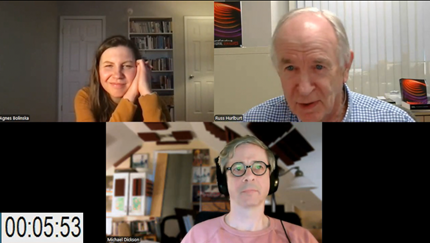
The interviews were conducted by Russ Hurlburt and Agnes Bolinska.
Russ meets Michael and Agnes for the first time (all previous interactions have been by email). The beeper has arrived, and we have an unboxing video along with discussion of how to use the beeper....
The conversation is not scripted. Here is a rough outline of topics covered:
[0:02]: Opening remarks & session framing
[2:18]: Review of prior discussion and goals
[5:07]: Clarifying DES method and procedures
[11:36]: Participant experience vs. interpretation
[18:22]: Difficulties in describing inner experience
[26:45]: Role of language in shaping reports
[34:10]: Examples of inner speech and imagery
[42:53]: Attention, noticing, and experiential limits
[51:27]: Observer effects and reactivity in sampling
DES generally discards first-day samples, but there are three samples that have phenomena that will later be of interest: Sample 1.2 involves a synchronization of inner rhythm and external behavior; sample 1.4 involves speaking without noticing whether it is aloud or iner; and sample 1.4 involves what DES calls "creative seeing."
In general—sampling day 1: All DES interviews are some combination of iterative training (so that future sampling days can be more skillful) and description of experience. The aim of the first sampling interview (or the first several sampling interviews) is almost entirely iterative training. First-day sampling interviews appear to be inquiries into experience, but their fundamental aim is to facilitate discussions of how to do DES more skillfully. DES recognizes that participants on their first sampling day are not skillful, so DES routinely discards first-day descriptions.
Michael's samples:
Sample 1.1: Two main, two lesser experiences:
Michael feels his arms (upper and forearms) tensing in preparation for lifting [a stump to serve as a chopping block]
Michael thinks I need the gloves—are they wet? This is all present at once, and may be in words—not sure.
Michael feels the coldness of breeze on back of my neck. [Had been more prominent earlier, but now has faded]
Michael hears a small gasoline engine (perhaps with a tinge of irritation, which had colored this hearing earlier.
Sample 1.2: Michael is chopping wood and singing (perhaps aloud) the 3rd movement of Mozart's horn concerto: "da da da da da DA! da" with great emphasis on the DA as he slams the axe through the wood. This experience is primarily of synchronizing the singing to the action. He feels a bit of satisfaction that he has indeed synchronized the "DA" to the bodily discharge of energy into the wood; this satisfaction is mental.
Sample 1.3: [Michael has finished chopping wood and a second or so before the beep raised his arms in a bodily stretching, during which he feels a pleasant tiredness of my arm muscles. At the moment of the beep he has lowered his arms but] he continues to feel the pleasantness up there [where his arms have been]. That is, the tiredness stays attached to his real arms which are at his sides, but the pleasantness stays where it originally was a few seconds earlier. At the same time he [looks over the fence and] sees [his neighbor, primarily noticing] their big red hair.
Michael skips a sample. It beeps, but he is in a meeting that is intense and he doesn't have the bandwidth to process the beep.
Sample 1.4: [The meeting is over, he puts the beeper back on, and am looking out my window, probably to unwind from the tense meeting. He sees the white house across the way.
Simultaneously he sees the same house overlaid on the original; this second house moves slightly toward me and then floats upward and rotates backward (so that it faces toward the sky). He says (perhaps aloud, perhaps silently) "The house is doing yoga" [a reference to the Sun Salutation yoga sequence, which the motion of the house resembles]. [As the house moves and rotates, he sees that it is a flat façade, as if it had been painted on canvas and then the canvas was rotated revealing that it is thin.]
Selected commentary:
[0:17]: Clarification of DES goal: apprehending experience (past and future)
[1:51]: Iterative process: improving future apprehension through questioning
[3:31]: Distinction between "understanding" vs "apprehending" experience
[4:19]: High-fidelity vs veridical description of inner experience
[5:42]: Practical setup: previous day sampling and learning from prior session
[6:14]: Difficulty locating precise timing of beep relative to experience
[7:21]: Beep as minimally disruptive to ongoing experience
[8:11]: Timing uncertainty and processing delay between beep and awareness
[12:00]: Kinesthetic rhythm: tapping disc felt in fingers
[12:52]: Hearing distant voices and recognizing individuals by voice
[14:11]: Worded thought "throw it on hyzer" without speech or imagery
[15:28]: Relative salience: worded thought primary among concurrent streams
[18:00]: Words present without voice, imagery, or production
[19:37]: Sequential vs non-sequential presentation of words
[20:10]: Words without speech quality (non-produced, non-heard)
[21:29]: Words present without clear agency or location ("just there")
[25:30]: Recognition of others as "here" (social presence vs spatial location)
[29:28]: "Here" as group-membership rather than spatial proximity
[32:40]: Felt rhythmic experience localized in fingertips (non-auditory)
[33:31]: Rhythm as felt pattern without conceptualization
[38:27]: Independence of concurrent streams (rhythm vs worded thought)
[42:18]: Emotional reaction to name "Mikey" and self-reassurance
[42:54]: Inner speech "it's okay" as self-directed regulation
[44:05]: Coordinated bodily action (turning) with wordless awareness of reason
[45:21]: Near-simultaneity of hearing, inner speech, and action
This is Michael's second sampling day. The rapid and specific rhythm of sample 2.1 is noteworthy. ...
In general—sampling day 2: All DES interviews are some combination of iterative training (so that future sampling days can be more skillful) and description of experience. The aim of the second sampling interview is a combination of experience description and iterative training.
Michael's samples:
Sample 2.1: [Michael was standing on the first teepad of disc golf, which he plays on many Sundays.] There are three strands of his experience.
First (~50%), Michael thinks "Throw it on hyzer" ["on hyzer" refers to the disk angle—the farther disc edge is lower than the closer edge]. These words are experientially present all at once—they do not unfold over time. (The experience is in words, not merely of the meaning.)
Second (~25%), Michael hears voices (from about 200 ft away) that he registers as being Dillon and Todd. (By "registers" Michael means somehow grasping that Dillon is here and Todd is here—playing disc golf today.) [These are not explicit thoughts, but the registration that they are here is nonetheless somehow explicitly present.]
Third (~25%), [Michael holding the disk in his left hand; Michael throws left-handed] and tapping the disc between the thumb and forefinger (of his right hand).] He feels the tapping as a rhythmically felt pattern (in his right-hand thumb and forefinger) [Ta takata Ta katakataka Ta takata Ta katakataka Ta; but whereas he can confidently say in retrospect what the pattern was, at the moment of the beep he does not register the particularity of the pattern] with a recurring pattern that has emphasis on his thumb. [The experience is of the felt-in-his-thumb/finger rhythm, not of producing the pattern.]
Sample 2.2: [We skipped because we were short of time; Michael preferred to move on to beep 3.]
Sample 2.3: [The beep occurred in the parking lot at the end of the disc-golf outing. Michael was standing next to his car; Todd and David were adjacent.] There are two strands of his experience.
Todd said "Bye Michael"; David said "Bye Mikey" [for historical reasons, probably extending back to the 1970s/1980s "Mikey likes it!" Life cereal commercial, Michael does not like to be called "Mikey"]. Michael hears both utterances and innerly says (in his own naturally inflected voice) "It's okay" (conveying that whereas he doesn't like that David is calling him "Mikey," because of David's other characteristics it will not bother him; that is not explicitly thought or realized but is somehow conveyed in the inner speaking).
Second, [Michael needs to take off his elbow compression sleeve, which requires removing his shirt. He has a large tattoo on his back, which he does not want Todd and David (who are conservative Protestants) to see, so] he turns his back away from Todd and David. He is physically aware of the turning and also somehow aware of the reason for turning [but this is not an explicit directly apprehended thought or observation].
Selected commentary:
[3:26]: Minimal consciousness and "nothing going on" characterization
[4:42]: Tactile focus on resistance of oatmeal while stirring
[6:01]: Vague visual awareness of oatmeal as sole attended object
[9:52]: Dynamic visual distortion: characters moving around stable word
[11:27]: Swirling described as elliptical, record-like motion
[13:10]: Perception of multiple characters without individual focus
[16:32]: Experience of motion as real despite knowledge of static display
[17:39]: Post hoc attribution of frustration (not directly experienced)
[19:35]: Simultaneous inner speech: "I wanna see Saturday"
[20:29]: Blend of speaking and hearing (production-dominant inner speech)
[23:55]: Distinction between speaking/hearing and aloud/not-aloud dimensions
[26:07]: Equal salience of visual distortion and inner speech
[27:58]: Visual experience of blocked path despite physical reality
[28:08]: Sudden anger experienced as spider-like sensation on scalp
[29:46]: Emotion-as-sensation: anger identical with "bug-like" feeling
[30:48]: Instinctive brushing action in response to felt "bug"
[34:11]: Spatial localization and size of anger-as-bug experience
[35:44]: Tactile awareness focused on head, not arm, during brushing
[37:46]: Lack of clear experiential resolution before beep interruption
[39:05]: Visual perception of aisle as closing off (non-Euclidean space)
[41:13]: Visual constraint implying need to move backward
[42:21]: Co-occurrence but independence of visual and emotional streams
We had agreed that we would focus more on Michael's experience and answer DES procedure questions off-line.
Michael said he was attempting to practice the epoché during this sampling.
...
Sample 3.1 is an instance of what will become common for Michael: there is no 'penumbra' around the main central figure. Sample 3.3 involves a creative seeing and a feeling apprehended as a hyper-specific bodily sensation. Sample 3.4 involves hearing voices. Sample 3.5 is an instance of Michael's difficulty in ignoring non-essential phenomena.
In general—sampling day 3: All DES interviews are some combination of iterative training (so that future sampling days can be more skillful) and description of experience. The aim of the third sampling interview is a combination of experience description and iterative training.
Michael's samples:
Sample 3.1: [Michael was stirring a pot of oatmeal.] There were two strands of experience, neither of them prominent, perhaps 25% each. He sees the oatmeal, not really focused on it, but a visual experience none-the-less. He sees just the oatmeal, not the pot or the surrounding stove. Also, he feels the resistance of the oatmeal as he stirs. [The intention is doubtless to determine if the consistency is of done oatmeal, but mostly] he feels the resistance of the oatmeal. [The remaining 50% is nothing; it is not that he directly apprehends nothingness, but instead it seems, on immediate retrospection, that he was not occupying all his potential experiential realm.]
Sample 3.2: [Michael is looking at a calendar on his computer. The calendar is displaying Friday, and he wants to see the Saturday display.] There are two related experiential focuses.
First, at the moment of the beep he sees "Friday" clearly on the screen. "Swirling" around the "Friday" word he sees a dozen or several dozen characters from the screen rotating clockwise around the word (Michael's metaphor is that it is like a phonograph record with the word "Friday" fixed in the center and the characters (letters and numbers) rotating at about record-player speed around. The metaphor breaks down in that the characters' tracks are oval—wider than tall—so as to remain more-or-less equidistant from the word (which is wider than it is tall). Russ's unstated metaphor is like a racetrack: "Friday" in the infield and the characters are on the track.) The characters are at a variety of distances from the middle—that is, they are not all on the same track. [Michael has felt that the characters are taunting him—not acquiescing to his intention to get to the Saturday display—but that is not, he thinks, exactly at the moment of the beep.]
Second, Michael says "I wanna see Saturday!" (Michael has no idea whether this is spoken aloud or silently.) This is clearly predominantly the experience of speaking (~70%) more than hearing (~30%), but there is a hearing aspect; the heard aspect is of hearing it as spoken aloud.
Sample 3.3: [Michael is shopping at Whole Foods, and has just entered a freezer aisle. Something happens ahead of him in the aisle that make him angry; we did not discuss what that event was.] Michael (~25%) sees the (real as they are) freezer doors (converging in perspective) and as part of this visual experience but not experientially seen, "sees" that the doors converge, blocking his way. That is, he has the visual experience of being blocked. This is not a cognitive knowing; the you can't get out this way! is experienced as being part of the seen convergence—the blocking convergence is visually experienced but not experientially (even in imagination) seen.
At the same time, Michael (~75%) feels anger and is vigorously brushing / scrubbing / swatting it away with his left hand. The anger is felt spider-like with sharp feet, scuttling across the top left of his head. This scuttling sharpness is directly apprehended as anger (that is, it is not a metaphorical representation of anger; it is anger). (Michael is in fact vigorously brushing, but he doesn't really feel himself doing that. He does) feel the vigorous brushing as a sensation in his head/scalp.
Sample 3.4: [Apparently as an effort to calm down from the previous episode, Michael is "blind driving," aimlessly driving without a goal (he is in fact heading for his office, but at the time is driving in a direction away from his office). He is driving skillfully, but he does not experience the driving. Slightly before the beep, he has heard a familiar voice "John" (this is not the voice's real name; we did not inquire about what the voice's real name was or why he preferred not to use the real name) say "That's really nice." "That's so great." "That's so great." "That's really nice." in a repetitive manner.] At the moment of the beep, Michael says to John, "Yes, John, that's really nice" (with the intention of slowing down or stopping John's speaking [but this intention is not explicitized; it doubtless is the intention but there is no direct apprehension of the intention]). (This experience is mostly of saying (~80%) rather than hearing (~20%, or perhaps less). Whether it was actually spoken aloud, Michael does not know.)
Sample 3.5: [Michael was at his office writing an email to Agnes about the upcoming workshop they were jointly planning. He was in the process of deciding where the discussion of DES would fit into the workshop, and] at the moment of the beep he was typing and speaking aloud "DES." (There was, or may have been, some sense of solving a puzzle—where to put the various workshop events. He was doubtless actually engaged in solving that puzzle, but whether or how that puzzle-solving was directly apprehended was not clear. It was not visual—it was not a seen (in reality or in imagination) moving of puzzle pieces. It was not kinesthetically felt.) The saying of "DES" was entirely productive (that is, he did not experience himself as hearing himself say "DES"). (Michael was seeing "DES" on the screen, but the visual aspect was a very small part of (~20%) the "DES" experience.
There were two other directly apprehended but small (~10%) aspects of Michael's experience simultaneous to the saying "DES." Michael heard the rattle of the office HVAC. [His sense was that he always hears it when he first enters his office, and it takes a while for him to background that noise.] And he was, with his right ring finger, picking skin off his left thumb; he had slid the fingernail under the skin [and would eventually scrape that skin away]. (This was primarily a feeling of the left hand doing, rather than the right hand feeling it being done.)
Selected commentary:
[2:24]: Low-level awareness ("brain dead") with partial sensory engagement
[3:20]: Integrated auditory–productive experience (hearing and singing as one)
[5:35]: Visual awareness of greenness as salient feature
[7:33]: Narrow visual focus on letters excluding surrounding text
[9:47]: Visual sense of incompleteness (unfinished word)
[10:46]: Absence of semantic awareness despite meaningful typing
[12:36]: Singing with attention to tongue position and throat sensation
[15:23]: Relative dominance of singing over environmental perception
[16:21]: Sensory monitoring of tongue height and throat strain
[21:25]: Absence of explicit intentionality despite goal-directed action
[23:17]: Visual experience of darkness and emptiness without conceptual overlay
[24:18]: Seeing "emptiness" as a visual property
[27:58]: Production-dominant inner speech with hearing component
[28:40]: Indistinguishability of inner vs aloud speech in experience
[34:11]: Irony embedded in tone rather than explicit thought
[36:19]: Temporal precision of beep within ongoing inner speech
[41:12]: Dominance of visual search over partially automatic singing
[42:37]: Goal-directed visual scanning without explicit template
[44:07]: Attention to tone quality and throat sensation in singing
[46:31]: Background auditory stream (voice "John") as undifferentiated speech
[47:22]: Simultaneous inner speech ("turn it back off") and sensory awareness
[48:16]: Inner speech as primary experiential component (productive)
[49:19]: Inner speech as self-directed, neutral-toned reminder
Samples 4.1 and 4.6 are notable in that Michael is hearing as music the noise of household devices....
Michael's samples:
Sample 4.1: [It was early morning, and Michael was standing in front of the coffee maker in his kitchen. The coffee maker has illuminated the green light that indicates that it is brewing, and it is making an alternating BA-DA-BA-DA growly/hissy sound as it brews.] Michael (~40%) was singing along with the coffee maker (which he heard as the growly/hissy alternation between F# and B). [This was not an experienced cognition that is F#; that is B; the F#-ness and the B-ness were simple directly-apprehended characteristics of the sound.] (This experience was primarily of singing along with; that is, it is not a separate hearing and then singing.)
Simultaneously, Michael was (~10%) seeing the green-ness of the coffee-maker light. (He sees the light, but it is the green-ness rather than the brewing-ness that is present to him.)
(The remaining ~50% was unoccupied; it was not the experience of nothingness, and it was not a meta-awareness of nothing. It was that the two aspects were not experienced as completely occupying the capacity of his experiential realm.
Sample 4.2: [Michael was grading a paper, in the middle of typing the word "doesn't."] Michael had gotten through "d-o-e-s" and was seeing those letters. (Perhaps there was some vague sense that those were the letters of an unfinished word; that is, he had some sense of it not being finished yet.) (He wasn't saying anything to myself or hearing anything; he was just seeing those letters. [The screen was full of words that surrounded the letters he was typing / seeing, but he was not seeing them.]
Sample 4.3: [Michael was driving, which was not in his directly apprehended experience. It was about 5:15am, and dark, but that was also not directly apprehended. ] At the moment of the beep Michael was noticing the lack of cars and the lack of people. (This was a visual experience—that is, he was seeing the emptiness.) [It was not a cognitive or analytical experience, and not a meta experience.] Simultaneously, Michael was singing
"we're all," (from the lyric "we're all taking the same steps" ) and was paying a special attention to the feeling of the "'re" of "we're," specifically the feeling of where the rear part if his tongue in his mouth is—high up in the back of his mouth). [Michael was trying to learn this song so that he could sing it himself, and was trying to figure out how to emulate the original artist's particular shouty sound without himself engaging in the shouting.]
Sample 4.4: [Michael was grading and two moments before the beep typed the phrase "is surely too strong a statement." ] At the moment of the beep he was saying ironically to himself (whether aloud or in inner speech was irrelevant) "That's too strong!" referring to Michael's own statement. (The irony arises from the fact that he was accusing somebody of saying something too strong by himself saying something too strong.) [As best we could say, the tone expressed irony, but he did not feel irony separate from the tone.]
Sample 4.5: [In grading papers,] Michael was searching for a closing parenthesis. [Before the beep, Michael had wondered has the student left out a parenthesis or have they put it in the wrong place? but now] he was 80% visually searching [with no meta-awareness]. [Michael was singing / trying to learn the same song as in 4.3.] He was 20% singing "we've been had" aloud and was paying particular attention to his vocal cords.
Sample 4.6: [Michael is in the office shredding something. The shredder makes a low guttural sound] that Michael is humming along to. [Without meta or any other experienced cognition, he immediately recognizes it as a B and] hums a B along with the shredder. Simultaneously he says to myself, "Turn it back off" [as part of reminding himself to turn it off when he is finished]. Simultaneously he sees (10%) the blue light [which indicates that the shredder is on and may be part of the "Turn it back off" reminding.] Simultaneously, Michael (10%) hears John's voice [see 3.4] speaking, (but Michael doesn't make out the words John is saying) above him and to the left.
Selected commentary:
[2:24]: Divided awareness: singing/hearing blend, green light, and “brain-dead” low consciousness
[3:20]: Integrated experience of producing and hearing tones as a single phenomenon
[5:35]: Visual awareness of greenness as primary feature of light
[7:33]: Visual fixation on partial word as incomplete (letters only, no context)
[10:19]: Visual sense of incompleteness without semantic awareness
[12:36]: Singing with focus on tongue height and throat sensation
[15:23]: Relative dominance of singing over environmental awareness
[16:21]: Sensory monitoring of tongue position and throat strain (production-focused)
[21:25]: Absence of explicit intentionality despite goal-directed vocal control
[23:17]: Visual experience of darkness and emptiness (not conceptualized as “early morning”)
[24:10]: Seeing emptiness itself as a visual property
[27:58]: Inner speech as production-dominant with hearing component
[28:40]: Indistinguishability of inner vs aloud speech in experience
[34:11]: Irony embedded in tone rather than explicit thought
[36:19]: Temporal precision of beep within ongoing inner speech
[41:12]: Dominance of visual search over partially automatic singing
[42:37]: Goal-directed visual scanning without explicit template
[44:07]: Attention to tone quality and throat sensation during singing
[46:31]: Background undifferentiated speech (voice “John”) as unattended auditory stream
[47:22]: Inner speech "turn it back off" as primary experience
[48:16]: Inner speech as productive, neutral-toned self-reminder
Sample 5.4 is noteworthy in the creative seeing of moving characters....
Michael's samples:
Sample 5.1: [It was dark in the early morning. Michael was backing out of his garage, and his car was flashing a red warning circle and beeping, the car's computer notifying him that there might be something behind him. Michael understood it to be a false alarm, the result of his bike rack blocking a sensor.] Michael said to himself "C'mon!" in a pleading and exasperated tone (that expressed irritation at the car for doing it and at himself for not already fixing the problem). This was more an ejaculated utterance than a intentionally semantic utterance; (Michael could not say whether it was aloud or inner.)
Simultaneously he was hearing the warning beep and seeing the warning circle, probably primarily drawn to the bright red of the warning circle (more to its red-ness than to its warning-ness).
Sample 5.2: [Michael was parked by the side of the road, writing notes about the previous sample (5.1).] There were two separate experiential organizations (not two experiences within the same consciousness). In one, Michael said the words, "they'll ask about that" referring to the question of how much was the beep versus how much was the redness experienced in sample 5.1. Those words were uttered matter of factly (but Michael did not know whether they were aloud or inner).
Simultaneously, but seemingly not part of the same consciousness, Michael was seeing two particular drops of water rolling down his rainy windshield and was wondering whether they would intersect. (This wondering was directly apprehended and was not in words.)
Sample 5.3: [Michael had just sent an email to Agnes; he had used a group email as the starting point, and was now worried whether he had replied just to Agnes or had inadvertently hit Reply All.] There are three simultaneously aspects. (1) Michael feels a slight panic located in a demarcated region inside his left upper chest; the region is roughly spherical, beneath the skin and bone, and extends into the interior of his body but not to the back. The slight panic is not a bodily feeling, but it is a feeling that resides in that region of his body.
(2) He is watching the arrow (the mouse pointer) look for the Sent folder; [he is in reality controlling the motion of the arrow with the mouse, which he operates with his left hand, but he has no experience of that. Instead] he sees the arrow (as an agent) looking for the Sent folder (but not yet finding it); and
(3) he is mid-gesture with his right hand, pointer finger moving toward the screen, gesturally pointing at where that Sent folder is. That is, these are three separate consciousnesses: the demarcated panic, the seeing of the (agentic) arrow, and the look there gesture with the right hand.
Sample 5.4: [Michael is creating a makeup quiz for a student who missed a quiz in his logic class, considering how to alter a question to be similar but different to the original. He is looking at the screen, which displays "~Bd → Ja".] There are two experiential aspects (within one experiential organization / consciousness). (1) Michael says to himself "let him try the bonus," said matter of factly [as the answer to the question of whether Michael should include the bonus question on the make-up quiz]. (It is experientially irrelevant whether this is aloud or silent speaking.) (2) Michael sees the tilde in "~Bd ? JA" move quickly in an arc up and over the Bd and the →, and come down to rest before the Ja. [The ~ does not move in reality, but Michael sees the ~ make the arc-shaped motion. This seeing is experienced as a real seeing, but at the same time Michael could say that the ~ did not really move. The seen ~ is experienced as agentic in the sense that it is as if the ~ is showing Michael where it could go to accomplish the aim of creating a similar but different question.] [The ~ here is similar to the mouse pointer in 5.3 in that Michael experiences them as being agentically independent of Michael—that is, Michael does not experience himself as controlling them or creating their movement. The two are different in that the ~ is aiming at a specific location, whereas the pointer does not (yet) have a specific aimed location.]
Selected commentary:
[2:36]: Perception of backup camera warning (red circle and beeping)
[3:40]: Spontaneous exclamation "C'mon!" as involuntary expression
[5:10]: Exasperation manifested in utterance rather than separate feeling
[9:32]: Distinction between emotion-as-experience vs emotion-as-quality-of-action
[14:41]: Visual and auditory components: redness and beeping as experiential content
[15:48]: Relative salience of simultaneous experiential elements (non-additive percentages)
[17:01]: Experiencing sensory qualities (redness) vs functional meaning (warning)
[23:44]: Inner speaking: "they'll ask about that" (productive with hearing component)
[24:00]: Visual attention to water droplets on windshield
[25:22]: Dual experiential streams ("100–100"): inner speech and visual tracking
[30:31]: Nonverbal anticipation/wondering about droplets intersecting
[32:09]: Clarification of "absent-mindedness" vs full experiential engagement
[35:13]: Multiple experiential realms vs single unified stream
[38:33]: Exclamation "Shit! What did I do?!" and onset of slight panic
[Preliminarily, Michael began the conversation by saying the he is okay, and that we might want to know that in advance. He had had a "bad morning," he said, and some of today's samples will reflect that. That turned out to be the case in samples 6.2 and 6.3.]...
In general—sampling day 6: All DES interviews are some combination of iterative training (so that future sampling days can be more skillful) and description of experience. The aim of the sixth sampling interview is a combination of experience description and iterative training.
Michael's samples:
Sample 6.1: [Michael had gotten up at 4am to put a log on the fire. He couldn't sleep, so he was washing dishes.] At the moment of the beep there were three things ongoing. First, he felt (20%) a pressure in his head (rather like a headache, but without the pain). Second, he was noticing / enjoying (20%) the pleasant warmth of the water on his hands. Third, he was seeing (10%) the darkness of the early morning. [There were no words involved in any of those aspects.] [Those don't add to 100%, reflecting what he called the stirring the oatmeal sense that none of those things was occupying him very completely.]
Sample 6.2: [Michael was concerned about losing his ability to maintain a grip on reality, to keep reality from melting away or disappearing. He had reclined 3/4 of the way in his office reclining chair trying to relax and to keep himself focused by looking at his favorite guitar which was on a guitar stand in front of him.] There were two experiential strands. First, he saw the guitar surrounded by directly apprehended blackness (that is, this was not merely ignoring the stuff in his peripheral vision—the peripheral things were not at all seen or otherwise present). [Michael referred to this as the "guitar was at the end of the tunnel," but this "tunnel" had no 3-D extension into the distance.] This seeing felt like at any moment it could "melt" (by "melt" he meant somehow lose its reality—dissolve, reveal itself as merely a façade that could peel away). [That is, Michael was trying (not very successfully) to relax, focusing on the guitar with the specific intention of trying to make the guitar (and Michael himself) feel stable.]
Second, Michael heard James saying "People just pretend to like you.... People just pretend to like you." James's voice came from directly above him (perhaps three feet above him)] James spoke (as he always does) in a very flat affective tone ["like reading a phone book"—that's part of what makes him particularly nasty.]
Russ comments: In this description, Russ is calling the voice "James," a pseudonym Russ made up here in the creation of the description. There was no mention of a name during the interview itself. Michael said that the voice does has a name, but he did not say what that name was. He acknowledged that the voice had a name in the same way that "John" (see samples 3.4 and 4.6) had a name. The first voice's name was not "John"; Michael did not use his real name but was willing to use the pseudonym "John" in the interview. Here, by specific contrast, the voice had a name, but Michael did not provide it or produce a pseudonym in the interview, even though he had the opportunity to do so (as for example at 24:29).
I consider here why, in the writing of this description, I give him a name at all. Here are the alternatives for the opening of the second paragraph:
Possible wording
Implications
Second, Michael heard a nasty voice saying "People just pretend to like you"
Emphasizes the vocal characteristics of the voice, particularly those that are typically thought of as nasty (harsh, abrupt, clipped, etc.); that is misleading because the actual voice is monotone.
Second, Michael heard the nasty voice saying "People just pretend to like you"
Emphasizes the enduring-ness and familiarity of the speaker, but it makes the speaker one-dimensional—emphasizes the nasty and only the nasty.
Second, Michael heard a familiar voice that usually says nasty things saying "People just pretend to like you"
Emphasizes the voice-ness of the experience—downplays any other experienced personhood, as well as being cumbersome.
Second, Michael heard James saying "People just pretend to like you"
Emphasizes the enduring being-ness and familiarity of the speaker.
Second, Michael heard a voice whose identity is known to him, and who typically says nasty things, saying "People just pretend to like you"
Emphasizes the enduring being-ness and familiarity of the speaker without making up a name
When I wrote this table, it included only the first four options, and I wrote:
To my ear, the "James" option seems the most rhetorically convenient way of conveying the voice's familiarity and specificity. However, I do not at all understand the non-rhetorical ramifications of that choice. There is perhaps (probably?) a reason that Michael did not provide a name when RTH gave him the opportunity at 24:29. If so, I would be happy to edit this description in whatever way suits Michael.
Michael subsequently suggested the option in the last (purple) row, which also seems good to me.
What makes this discussion interesting is not so much the result (how to refer to the voice) but the process: it is that kind of attention to detail that results (or at least can result) in high-fidelity description. Not just the detail of voice references, but how to refer to anything experiential.
Sample 6.3: [Michael is now fully reclined in the recliner, having closed his eyes, still trying to relax and to maintain the existence of reality.] At the moment of the beep James is still talking, but it's more like background noise (Michael is not attending to words or their meaning). Mostly Michael feels the chair holding him up. This is a bodily (across the entire back parts of his body) sense of being supported by the chair. (That is, this is not merely a felt pressure of chair against body, but rather of being supported in space.) Along with this bodily-supported sense is an unnerving, precarious worry that the chair could itself disappear—this is a am-I-gonna-fall? sense.
Also, Michael is saying to himself "You should take an Ativan." (He has said this perhaps 20 times already, separated by perhaps a minute. (Michael does not know whether this was said aloud or innerly.) [On retrospection, Michael finds it weird to have said "Ativan" because he never calls it by its Ativan brand name, instead referring to it as "Lorazepam."]
[The lack of confidence that the chair will remain real is very similar if not identical to the (sample 6.2) lack of confidence that the guitar will remain real.]
Sample 6.4: [Michael is at his computer deleting old emails.] (Without paying very careful attention to them, but) noticing the Subject and From portions, Michael was in the act of deleting or not (occupying 20% of his experience).
Mostly Michael was listening to a song, attending to it particularly for meter. [Earlier he had told his band-mates that this portion of the song was in a multi meter; prior to the beep he had collected several live performances and had listened to the relevant section of each, discovering that there was actually no multi meter section. A few seconds before the beep he had said "Oops!", but now] he was continuing to listen to the song and its meter [so that he could help his mates learn it].
Sample 6.5: [Michael was walking across campus, and as he walked] he was clicking his (right hand) thumb and middle finger together, making a specific Da da da Da da da Da da [the underlining/capitalization indicating accent; that is, this is a rapid 8/8 (3 + 3 + 2) lilting rhythm] repeating rhythm with his thumbnail as it moved back and forth across his fingernail. (He was especially feeling the accenting pressure upwards on his fingernail [even though it was his thumb that was doing the pressing].)
Simultaneously, Michael is synchronizing his steps to the rhythm, matching his step particularly to the rhythm of the sensation in his fingernail. [Retrospectively, he thinks this lilting gait might have looked weird to a passerby, but that potential weirdness was not present at the moment of the beep.]
Sample 6.6: [Michael is at his computer reading / commenting on a graduate student's paper. He was in the act of saving the file, which he had titled "Acosta-comments." Then he had remembered that the student has two last names, and Michael looked up at the top of the paper to see what the student had used as his own last name, discovering that it wasn't Acosta, it was Alonso. So about the file name,] Michael said to himself, "Alonso! Better change it now." (This was spoken to himself; Michael did not know whether the speaking was aloud or inner.)
At the same time, Michael was also thinking, "I'll just change it before I send it." This thinking was in those words, but not experienced as spoken and not experienced as unfolding over time—that is, the words were all present at once. [The two worded expressions were happening, which on retrospection seemed impossible or weird to Michael; RTH assured him that that was fairly common.]
Simultaneously Michael saw the (first part of the) email address "ALONSOAD," and this seeing contained some confirmation that Alonso was the correct last name. (That is, this confirmation was in the seeing, not a thought process that accompanied the seeing.)
Selected commentary:
[0:44]: Anticipation of a difficult ("bad") morning
Sample 7.1 is noteworthy in his fingering of the French horn with his right hand rather than the left, and that he sometimes writes two separate things, one with the right hand and one with the left. Sample 7.4 is noteworthy in the way Michael reifies the electronic transfer of a file.
...
[Prior to discussing samples, we discussed Russ's comments in the contemporary descriptions to day 6, wherein he mentioned that Michael had not provided a name for the second voice. Michael said he did not like the second voice and did not want to provide it status by using its name, even though it did have a name.]
[We also discussed referring to things and people in the way that is experientially natural, and the difficulty and importance to the fidelity of a description of doing so.]
Michael's samples:
Sample 7.1: [Michael was walking back from class] softly singing (and experiencing) a tune ba ba ba, ba ba badaba ba ba ba. At the same time he was [fingering with his right hand French-horn fingerings that were relevant to but not the same as the tune he was singing and] was experiencing / enjoying the kinesthetics of the motion. Simultaneously Michael was actively coordinating his walking to the cadence of the sung rhythm [but this did not take much effort because the rhythm was close to the cadence]. [Michael had been reflecting on a conversation with a student after class, and had, a few seconds before the beep, produced the words "she gets it," without those words having been spoken or heard.] Now, at the moment of the beep, there is some unworded sense of the student's having understood [perhaps something like a residual of the previous thought process and worded expression of it].
[In the conversation about sample 7.1, we noted that the French horn is fingered with the left hand but Michael was producing the fingerings with his right hand, and that seemed just as natural as fingering with his left hand (which RTH found remarkable). In explanation, Michael also reported that he writes equally with either hand (which RTH found remarkable), and that in graduate school while taking notes he would write simultaneously with both hands, the right hand taking notes about what the professor said and the left hand is own thoughts about it (which RTH, AB, and Michael's fellow students found remarkable).]
Sample 7.2: [Very shortly after 7.1; Michael was just finishing jotting notes about 7.1] Michael is saying to himself "What is that from?" [referring to the sung melody of sample7.1] [because of the people around, Michael probably did not say that aloud, but the aloudness-or-not was not in his experience at the moment of the beep.] Simultaneously, but separately, Michael is chuckling, a small laughing that is the ejaculative expression of noticing that the fingerings were wrong: (1) the fingered notes did not match the notes of the tune, but were consistent across repetitions (i.e., the same note in the tune always corresponded to the same (wrong) fingering for that note, which to Michael's sense of humor makes it funnier); and (2) he was adding in some ‘extra notes' with the fingering, especially during longer (held) notes in the tune (which in this case tends to be the final note in each phrase). [The laugh probably occurs in the middle of the said sentence, underscoring the separate tracks of the sentence and the laugh.]
Sample 7.3: [Michael is in the grocery store self-checkout line; the checkout-computer has just said "Please use PINpad to complete transaction."] Michael says [aloud] to the checkout computer "You need to learn the rest of the words," (said with resignation [this is an old complaint of Michael's]). [Michael knows this is aloud because the store employee laughs at Michael's statement.] [By the rest of the words, Michael means "Please use the PINpad to complete the transaction."]
Simultaneously, [Michael is reaching for his phone/wallet] (and sees it [as the target he is reaching for]) .
Simultaneously but separately he feels the kinesthetic motion of this arm through space [as he reaches]. [The kinesthetic sensations are part of the reaching, but] they are experienced as their own kinesthetic / bodily experience. [This kinesthetic noticing is very similar to the noticing the finger movement in sample 7.1]
Sample 7.4: [Michael is at his home computer, and has turned it on to see if it would work—there have been issues with his cloud data server.] He sees [at the right of the screen] the blue cloud logo (that signifies he has successfully connected to the server) and is experientially aimed mostly at its blueness [the blue signifies the successful connection—he is not appreciating it for its blueness qua blueness].
Simultaneously [but separately from the cloud-logo seeing—these are two separate visual experiences], he sees [on the left of the screen] the cloud file directory window—sees that it contains file names [whereas before it had been blank]. He apprehends those files as entities that have physically come from Charleston through the back of his computer into that window. (This is the direct apprehension of a physical trajectory—a straight line path from over there to here in the computer.) [That is, this is not merely the analytical understanding that the cloud server is in Charleston (or wherever) and that the files have been electronically transferred from there, although he certainly knows that that is the case.]
Simultaneously he says "Ta da!" (expressing the satisfaction / relief [that the server is working and the files have arrived]).
[The transcript of this sample includes discussion of the difficulties of bracketing the natural attitude, including the bracketing of theory, in the service of obtaining a faithful apprehension of the experience.]
Selected commentary:
[0:50]: Discussion of pseudonyms and naming voices
[2:16]: Naming as conferring status; refusal to name disliked voice
[4:28]: Distinction between experience content and contextual knowledge
[6:50]: Fidelity vs accuracy in DES and limits of context
[8:10]: Example of "my car" vs named object in experience
[11:58]: Simultaneous singing, fingering, and thought about student understanding
[13:22]: Hearing own singing (hear-y vs sing-y distinction)
[14:46]: Kinesthetic enjoyment of coordinated finger motion
[14:46]: Thought "she gets it" and residual sense of completion
[17:12]: Persistence of non-verbal completion after verbal thought
[19:25]: Dominance of kinesthetic finger experience
[22:05]: Agency in coordinating walking with finger rhythm
[23:25]: Motion experienced as pure movement, not as instrument-specific
[26:44]: Coordination of walking cadence with singing
[29:37]: Simultaneous chuckle and verbal self-question
[32:15]: Chuckle as reaction to prior realization (not concurrent content)
[34:07]: Chuckle as involuntary bodily experience (non-auditory)
[36:26]: Distinction between speaking and spontaneous vocalization ("ejaculation")
[37:07]: Separation of chuckle and verbal thought as independent streams
[40:38]: Speaking aloud to machine ("learn the rest of the words!")
[41:43]: Simultaneous reaching for wallet and speaking
[42:46]: Visual target-directed seeing vs proprioceptive arm movement
[44:26]: Parallel experiential tracks: seeing vs bodily motion
[46:39]: Speaking with resigned annoyance toward machine
Sample 8.3 is noteworthy in the way Michael reverses a word....
Notice that the sample descriptions here (and in later days) are written with Michael indicated with first-person pronouns. This is actually Russ's preferred way of writing sample descriptions--it does not reflect any change in procedure (other than Russ now declining to do the extra work involved in transforming a first-person description into a third-person description.
Michael's samples:
Sample 8.1: [I was watching the replay of a live disc-golf competition on my computer. The announcer had just said, "He could go forehand – forehand!" in a complimentary way, which had drawn my attention away from the game I had been playing because I respect the announcer and I like the player. So my attention comes back to the disc golf game, where] I continue to be aware of the compliment that announcer had just paid the player. (This awareness is not in words, but somehow I continue (15%) to notice the compliment.) [Simultaneously,] I see (on the screen) a picture of the player eating a giant pretzel; I'm visually focused (75%) primarily on the pretzel.
[Simultaneously,] I was hearing (15%) a cello play a melodic [but unknown to me] melody. [On retrospection I can say this is an imaginary hearing, but] (at the moment of the beep my experience is of hearing a real cello).
[I was playing a game on my computer, but the game playing was not experienced.]
Sample 8.2: [I'm watching the same disc-golf game, where a player was preparing to make a difficult shot through a gap in the trees. The camera angle is from behind the player, seeing essentially view that the player has.] I am lining up the shot, somehow understanding the curved path that my disc might take if I were to throw it.
[Simultaneously,] I say (probably aloud but whether it is or is not aloud is not a part of my experience in the moment of the beep) "C'mon Adam!" (This is mostly the experience of speaking more than hearing, 70—30.)
[Simultaneously,] I was hearing (15%) a cello play a melodic [but unknown to me] melody. [On retrospection I can say this is an imaginary hearing, but] (at the moment of the beep my experience is of hearing a real cello).
Sample 8.3: [I'm still watching disc golf, and three things are experienced simultaneously.
(1) I'm watching Simon collect his disc out of the basket.
(2) I hear Simon say "Thank you" to the watching, appreciative crowd (he had just made a good shot and they were cheering).
(3) [Just before the beep, the announcer had said "It happens quick," more or less matter of factly. There's a second-or-so pause and then] I hear the announcer continue to say "quick kciuk quick kciuk quick kciuk quick kciuk" (where I understand that "kciuk" is "quick" spelled backward) [and pronounced like the first syllable in cucumber]. (This is heard as a real hearing [even though part of me, perhaps retrospectively and analytically, understands that it is probably not real].
Sample 8.4: [I am brushing my teeth at my sink. Mostly] I (60%) see with some ironic self-deprecation some faint lines (on the Cambridge University poster that covers the mirror behind my sink). [The lines are probably tiny scratches that I caused when I installed the poster years ago; the ironic self-deprecation arises from the knowledge that when I first installed the poster, I thought the lines were fishing lines into the River Cam.]
[Simultaneously,] I feel (20%) the pressure of my toothbrush on my gums. [The brush is moving and has individual bristles, but I feel just an area of pressure with a sense of it's being the right amount of pressure.]
[Simultaneously,] I am hearing (15%) a cello play a melodic [but unknown to me] melody. [On retrospection I can say this is an imaginary hearing, but] (at the moment of the beep my experience is of hearing a real cello).
Sample 8.5: [I'm driving on a highway, but that is not in my experience. I am trying to learn a song to play on my guitar / sing; it is a rhythmically complex song involving plucking the strings by sliding my fingernail across them, slapping the strings, and singing. My right hand is on the gearshift knob, and] at the moment of the beep I am flexing my index finger across the knob (representing the plucking the strings)—this is a kinesthetic-of-the-index finger sensation [I don't feel the knob contact]. [Simultaneously, with the same finger,] I am tapping the knob (representing the slapping); (this also is kinesthetic). [Simultaneously,] I am tapping my left foot (as the time keeper, felt kinesthetically) and hearing that tapping [I don't hear the other sounds that are in the car at that time]; that hearing/sensation is heard/felt as the basis or the authority [the rest of the sensations have to align with it]. (These are four simultaneous but separate experiential tracks.)
Selected commentary:
[0:21]: Introduction of ongoing hallucinated cello music (background feature)
[2:02]: Context: watching disc golf and divided attention
[3:13]: Announcer's "forehand" comment and shift of attention
[3:54]: Visual focus on player image with pretzel (dominant experience)
[5:48]: Relationship between perception and contextual understanding (compliment)
[7:01]: Nature of hallucinated music as externally real-seeming
[9:44]: Visual simulation of disc path through space
[10:49]: Speaking/hearing blend ("C'mon Adam!")
[11:44]: Static visual apprehension of trajectory (not sequential)
Sample 9.3 is notable for the way it eliminates the semantics of a word. Sample 9.4 is notable for its creative seeing....
Michael's samples:
Sample 9.1: [It was early morning, and just before the beep I had said (about the beeper earphone) "it fits in your left ear." I don't know whether that is aloud or not.] At the moment of the beep I am purposely saying (60%) silently [so as not to disturb anyone who may still be sleeping) "it's eared not handed." (This is spoken, not heard) [and I know it to be silent because it is purposefully so]. [Simultaneously] I hear (20%) (my own) footsteps, and [simultaneously] I hear (20%) the dishwasher running.
Sample 9.2: [I was having trouble navigating a hardware website, and a bit before the beep I heard the website say something like "Here's what professionals who searched for borate bought." At the moment of the beep I said with annoyance to the website, "Fuck you!" Simultaneously, I was closing the browser, and experienced the window closing (under my agentic command). [This was not a meta-experience, but it was more than merely the window closing—it includes the by-me aspect.]
Sample 9.3: [A bit before the beep I had seen the cover of a book which included the word "stratification" in the title. [I had understood the entire title as I read it, but I quickly forgot what it was.] Now, at the moment of the beep, I see a random collection of letters [which somehow then or a bit later I understood to be the letters of "stratification," but at the moment of the beep I experienced them as a bunch of nonsensical letters with no semantic significance]. I also see the cover of the book that included a group of graduating students wearing mortarboards; the mortarboards were seen as ridiculous [this is not a separate thought, but is a seen experience, as ridiculous as if they had been wearing bananas on their heads].
Sample 9.4: [I was sitting in my colleague Chris's office helping him fix his laptop. I was saying to him (aloud) "I could never connect to eduroam" (the beep happened immediately after those words. (This experience was of speaking, but I also heard my own words.) [Eduroam is a roaming access service for the international research and education community.]
I saw the word "eduroam" in a dropdown menu on his laptop (printed in white on a black background). [Simultaneously,] I saw "eduroam" suspended an inch or so in front of the screen. (I saw just the letters [no background, including no blackness in the "o" of eduroam]. [The seen letters were thin (or two-dimensional), but my experience was not of seeing thin or two-dimensional letters—rather it was somewhat like seeing a copy of what was displayed on the screen.] I was seeing both eduroams (the two seeing experiences were the same) [but I could have told you, if you had asked, that the front eduroam was not real, but that distinction was not present at the moment of the beep.]. (The front eduroam was not moving, it had just kind of popped out and was sitting there in front of the screen.)
Selected commentary:
[0:14]: Disclosure about "good voice" identity (Chris) and permission
[0:50]: Participant control, voluntariness, and interviewer restraint
[2:07]: Real names, authenticity, and avoiding categorization
[3:22]: Importance of DES vs categorization; fidelity to lived experience
[4:43]: Interpretation risks when identifying voices with real people
[5:30]: Epoché and limits of assuming shared experience
[7:56]: Context of first beep: early morning, concern about noise
[10:02]: Inner speech vs external sounds (footsteps, dishwasher)
[10:21]: Experientially inner and intentionally (premeditatedly) inner speech
[11:51]: Inner speaking vs inner hearing distinction
[13:00]: Non-auditory inner speech (thinking words without hearing them)
[15:25]: Premeditated vs naturally occurring inner speech distinction
[19:11]: Critique of psychological methods using premeditated inner speech
These samples are notable for their heard voices.
...
There are 3 samples from yesterday, 3 from today. Usually, we would start with those from today, but we started with the last from yesterday because Michael said it might have some bearing on why the samples were divided across days. So we decided to order the discussion 3-4-5-6-1-2.
Michael's samples:
Sample 10.3: (last sample from yesterday): [I have bad allergies, and had been lying down in my office chair.] At the moment of the beep I said to myself, "Turn it off and go to sleep." [This referred to the beeper, and I had said that perhaps 8 or 10 previous times, trying to convince myself that it was okay to turn the beeper off and go to sleep. I don't know whether this was aloud or silent.] Simultaneously I hear lots of voices all around me chattering loudly; I am frustrated/annoyed by this. [By "lots of" Michael meant of the order of the voices one might hear at Victoria Station. As the result of discussions of this sample and others upcoming, Michael realized that he conflated numbers with how unbearable and overbearing the voices were. He said that counting would proceed something like "1,2,3,students in a small class before class starts, busy cocktail party, Victoria Station"]
Sample 10.4: (first sample from today): [I'm at my desk working, and I looked at my phone to see whether I had received a message I'm expecting. I see instead a message from somebody else that was an invitation to play disc golf. A second or so before the beep, I had read that message, which included "I'm playing with Adam Thursday." As I had read it, I read "Adam Thursday" as a semantic unit, as if "Thursday" were Adam's last name.] At the moment of the beep I gave a slight chuckle ("Huh!!") in realizing my mistake. The chuckle was apparently both bodily (tensing up of my stomach area) and auditory (I heard it).
I also heard chatter (not as bad as it was last night, but it was still there, and still all around me), somewhat muffled (as if heard through a wall). [Michael's metaphor was as if in the bathroom at Victoria Station—same number of voices, but less distinct/more muffled. The metaphor fails because the voices are still all around him rather than over there, as they might be in the bathroom.]
Sample 10.5: [I'm at my computer working on a complicated document, looking for the window that had one of the sub-documents that I want to refer to.] I said to myself, "Where did I put that?" (words primarily spoken but also heard). [I did not notice whether those words were aloud or silent.] Simultaneously I was visually searching/scanning for the window where that file was likely to be (an active scanning process in my direct experience, but without any particular characteristics (not verbal, not visual, not...).
Sample 10.6: [I'm working on a document that uses a program to write Gregorian chant (square-note) notation. I am in the process of aligning some tabs, which requires inserting the 5-character string "[EM1]" in 40-ish places in the text wherever there is a "(" followed by pattern that I am familiar with.] At the moment of the beep I am searching/scanning for [primarily] the next "(" (and also but not as prominently for the correct following string). (This scanning/searching has no particular characteristics other than I understand myself to be scanningly ready to see the next "(" and then to see the adjoining pattern).
Sample 10.1: (first sample from yesterday): [My son James and I are doing a house repair which involves cutting a hole in the wall. I had scored the wall with a utility knife, and] at the moment of the beep I am (60%) looking for a deep part of the score where I might be able to insert a saw. I (25%) say "James, hand me the saw, please." Simultaneously I also (15%) hear voices chattering (clearly this is chattering in words, but I don't grasp their semantic meaning). [These voices are all around me, and maybe of the numbers that would take place in a classroom before class where students are talking amongst themselves. That is, this is not as many or as powerful or as annoying as the voices will become later (see the note at 10.3), but of course I don't know that now.]
Selected commentary:
[1:12]: Clarifies distinction between describing experience and explaining it conceptually
[3:45]: Raises concern about possible interviewer influence on participant reports
[6:08]: Highlights ambiguity in participant's use of key experiential terms
[9:27]: Notes tension between immediacy of experience and retrospective reconstruction
[12:54]: Questions whether reported inner speech is fully apprehended or inferred
[18:31]: Points out potential mismatch between participant confidence and evidential support
[24:10]: Emphasizes importance of bracketing presuppositions in interpreting reports
[31:22]: Identifies subtle shift from description to theorizing in the interview
[39:47]: Highlights difficulty of capturing fleeting or partial experiences
[48:05]: Raises issue of consistency across multiple samples from same participant
[56:33]: Notes possible overgeneralization from a single experiential instance
[1:05:14]: Emphasizes need for careful wording to avoid leading the participant
[1:14:52]: Questions reliability of participant's retrospective certainty
[1:26:09]: Highlights methodological strength in returning to concrete moments
[1:35:41]: Summarizes key concern about maintaining descriptive fidelity throughout
Michael requested at the beginning of the interview that we start with #6 and work backwards, saying that samples in the #5 and #6 slots "feel left out." We agreed to that ordering. We used the order 6-5-4-3, after which Michael noticed that #5 and #6 "got some stage time."...
Michael's samples:
Sample 11.6: [I was on campus, and was hungry and wanted to get something to eat before class. I was in line in the coffee shop, which was getting busier and noisier as I waited; part of that is noticing a bunch of online-orders waiting to be picked up, and thereby avoiding the line.] At the moment of the beep there were four simultaneous related but separate experiences:
1. Experientially most prominently I said "It's too much." (Experientially, it was irrelevant whether the speaking was aloud or silent, [but from the reaction of the girl behind me I could infer it was aloud]).
2. [Two-ish minutes before the beep, I felt someone tap-tap-tap on my back to get my attention. I had turned to respond and found that there was no one there. In the intervening minutes, the tap-tap-tapping had happened two more times (but now, knowing that there was no one there, I had not turned around).] Now, at the moment of the beep, I am [less prominently than the speaking) anticipating / awaiting expectantly that someone might tap me again. I am mentally aimed at the specific region of my back (below my right shoulder blade); (this is much more a mental expectancy than a bodily or proprioceptive focus); [I of course know that it is not really someone, but my experience is of expecting someone to poke me].
3. [less prominently] I feel hungry as a pit in my stomach.
4. [less prominently] I am vigilantly scanning the shop looking for danger [that is, the experience is of looking for danger even though I know there is no danger present].
Sample 11.5: [I'm sitting in Chris's office in his black chair, talking about taking a trip to Cambridge this summer and visiting Fulbourn Hospital (which Chris knows is the site of my first psychiatric hospitalization). Chris has expressed in some way (I don't remember how—a facial expression? a gesture? a word? a phrase?) some concern about the potential difficulty of that visit. I am also using my hands to pull my foot up into a half-cross-legged position.] Two experiences are simultaneous:
1. I say aloud to Chris "Misty will be there" (aimed at both myself—a defensive I can do this expression—and at Chris—a reassurance—probably more at myself.
2. I feel my heel scraping the front of Chris's chair and my arm as I extend it to move my heel away from the chair. [RTH is skeptical about some of the details of this experience because Michael demonstrated the movement for us, which perhaps caused some conflation of the at-the-beep experience with the during-the-interview experience.'
Sample 11.4: [I am in my office] and there are two simultaneous experiences:
1. I am 80% innerly saying "They're moving to UVA" as if to Chris to tell him about some mutual friends who are moving to Virginia. [This is rather clearly recognized to be an instance of innerly speaking (perhaps the first time that that concept made sense to Michael.]
2. I am 20% hearing resignedly the rattling of the HVAC. [I have tried to ignore it, but have been only partially successful.]
Sample 11.3: [I am in my office grading papers. A student has made a mistake, and I am trying to decide whether to deduct 1 or ½ a point. I recall that another student had made that mistake, and I have gone back in the pile of graded papers to see what penalty I had applied then. Simultaneously my left eye was itching from allergies.] At the moment of the beep there are two simultaneous experiences:
1. I see the red "−1/2" [on the previously graded paper]. (The redness is important in the sense that it indicates that this is my own writing rather than the student's.) [RTH notices that Michael's way of talking about the redness is similar to the way that others describe sensory awareness, and he tried to explore that in the interview without success.] (The "−1/2" is important in the sense that my intention is to give the same penalty.)
2. I feel the itchiness in my left eye, and I feel, with my eye, my finger rubbing it to relieve the itch. (This being rubbed is a sensation in my eye, )[not in my finger or arm which are in fact doing the rubbing]. (That is, at the moment of the beep I feel the rubbing as skillfully aimed at my eye itch, [but I do not feel the skillful rubbing as being performed by me].
Selected commentary:
[19:31] Epoché
[25:59, 31:08] Conflating experience at the beep with experience in the interview
This is a debrief conversation where all participants are free to ask anything or comment on anything. The rules for Russ are that he can decline to answer a question, but if he answers, he should do so in a forthcoming and candid way....
The conversation is not scripted. Here is a rough outline of topics covered:
[0:01]: Opening logistics & document discussion
[3:02]: What have we learned? (Agnes's core question)
[4:31]: How DES synthesizes experience (the "green meeting" process)
[15:42]: Fidelity, disagreement, and early clarification in DES
[47:05]: Attention and absence of background ("no penumbra")
[53:50]: Critique of psychology & avoiding imposing frameworks
[55:28]: Russ's own experience & limits of self-knowledge
[58:29]: Asperger/lightbulb example & "coming into experience"
[1:00:50]: Epoché and bracketing presuppositions
[1:02:58]: Learning to describe vs. performing expected descriptions
[1:09:59]: Reality-testing, hallucination, and social confirmation
[1:19:21]: Clinical authority, confinement, and ethics
[1:22:21]: Psychosis, hospitalization, and dehumanization
[1:32:48]: Intermanual transfer (skills transferring between hands)