Part IX: Michael Pollan, a New York Times bestselling author
Russell T. Hurlburt
University of Nevada, Las Vegas
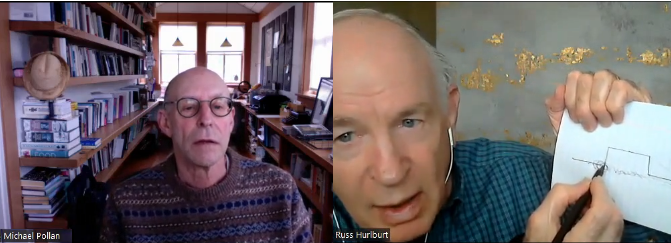
Michael Pollan is a six-time New York Times bestselling author of books such as How to Change your Mind and The Omnivore's Dilemma. A professor at both Harvard and the UC Berkeley Graduate School, Pollan was, at the time of this sampling, working on A World Appears: A Journey Into Consciousness. As part of that project, he interviewed Russ, and that led to his interest in trying descriptive experience sampling for himself; this is the result. Pollan writes about this in A World Appears (pp. 134-149).
This is a fairly typical first sampling day—there was considerable discussion about what is experience, differentiating experience from context, limiting ourselves to the moment interrupted by the beep, and so on. ...
In general—sampling day 1: All DES interviews are some combination of iterative training (so that future sampling days can be more skillful) and description of experience. The aim of the first sampling interview (or the first several sampling interviews) is almost entirely iterative training. First-day sampling interviews appear to be inquiries into experience, but their fundamental aim is to facilitate discussions of how to apprehend inner experience with fidelity. DES recognizes that participants on their first sampling day are not skillful, so DES routinely discards first-day descriptions.
Michael's samples:
Sample 1.1 [4:34; I'm standing in line at Cheeseboard.] I'm trying to decide whether to buy a new roll or use the heel of the bread that I have at home for a lunch sandwich. This apparently involves innerly seeing the roll and then the bread, but we are not confident. There are lots of other details: the smell of the cheese, the plaid pants of the woman in front of me, how close to stand to the people in the line (leftover Covid sensitivity), that the roll will be fresher but white flour, whereas the heel will be stale but whole grain. How much of that is in experience is hard to say.
Sample 1.2 [24:55; I'm sending an email to my sister Dana, answering her question about my pants size.] I've looked out the window past a photo of my father, taken at Thanksgiving a few months before he died. I'm thinking how good/healthy he looks (he died a few months later). I'm thinking that the beep is going to come right now. It's hard to say what of that is in experience at the moment of the beep.
Sample 1.3 [38:35; At computer typing an email.] As I type I innerly hear the words I am typing "no wonder neither of us k___" [the beep hits at the beginning of the word, which would be "know"]. But we are not confident about how or whether the inner hearing is taking place.
Sample 1.4 [52:59; Rereading the email, about to press Send.] I have reread it from her point of view, trying to figure out whether it has the right tone, etc. I apparently have found it satisfactory, so I'm ready to send it. I'm not sure whether this experience is more about my readiness or still looking at it from her point of view.
Selected commentary:
[13:15]: Russ explains that his questions about the visual imagery are not based on accepting it as the central feature of the experience. Instead, he is using the discussion as practice to help Michael develop better descriptive skills for future sampling and to test whether the visual aspect is genuinely salient.
[15:44]: Russ notes that when Michael responds to questions about inner imagery by describing real-world properties of the roll, it suggests uncertainty about the experience itself, which is common during first-day sampling interviews.
[16:58]: Russ observes that although he remains skeptical about the certainty of Michael's reported inner seeing, he deliberately avoids challenging it directly. The goal is to model the kinds of questions that help refine experiential descriptions over time.
[21:04]: Russ explains that the purpose of the discussion about the awkwardly cut bread is less about obtaining a definitive answer and more about practicing distinctions that may later improve the precision of experiential descriptions.
[23:02]: Russ states that Michael is engaging appropriately with the important questions about sensory awareness and simultaneity without prematurely assuming answers, which is the intended aim of DES sampling.
[38:24]: Russ clarifies that DES is not primarily an attempt to infer a participant's experience from ambiguous reports. Instead, it aims to help participants become better at apprehending and describing their own experience with increasing fidelity over time. He notes that Michael's descriptions of anticipating the beep remain ambiguous, but rather than resolving those ambiguities directly, the process is intended to cultivate Michael's future skill in recognizing and articulating such distinctions independently.
[43:51]: Russ remarks that recreating an experience on demand is risky because the recreated experience may differ from the original naturally occurring one. Since this is the first sampling day, he chooses not to emphasize that concern.
[49:05]: Russ identifies several assumptions in Michael's comments about reading, writing, and hearing words internally. He explains that DES attempts to "bracket" such presuppositions by suspending assumptions about how experience works so future experiences can be examined more openly.
[49:51]: Russ explains that one way to encourage bracketing presuppositions is to introduce counterexamples and provoke curiosity about alternative possibilities.
[50:47]: Russ observes that Michael responds to attempts at bracketing by elaborating further on his assumptions. He notes that this is typical because presuppositions tend to feel self-evidently true and therefore naturally invite further elaboration.
[51:09]: Russ explains that his previous comments were intended as a continuation of the effort to encourage bracketing of presuppositions rather than to steer Michael toward predetermined conclusions.
[1:02:29]: Russ notes that the remainder of the conversation involves scheduling their next meeting.
Samples are from two days ago. DES prefers "fresh beeps," because of the problematics of memory issues in "stale" samples. Therefore everything about this day's samples should be understood with a veil of skepticism. ...
In general—sampling day 2: All DES interviews are some combination of iterative training (so that future sampling days can be more skillful) and description of experience. The aim of the first sampling interview (or the first several sampling interviews) is almost entirely iterative training. First-day sampling interviews appear to be inquiries into experience, but their fundamental aim is to facilitate discussions of how to do DES more skillfully. DES recognizes that participants on their first sampling day are not skillful, so DES routinely discards first-day descriptions.
Michael's samples:
Sample 2.1 [2:08; Michael's wife Judith is reading her book, Michael is beside her reading his book. Judith has started to read him aloud a sentence, presumably because he might find it interesting. At the moment of the beep, Michael is wondering Why? (is she reading this to me), perhaps with a bit of annoyance. It is not clear whether the word "why" is or is not present. It is apparently cognitive, but RTH is skeptical. Michael's account is subjunctified and inconsistent, perhaps because the sample took place two days ago.
Sample 2.2 [7:30; Michael and his wife are on the couch reading their books. Michael is reading To the Lighthouse by Virginia Woolf, reading a very long sentence.] At the moment of the beep he has come across the word "sop" and is having some sort of Huh reaction that that word seems somehow out of place in the flow of the rest of the sentence. This reaction seems something like precognitive, [but RTH has some skepticism arising from the fact that the beeps are stale].
Sample 2.3 [14:55; Michael is looking out the window and] wondering what he would be thinking if the beep went off right then. RTH is not sure whether this thinking is in words, and if so whether the words are innerly heard, spoken, or implied. There is also the possibility that something of the live oak scene is in Michael's experience, but we don't become confident about that. [There is a longish discussion about fresh beeps and the difference between hearing and speaking.]
Sample 2.4 [36:23; Michael is meditating, and a worrisome recollection of a heart palpitation from last night arises.] Michael either imaginarily feels the heart palpitation sensations, or he recalls cognitively what the characteristics of those palpitations were. [We were not able to sort out that distinction—we spent a fair amount of iterative-training time discussing this.] Michael was worried about this palpitation; worry was apparently emotional (but was not described more than that).
Sample 2.5 [53:10; Michael is opening his phone to call his 94-year-old mother who has been to a doctor's appointment. As he opens the phone, he sees some texts from his siblings who have been involved with the visit.] He thinks, "Better look at these texts first," (or perhaps just "Better look"; or perhaps a reaction without words—RTH is never confident the Michael grasps the distinction.)
Selected commentary:
[4:34]: Russ explains that Michael's account of his confusion about the sentence could correspond to several distinct experiential possibilities, including inner speech, unsymbolized thought, bodily reaction, or emotional feeling. Because the beep is two days old, Russ doubts such distinctions can now be reliably disentangled, but continues the discussion as practice for improving future sampling.
[5:33]: Russ observes that Michael's heavily qualified and hypothetical language suggests he is not recalling a clear momentary experience but instead offering a generalized account of what would normally happen in such a situation. Russ notes that this may result from stale beeps, unclear experience, misunderstanding of the question, or other factors.
[6:41]: Russ remains skeptical of Michael's confidence about the nature of the experience because the account mixes certainty with earlier ambiguity and qualification. He argues that respecting the report requires acknowledging both the confidence and the uncertainty rather than pretending clarity where there may be none.
[8:23]: Russ interrupts Michael's reading of the Woolf sentence because reproducing the sentence during the interview could create a new experience that contaminates recollection of the original moment. He explains that the goal is to get as directly as possible to the remembered experience itself.
[18:41]: Russ explains that Michael's varying descriptions of his inner question suggest the recollection lacks the clarity expected if the verbal experience were directly apprehended and recalled precisely. Russ frames the discussion as training for future sampling rather than criticism, with the aim of helping Michael eventually distinguish such experiential details more clearly.
[18:53]: Russ notes that Michael's reliance on what he wrote in his notes rather than on direct recollection suggests he cannot clearly recall the original experience itself. Russ attributes this ambiguity potentially to stale beeps, unclear experience, memory limitations, or undeveloped vocabulary distinctions.
[19:56]: Russ explains that the discussion of full versus truncated inner sentences is intended to help Michael develop future sensitivity to such distinctions using Michael's own natural language rather than technical terminology.
[21:05]: Russ observes that although Michael speaks confidently about hearing an inner voice, his language also contains uncertainty and general theorizing about inner speech. Russ treats this ambiguity as an opportunity for further iterative training rather than resolving it prematurely.
[25:05]: Russ explains that the difficulty distinguishing hearing from speaking internally is compounded by stale beeps and by Michael's reliance on self-theories about how his inner speech typically works. Russ argues that DES requires bracketing such presuppositions and focusing only on the particular sampled moment. He also introduces the importance of fresher beeps, explaining that discussing Michael's own examples makes the issue concrete rather than abstract.
[40:29]: Russ notes a possible contradiction between Michael's apparent reluctance to describe re-experiencing bodily sensations and his earlier descriptions that seemed to imply vivid bodily re-experiencing. Russ suggests this may reflect tension between self-theories about memory and the actual sampled experience.
[43:58]: Russ explains that Michael's language suggests a tendency to collapse together two distinct possibilities: cognitively remembering a sensation versus imaginatively re-experiencing it in the body. Russ emphasizes the importance of helping Michael remain open to bodily imaginative experiences without pressuring him toward any particular conclusion.
[48:49]: Russ identifies Michael's continued use of the term "memory" for both cognitive recall and bodily re-experiencing as evidence of a persistent presupposition that there is no important distinction between them.
[49:02]: Russ concludes that the discussion has successfully clarified the distinction between bodily re-experiencing and purely cognitive memory, at least as far as possible within this round of interviews.
Repeatedly throughout the interview we discussed the issue of whether or to what degree the context or surround of a situation is directly apprehended.
The first three samples are from today; the next two are from yesterday. We continue the discussion of the difficulty in distinguishing between description of phenomena and context. ...
In general—sampling day 3: All DES interviews are some combination of iterative training (so that future sampling days can be more skillful) and description of experience. The aim of the third sampling interview is a combination of experience description and iterative training.
Michael's samples:
Sample 3.1 [1:16; I had just received a text that indicates that my 94 year old mother thinks I am coming to visit next week, which is not true, and which I take to be a sign of her dementia.] I feel sadness and frustration [we spend a long time trying to sort through how this is experienced, without making much progress.] I'm also typing a reply that says the info is wrong—I am coming next month [but is it not clear how or whether this is directly experienced.]
Sample 3.2 [21:36; A few minutes before, I had put in a call to my mother, which hadn't gone through. I had left a message. Now, at the moment of the beep, my phone is vibrating and I see her name in the From window. I'm in a rush to answer it, and I don't have the bandwidth both to answer it and to attend to my experience. So we skip this beep.]
Sample 3.3 [22:36; Just beginning my day at work; I've had coffee, I'm opening the folder that has yesterday's drafts; my first task will be to edit/clean/revise that work.] I read the first sentence, which is "What was I thinking?" [This is apparently a taking in of the sentence without articulating it in any way.] I have a sense of trepidation / anticipation [we spend a long time trying to sort through how this is experienced, without making much progress. Perhaps it is mental; perhaps it is just what I always feel when I open the folder at the beginning of the day].
Sample 3.4 [40:48; I'm in the kitchen preparing a fish for dinner. I've salted it and I'm on the way to the refrigerator.] At the moment of the beep I innerly say "Pepper!" in my own exclamatory voice. [I have forgotten to pepper the fish.]
Sample 3.5 [1:00:36; I'm reading a dry linguistics text about awareness of your body in space, but I have left that reading behind to re-experience an uncomfortable scene from 15 years ago, where I had been the moderator of a panel, and a person had just arrived who I wasn't prepared for—no chair, no introductory text, etc.] At the moment of the beep I innerly see a stage with people milling around and a horseshoe of chairs. The seen stage is dark wood [I think the actual stage was more modern]. I feel a shiver of embarrassment (but it is not clear whether the shiver is directly apprehended or presumed to be a characteristic of embarrassment).
Selected commentary:
[2:11]: Russ notes that Michael's descriptions mix direct accounts of feeling with extensive contextual explanation. He identifies the references to sadness and frustration as the actual experiential content, while most of the remaining discussion provides background and narrative context.
[3:29]: Russ remarks that after a contextual digression, Michael returns to a straightforward description of feeling, which Russ views positively.
[3:39]: Russ observes that it might have been more useful to focus immediately on the emotional experience itself rather than detouring into the mechanics of typing.
[6:26]: Russ points out that when asked how the sadness feels, Michael instead provides background information about his mother's decline and the surrounding circumstances rather than describing the experiential qualities of sadness itself.
[6:59]: Russ notes that Michael's comments about being "filled with sadness" may either describe an actual feeling or reflect a generalized self-theory about how such situations normally affect him, while the rest of the discussion remains contextual.
[7:25]: Russ distinguishes between contextual narrative and experiential description, identifying the references to sadness and frustration as possible descriptions of feeling while treating most of the remaining remarks as explanatory background.
[8:41]: Russ explains that his questions serve both to investigate the original sampled experience and to train Michael for future sampling by helping him discriminate between direct experience and contextual explanation.
[9:10]: Russ observes that Michael continues responding primarily in terms of situational context and causes rather than describing the felt quality of sadness itself.
[9:20]: Russ attempts to redirect attention toward the experiential character of sadness rather than its causes or narrative background.
[9:40]: Russ notes that Michael frames bodily feelings as consequences of emotional intensity, which introduces ambiguity about whether the bodily descriptions are direct reports of experience or theoretical explanations of how feelings generally work.
[9:52]: Russ explains that Michael's description of sadness "taking his breath away" remains framed as a classification of a type of feeling rather than a concrete description of the specific experience at the sampled moment.
[11:44]: Russ observes that Michael again explains the bodily quality of sadness in terms of suddenness and situational factors, reinforcing a theoretical account rather than describing the immediate experience itself.
[11:44]: Russ notes that Michael's account of the feeling as a "surge" may similarly reflect an explanatory theory about how emotionally charged situations produce stronger feelings rather than a direct experiential report.
[14:34]: Russ comments that Michael increasingly explains and theorizes about his emotions instead of describing the feelings phenomenologically. He notes Michael's own recognition that separating experience from explanatory context is difficult.
[15:30]: Russ observes that although Michael is articulate and motivated, he still struggles to describe the actual experience of sadness directly, instead describing what caused it or what it was not.
[16:48]: Russ notes that when asked to describe frustration itself, Michael again responds primarily with contextual explanation rather than describing how frustration experientially presents itself.
[20:41]: Russ explains that the discussion about bodily sensations accompanying sadness is intended less to clarify the original beep than to train Michael for future sampling by sharpening distinctions between bodily experience, feeling, and explanatory interpretation.
[22:32]: Russ agrees to skip a sample because the experience was too time-pressured and attentionally absorbed to be captured effectively by the beeper method.
[24:28]: Russ proposes an exercise focused on separating context from experience, encouraging Michael to describe only the directly apprehended experience while assuming the contextual background is already understood.
[25:07]: Russ deliberately interrupts Michael to keep the focus on experience itself rather than explanatory context, using the exchange as iterative training in distinguishing the two.
[26:18]: Russ notes that Michael continues to emphasize contextual explanation rather than experiential description, leaving open whether this reflects a genuine feature of Michael's experience or simply a conversational habit.
[28:39]: Russ remarks that Michael again supplies contextual explanation instead of describing the felt quality of trepidation itself, suggesting that the feeling may lack further describable features.
[29:32]: Russ characterizes Michael's explanation of trepidation as a self-theory about how thoughts condense into emotion rather than a direct description of what was experienced at the moment of the beep.
[30:37]: Russ continues probing for concrete experiential features of the trepidation, specifically whether it had bodily qualities, partly because Michael may be overlooking them.
[30:51]: Russ notes that Michael again explains the bodily feeling in theoretical physiological terms rather than describing the actual experience phenomenologically.
[40:44]: Russ reflects that the interview has become difficult because Michael often answers questions about experience with context, theory, or explanation. Russ emphasizes that this is not criticism but part of the iterative DES process, which may gradually clarify whether the difficulty reflects Michael's experience, the method, or the interview dynamics.
[44:08]: Russ observes that the "pepper" sample is notably clearer and easier to describe than earlier emotional samples. Although there is some ambiguity about whether the word carried a question mark or exclamation point, the experience appears to involve directly apprehended inner speaking.
[46:46]: Russ explains that although Michael's bodily motion toward the refrigerator was unquestionably occurring, the DES question is whether that motion was directly experienced or simply functioning automatically in the background while attention was occupied by the inner exclamation "pepper!"
[49:14]: Russ notes that DES seeks to distinguish between physical facts and what is directly apprehended experientially. He suspects the bodily movement itself was not clearly present in experience, but avoids asserting that directly, preferring instead to cultivate Michael's future ability to discriminate between experience and context.
[55:17]: Russ explains that the extended discussion about bodily movement in the "pepper" sample is intended mainly as iterative training for future sampling rather than as an attempt to recover the exact original experience from the previous day.
[57:11]: Russ notes that Michael continues to find it difficult to bracket contextual bodily facts away from direct experiential content, illustrating the challenge of separating context from experience.
Michael collected 6 samples yesterday and six today; he suggested discussing today's samples as being fresher. We did so. We continue the discussion of the distinction between description and context....
Michael's samples:
Sample 4.1 [4:08; I'm meditating, and my mind has wandered to an article I'm writing about some scientists, and both the scientists and the editor are being slow to do what needs to be done.] At the moment of the beep I am thinking about what to say in an email to Tony, one of the scientists, about how to hurry him up, to be professional but vaguely threatening. This is a thought-y experience without words. Simultaneously I feel annoyed and irritated, which may involve a bodily warmth and tightening. [RTH is skeptical about all these aspects, as he is not convinced that we are adequately discriminating directly apprehended experience from self-theory and context.]
Sample 4.2 [19:05; Walking with wife to get coffee] Speaking aloud to wife "When I was walking yesterday...," (the beginning of a telling about recalling what it was like to walk during Covid—streets were empty, Covid hadn't affected the trees and flowers, etc.). [I know what I am talking about, but it apparently isn't directly present at the moment of the beep.]
Sample 4.3 [49:05; I'm getting into my car and see the workmen digging the stump out of a neighbor's yard.] At the moment of the beep I think am I gonna have to listen to this all day? [We have a substantial conversation about how this thinking is present.]
Selected commentary:
[7:50]: Russ explains that his questioning is intended as training in distinguishing direct experience from contextual explanation. He frames the conversation as an exercise in separating what is actually experienced from the broader situational background.
[10:18]: Russ notes that if Michael is accurately distinguishing experience from context, the "pre-verbal" strategizing about what to tell Tony would qualify as what DES calls cognitive awareness: apprehended thinking without explicit verbal content. However, Russ remains uncertain because of the ongoing difficulty separating experiential description from contextual characterization.
[11:23]: Russ interprets Michael's comments about leaving the meditative state and clenching up as a self-theory about how meditation and tension normally relate, rather than necessarily a direct description of the sampled moment.
[11:54]: Russ questions whether Michael's reported sensation of warmth reflects an actual recollection of the sampled experience or a theoretical expectation that leaving a meditative state should produce bodily warmth.
[12:29]: Russ explains that his discussion of bodily feelings is primarily intended as iterative training for future sampling. He emphasizes that DES does not privilege bodily feelings over nonbodily feelings and that either type of experience is equally legitimate.
[14:02]: Russ interprets Michael's remarks about contraction and expansion during meditation as another example of self-theory shaping the account of experience.
[14:36]: Russ notes that Michael's inability to specify where the bodily tension occurred makes him suspect the "bodily" characterization may be more theoretical than directly experiential. He observes that Michael did not originally record clear bodily details immediately after the beep, which suggests the bodily interpretation may be inferred rather than directly apprehended.
[15:00]: Russ explains that the discussion about whether frustration was bodily is intended as iterative training for future samples by clarifying distinctions between clearly bodily, vaguely bodily, and nonbodily experiences.
[19:05]: Russ comments that although Michael clearly describes speaking aloud about the COVID walks, the account does not yet specify what was actually directly experienced at the moment of the beep or how the remembered material was experientially present.
[24:45]: Russ agrees that "March 2020" functions as shorthand for a broader set of associations and memories, but notes that they still have not clarified how much of that broader material was directly before the "footlights of consciousness."
[26:50]: Russ notes that future discussions will need to distinguish carefully between what is directly experienced, what is only vaguely sensed, and what is merely being described metaphorically or contextually.
[29:08]: Russ highlights the distinction between material that directly appears in consciousness and material that merely informs or shapes the experience without itself being directly apprehended.
[33:52]: Russ explains that he is repeatedly trying to clarify the distinction between experiences that are directly apprehended and contextual or implied material that merely shapes the moment from the background.
[35:27]: Russ notes that Michael claims the "second packet" of words about the COVID walks is "really clear," which raises the question of whether the words themselves were directly apprehended or whether only a conceptual gist was present.
[36:08]: Russ points out that Michael's varying formulations of the future sentence raise unresolved questions about whether directly apprehended words were present at the moment of the beep or whether there was instead a conceptual structure implying later speech. Russ emphasizes that he has no preference for one interpretation over another but wants clarity about what Michael actually means.
[36:25]: Russ observes that the conversation has shifted from the issue of whether words were present at all to whether the inner speech involved complete or incomplete sentences, indicating another distinction they still need to sort out.
[37:14]: Russ summarizes four possibilities they are trying to discriminate: no direct awareness of future content, direct awareness of content without words, direct awareness of partial words, or direct awareness of complete future sentences. He emphasizes that despite both participants being intelligent and articulate, they still have not figured out how to distinguish these possibilities clearly.
[41:57]: Russ acknowledges that context always shapes directly apprehended experience but insists on distinguishing the contextual background from whatever is directly present before consciousness. He illustrates this with hypothetical examples involving visual imagery and sensory focus during the COVID-walk recollection.
[43:43]: Russ reiterates his attempt to distinguish between what is directly apprehended and what merely shapes or guides experience from the background.
[46:41]: Russ notes that Michael's formulation—that some aspects of the experience directly appeared while others merely "suffused" the moment—is precisely the distinction Russ hopes DES can clarify.
[48:27]: Russ includes a later email exchange in which William James's idea of thoughts being "suffused with the whole idea" is used to clarify the distinction between directly apprehended experience and contextual implications. Russ explains that context always matters but should remain distinct from whatever is directly apprehended.
[51:17]: Russ observes that Michael's account of the tree-grinding annoyance is internally inconsistent because Michael both claims there were words present and also describes the experience as "preverbal." Russ sees this as evidence that they still have not figured out how to separate directly apprehended experience from implied or theoretical interpretation.
[52:35]: Russ points out that Michael's descriptions of the annoyance involve three different sets of words across the conversation, suggesting continuing difficulty identifying what words, if any, were directly apprehended at the moment of the beep.
[54:14]: Russ explains that his goal is not to infer or "mind read" Michael's experience but to help Michael become interested in and capable of describing his experience clearly enough that mutual understanding becomes possible without interpretation.
[55:09]: Russ praises Michael's recognition that converting thoughts into organized language may distort the original experience. He identifies this as one of the most important insights about DES and about attempts to describe inner experience generally.
The first five samples are from today; the remaining are from yesterday. It is remarkable that Michael, after many discussions across the four previous sampling days, still mixes together context and directly apprehended experience....
Michael's samples:
Sample 5.1 [0:56; During morning meditation, Michael's mind has wandered to his upcoming schedule, in particular, to his 4:00pm scheduled walk with his friend. It has been raining, and Michael contemplates where to walk, considering trails that will be muddy, wet, etc. This contemplation has included an inner seeing of a muddy trail, and a subsequent inner seeing of an asphalt trail, viewed from an impossible perspective from the side.] At the moment of the beep Michael thinks, without words or visual imagery, we should go to Inspiration Point.
Sample 5.2 [10:13; Walking with Judith, who is talking about buying cushions for dining room chairs.] I say aloud (in experience) "with some foam in them, so they give some lift." Simultaneously I feel in my imagination some bodily sense of the slumping deflation of sitting in a chair that's too low. (We try to be specific about the characteristics of that feeling, but the conversation is pretty discursive.)
Sample 5.3 [23:20; I was at my computer and had just looked at my gmail to-do list, seeing that a transcript had arrived.] I think, not in words or pictures, I should really edit that transcript.
Sample 5.4 [28:55; I am reheating coffee in the microwave] As I head for the pantry, I experience (without voice or picture) the word "snack" (which may have a somewhat disapproving tone, although RTH wondered whether that was inserted during the discussion rather than at the moment of the beep).
Sample 5.5 [41:47; a sample from yesterday. I'm stepping outside to take a walk with Judith. She's already outside. I don't know exactly where she is.] At the moment of the beep I'm surprised to find her coming toward me from the right, where our front door is. She has an armload of mail and a package from Amazon. I'm perplexed, just the experience like a question mark.
Sample 5.6 [47:02; I'm editing a paper, trying to decide whether to cut the clause "we're constantly translating our thoughts into words."] At the moment of the beep I experience a binary analytical process, that could be expressed as cut /not cut, but there are no words (including "cut"). (I'm not sure whether the words of the clause are present at the moment of the beep.)
Sample 5.7 [55:26; not discussed] Like 5.6, making a binary decision about whether to clean up the grammar of a transcript.
Sample 5.8 [56:04; Michael is moving a piece of toast, which he has just buttered, from the cutting board to a plate.] He feels hotness in his fingers (from the crust) and a (apparently cognitive) sense of surprise [that the toast would still be that hot].
Selected commentary:
[4:44]: Russ notes that the visual image of the paved trail occurred before the beep rather than at the precise moment of the beep, so he treats it as contextual rather than part of the directly apprehended sampled experience. He also remarks that visual imagery often occurs from impossible or unfamiliar perspectives rather than replaying actual perception.
[5:50]: Russ identifies Michael's arriving at the conclusion to go to Inspiration Point without words as an example of what DES calls unsymbolized thinking.
[6:10]: Russ observes that Michael's explanation that familiar concepts do not require words is a self-theory about how experience works rather than a description of the specific sampled moment, and therefore chooses not to pursue it further.
[7:15]: Russ emphasizes that the earlier deliberations about rain, muddy trails, and alternatives occurred before the beep and therefore count as context rather than the directly apprehended experience at the sampled instant. He reflects that even after several sampling days Michael still tends to mix contextual material into descriptions of immediate experience. Russ speculates about possible explanations, including age-related cognitive habits, presuppositions, or the structure of the DES process itself.
[10:13]: Russ notes that Michael's report of imaginarily feeling the too-low chair may indeed describe an experiential bodily sensation, but he remains uncertain because Michael also introduces contextual analogies, explanations, and theoretical material that may not have been directly present at the moment of the beep.
[18:36]: Russ explains that Michael could have directly described an imaginal bodily sensation but instead moved into discussions of arms, children's awkwardness, and explanatory theories such as mirror neurons. Russ remains uncertain whether these additional elements were actually part of the original experience or whether they emerged later through contextual elaboration.
[23:18]: Russ comments that all experience necessarily depends on bodily processes, but that does not mean the experience itself is directly apprehended as bodily sensation. He distinguishes between bodily mechanisms and the phenomenology of experience.
[47:02]: Russ explains that DES generally discourages participants from selecting which samples to discuss because selective reporting undermines the randomness of the process and encourages theoretical reflection rather than careful phenomenological description.
[55:09]: Russ highlights Michael's recognition that translating experience into organized language may distort the original experience. Russ sees this as a central issue for DES and for all attempts to describe inner experience: once experience is converted into language, it may falsely appear as though it had originally existed in linguistic form.
[59:36]: Russ explains that Michael's toast example illustrates the distinction between directly apprehended experience and later explanatory elaboration. At the moment of the beep there was simply surprise, while the later reasoning about why the toast remained hot emerged only afterward as explanatory context.
This project arose as the result of Michael's writing a book about consciousness. This interview is the debrief about what we found, as well as asking some factual questions necessary for the book editing. It is discursive, so here is a very rough outline....
Topics (loosely defined:
Part 1: [0:49] About RTH's history
Part 2: [5:26[ The current status and critiques of DES (comparing DES to other sampling methods, questionnaires, etc.; limitations of DES; inner speech)
Part 3: [13:01] Has RTH has worn the beeper himself? (Advantages and disadvantages)
Part 4: [21:35] Why is DES difficult? (DES vs. AI; how to know whether DES interviewer is skilled; William James)
Part 5: [33:50] Questions about moments (and more William James)
Part 5: [39:36] Questions about fMRI studies
Part 6: [45:11] Questions about people who do not have inner experience (Is age a factor? Does Michael have inner experience? About unsymbolized thinking)
Part 7: [1:03:18] Did we get the essential Michael? (More about age.)
Part 7: [1:11:21] What about your bulimia studies?
Part 8: [1:17:18] Shall we put these interviews on the web?
Selected commentary:
[0:46]: Russ explains that the debrief interview is intentionally unstructured and discursive. He later inserted headings into the transcript to make navigating the topics easier.
[6:51]: Russ clarifies that modern experience-sampling methods usually rely on questionnaires delivered through apps rather than live spoken questions over the phone, correcting his initial misunderstanding of Michael's question.
[10:23]: Russ corrects himself, noting that he misspoke when discussing the prevalence of inner speech. He meant that approximately 20—30% of samples, not people, involve experiences that resemble inner speech.
[17:17]: Russ acknowledges that he repeatedly misspoke by referring to "inner speech" when he actually meant "inner experience" more broadly while discussing developmental issues.
[45:22]: Russ again notes that he accidentally referred to "inner speech" when he intended to discuss "inner experience" generally in relation to children and development.
[56:45]: Russ clarifies that unsymbolized thinking, as he defines it, refers specifically to directly apprehended thinking occurring before the "footlights of consciousness." It is not merely implied cognition or inferred background processing.
Best-selling author Michael Lewis (Moneyball, The Big Short, Liar's Poker) interviewed Pollan about A World Appears at the New Orleans Book Festival (videorecording by C-SPAN). Ten minutes of that interview concerned DES. Some of their conversation misunderstood DES in important ways, which provides me the opportunity to clarify. I present a Book Festival transcript, inserting comments that explain the misundertanding and why it is important....
The video is here; the DES portion starts at 35:42. The transcript with explanation is here.

 You can find Pollan's book