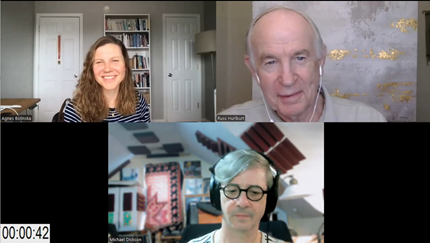
Part XVII: Agnes Bolinska—A philosopher of science (with DES workshop on day 3)
Agnes Bolinska1, Michael Dickson1, and Russell T. Hurlburt2 1 University of South Carolina2 University of Nevada, Las Vegas
Agnes Bolinska is a philosopher of science at the University of South Carolina. Her current research focuses on contemplative science, the study of how meditation and other contemplative practices shape experience, affect the brain, and influence health and well-being. She is interested in DES as a rigorous method for investigating lived experience, helping to answer central questions in contemplative science about the effects of contemplative practice....
Agnes and Michael Dickson organized a workshop at the University of South Carolina that included a demonstration of DES; that demonstration is Interview 3 here.
The interviews were conducted by Russ Hurlburt and Michael Dickson (and other workshop participants particularly on day 3).
This is Agnes's first sampling day. All DES interviews are some combination of iterative training (so that future sampling days can be more skillful) and description of experience. The aim of the first sampling interview is a combination of experience description and iterative training, mostly iterative training....
Agnes collected eight samples, four from yesterday and four from today. As usual in DES, we started with today's samples.
These are first-day samples, so descriptions should be viewed with substantial skepticism. Mostly, these samples were used as iterative training for future sampling.
Agnes's samples:
Sample 1.5 [8:35]: [I was meditating with eyes closed. I happened to open my eyes] and am perhaps seeing the room around me. The prominent part of my experience is that I am considering a presentation that I am about to give to my department colleagues, and am innerly saying "solicit feedback via email," as if I might say that to them. I experience that as speaking in my natural voice.
Sample 1.6 [26.27]: [I am writing some notes in preparation for the meeting of sample 1.5. I had just written (the moment before the moment of the beep) "we will now have an embedded MA." On the next line I had just written, "So ideally,"] and was pausing, thinking something like how am I gonna frame this? I perhaps am still seeing "So ideally."
Sample 1.7 [41:15]: [Before the beep I had read on my computer "A variety of issues arise about how to characterize those contexts..." The sentence continues,] and at the moment of the beep I was reading "…and what determines them," innerly speaking those words in my own voice. [Then or at the same time I softened my gaze and my eyeballs moved toward the bottom left of the computer screen in something like] a pause of focus (but whether that was experienced is hard to say). [Also I had just looked at my watch and had seen that it was about 7:00 AM, and] in the moment I have a vague sense that it's time to go outside (somehow understood without words, imagery, or other symbols).
[52:27]: 1.8 [I was eating breakfast granola and thinking about when to go to the office and about the wearing of the beeper. It is not clear how much of that is context or experienced.] At the moment of the beep the word "calibrate" (or perhaps "I'm going to have to calibrate") seemed somehow present (but not spoken, heard, seen, or otherwise sensed). [The context was something about describing or attending to the beeps.]
Selected commentary:
[0:00]: Russ clarifies that his inserted comments are provisional, interpretive, and open to disagreement or revision.
[4:04]: Russ notes Agnes is an unusual participant due to prior DES experience as an interviewer, which may shape her current experience.
[8:35]: Russ flags a possible presupposition about visual experience (eyes open = seeing), raising a methodological concern to explore later.
[9:50]: Russ explicitly begins investigating the earlier-noted visual-field presupposition.
[16:23]: Russ explains the iterative nature of DES—current discussions aim to improve future sampling rather than fully capture past experience.
[20:33]: Russ clarifies that "figuring out" experience means achieving clarity without interpretation or analysis, or recognizing limits to that clarity.
[22:57]: Russ critiques multiple-choice questioning as potentially encouraging analysis rather than direct apprehension of experience.
[24:25]: Russ emphasizes that uncertainty ("I'm not sure") is a desirable outcome on the first sampling day, indicating productive iteration.
[25:12]: Russ contrasts two interviewing aims: understanding reported experience vs. improving the participant's ability to apprehend experience.
[32:42]: Russ outlines two core DES skills: cleaving to experience (direct apprehension) and cleaving to the moment (the instant of the beep).
[37:20]: Russ reiterates that first-day responses are primarily training exercises aimed at improving future discrimination of experience.
[44:39]: Russ explains the broader methodological context: these sessions are preparatory for a later workshop demonstration.
[47:38]: Russ notes that asking about "unfocusedness" risks shifting into meta-experience rather than direct experience.
In general—sampling day 2: All DES interviews are some combination of iterative training (so that future sampling days can be more skillful) and description of experience. The aim of the second sampling interview is a combination of experience description and iterative training.
Agnes's samples:
Sample 2.1 [0:43]: [At computer working on paper. I had typed "Wallace: Sa", which would have completed as "Wallace: Samatha" but I wasn't there yet. I had turned away from the screen to look at a book, and now had returned to seeing screen.] I see "Wallace: Sa" as the center of my visual focus, seeing the rest of the screen with less interest or focus (but not seen as blurry). Simultaneously I innerly say "Wallace: Sa" (in my own naturally inflected, matter-of-fact voice).
Sample 2.2 [10:20]: [I was at my computer reading a paper, which included a quote that I had highlighted: "A person who may not even have been trained, um, to become aware of his or her subjective experience and describe it with great precision." Petitmengin 2006. Before the beep, I had read that quotation in my own natural inner voice.] At the moment of the beep I see the see the Petitmengin 2006 (see it without innerly saying it) and perhaps also (RTH isn't sure) sees the entire quoted text, including its highlighting. (That is, it is possible that there are two simultaneous seeings (one of Petitmengin 2006 and one of the entire highlight passage) or that there is one seeing of the highlighted passage, which includes the Petitmengin 2006 portion.)
Sample 2.3 [28:08]: [I am reading a paper and had just highlighted a sentence ("an interaction with a stimulus creates an object form in the subsequent moment, which is non-conceptual awareness. And then under the right conditions, a conceptualization of the object form is constructed.") I hadn't yet understood that sentence.] At the moment of the beep I am either in a state of nothingness (where I am not yet absorbing that sentence); or I am in a state of mild confusion (because I haven't understood the passage); or I am in a mode of what-to-do-next (go back and read it again, continue on, etc.) without recognizing how that was present to me. [Basically I am unsure of what was directly apprehended at this moment.]
Sample 2.4 [42:36]: [I am sitting outside having breakfast. I have been a bit concerned because the beep hasn't sounded in a while, and I had been thoughts along the lines of if the beeper went off now, how would I describe my experience like that?] At the moment of the beep it is not clear what if anything is in my experience. Maybe (Russ is skeptical) I was seeing the food. Maybe there is a low level agitation about what to report if it beeps.
Selected commentary:
[0:00]: Russ explains that his comments are provisional reflections meant to invite disagreement and refinement, not authoritative truths.
[2:51]: Russ observes that Agnes's description is heavily "subjunctified," suggesting uncertainty and hedging in her report.
[4:01]: Russ contrasts Agnes's earlier uncertainty with her later confident, declarative statement, noting sensitivity to shifts in her expressed certainty.
[4:21]: Russ highlights Agnes's confident report of inner speaking, noting the absence of subjunctifiers as evidence of experiential clarity.
[6:29]: Russ provides context about Michael's prior sampling experience, explaining differences in how individuals experience inner speaking.
[8:33]: Russ argues that distinguishing speaking vs. hearing is fundamentally difficult and tied to experiential learning rather than simple introspection.
[9:22]: Russ suggests Agnes's inability to elaborate ("that's just how it is") may indicate a reliable experiential distinction rather than confusion.
[16:07]: Russ criticizes asking about pre-beep experience, warning it encourages speculation and undermines the DES method's focus.
[16:58]: Russ challenges the assumption that looking is necessary for reading, emphasizing that experiential reports need not follow physical-world rules.
[17:18]: Russ interprets Agnes's uncertainty as caused by being asked about unattended aspects of experience, leading to speculative answers.
[18:41]: Russ cautions that plausible or typical accounts of reading may not reflect actual experience, emphasizing the danger of "reasonable" reconstructions.
[19:19]: Russ approves Agnes's admission of uncertainty as aligning properly with her experiential limits.
[28:08]: Russ critiques the phrase "moment before the beep," arguing it is vague and emphasizing precise focus on the sampled moment.
[42:00]: Russ notes that Agnes's earlier clear report shows her difficulty is not general but specific to certain kinds of experiences.
[45:00]: Russ warns against over-interpreting Agnes's tentative report of visual experience, emphasizing her overall uncertainty.
[45:20]: Russ argues Agnes's claim about seeing food is likely inferential rather than directly apprehended, distinguishing inference from experience.
[49:18]: Russ emphasizes that "plausible" or "reasonable" accounts are enemies of directly apprehended experience in DES methodology.
[52:00]: Russ strongly distinguishes between what is actually experienced and what is merely plausible, advocating preference for "I don't know" over speculation.
[55:58]: Russ clarifies that the goal of DES is not for researchers to learn about experience directly, but to help participants accurately apprehend and report it.
[54:04]: Russ articulates that all responses—including uncertainty or "nothing"—must be equally acceptable to support accurate reporting.
The interview for Agnes's third sampling day was conducted live at the workshop. Russ led the interviewing...
with workshop participants encouraged to observe and participate in whatever way they wished.
Agnes had collected four samples from yesterday and two from today; we started with today's samples and discussed only those two.
Participants questioned Agnes about her experience, and also discussed the DES method and objections to it.
Agnes's samples (starting with those from today):
Sample 3.5 [12:47]: [It is early morning, and I am walking toward my kitchen counter and reaching for a glass on the counter.] I'm seeing (a visual experience) a section of my counter, the glass, and the open dishwasher. [A few moments before the beep I had been thinking should I empty the dishwasher now save that for later?] Now, there is some kind of remnant of that thought (I'm not thinking it, but that thought is also not absent from my experience). [I'm not sure whether the reaching for the glass is experienced or just happening.]
Sample 3.6 [59:47]: [I'm writing on my remarkable tablet some notes about what I was going to say at workshop later today. I had started a sentence and then written in parentheses "(and this is particularly important to me as a philosopher of science)" and had been thinking about what I was going to say next to finish the original sentence, but then I had become distracted by the parenthetical remark about me as a philosopher of science.] At the moment of the beep, there were two experiential tracks: I see the part that I had just written (seeing it as a meaningful string words but not reading them innerly); and at the same time my mind was blank, something like a passive anticipation of the thought that would come next—and in-between-thought-ness.
Selected commentary:
[0:00]: RTH frames his comments as provisional, open to revision, and invites disagreement and collaborative correction.
[9:12]: RTH acknowledges he did not answer a participant's question well and clarifies that people can often discriminate fine-grained aspects of experience (e.g., blueness vs. shirt-ness).
[12:47]: RTH praises Agnes for clearly distinguishing background/context from moment-of-the-beep experience—central to "cleaving" in DES.
[27:03]: RTH emphasizes that Agnes's linguistic indecision reflects genuine indeterminacy in her experience, not poor description; clarity in language follows clarity in experience.
[29:17]: RTH argues DES must be "first-person plural" because individuals have blind spots and assume others' experiences are like their own; collaboration helps correct both.
[34:40]: RTH adds that clearer experiences are less vulnerable to distortion from the beeper; sharply defined experiences are easier to report reliably.
[36:38]: RTH critiques a participant's focus on the word "remnant," arguing it ignores that Agnes used it in a hedged/undermined way; the inquiry should target experience, not isolated words.
[36:38]: RTH strongly rejects the imposition of affect onto Agnes's experience, arguing there is no evidence for it and that such claims risk turning the interview from discovery into validation.
[40:33]: RTH reiterates that DES should redirect attention to experience itself, not to the meanings of words used to describe it; word-focused questioning is methodologically misleading.
[40:33]: RTH invites correction if affect was genuinely present but warns that theoretical commitments (e.g., to affect) can bias interpretation.
Many of Agnes's experience are unsymbolized—she directly apprehends her experience but it is not in words, visual imagery, etc....
Occasionally Agnes does innerly speak, often while reading.
Agnes's samples:
Sample 4.3 [2:48]: [I'm outside with my computer on my lap, looking at a Google calendar, which is displaying the May 3 grade deadline. I'm 95% confident that one of my students has submitted the final paper using AI.] I am mulling what to do about this. I see the calendar square that shows the date by which I must submit grades (but I am not reading that—I just understand what it represents). I am somehow contemplating how this will affect my ability to turn in grades on time, what it will do to the student, how much work it is, the process, all those things but none of them specifically. This is more than as unconscious process—it is directly apprehended—but it is also not explicitly specifiable in its details.
Sample 4.4 [14:03]: [I am revising a paper to respond to referee's comments. I have inserted a new reference, and now I am seeing the sidebar that holds the headings of the paper.] I am seeing the heading "mindfulness-based stress reduction..." (including the rest of that heading, which I do not remember what it is), and I am innerly saying "mindfulness-based stress"; the beep happens at the word "stress" and I break off the speaking. It is not clear whether I am just saying this or whether I am reading what I am seeing. [Saying it vs. reading it is a distinction that I could not differentiate adequately, even though I tried just after the beep.]
Sample 4.5 [34:50]: [I'm reading the AI-suspected student's paper with an eye towards highlighting passages that seemed to me to be obviously AI.] I am innerly speaking as I am (as part of the) reading "making it difficult to maintain a clear connection." [Here, it is clear to me that I am reading that passage.] I also see the screen on which that passage is written—that seems to be part of the reading. [I am standing at my standup desk] and I feel my body weight shift forwards onto my toes and then backwards onto my heels. I feel that postural shifting both in my feet and throughout my body.
Sample 4.6 [44:27]: [I am about finished writing the report about AI use.] I feel a bodily movement away from the report (or perhaps I experience the intention to move away from the report as more a mental act (I can't really differentiate between a mental act and an incipient/inchoate/ slight bodily movement) and towards the Remarkable tablet (but, I notice on retrospect with somewhat surprise, I don't have anything to write on that tablet). (It seems that this is more of movement away from the AI report than a movement toward the tablet, but it is possible that I move towards the tablet as a way of escaping the AI report.) I also feel a bodily activation, at least in part (and perhaps large part) as my heart racing. I am also seeing the screen, the central box of the report, but I am not writing anything.
Sample 4.1 [56:54]: [I am trying to sell my mountain bike, the Internet, and I'm scrolling through the pictures that I have posted.] This is a mindless scrolling through pictures; I see without particular interest or attention the picture that is displayed.
Selected commentary:
[0:00]: Russ clarifies that his inserted comments are provisional, interpretive, and open to disagreement or revision.
[1:32]: Russ points forward to samples 4.4 and 4.5 as relevant to Agnes's concern about remembering pre-beep experience.
[11:06]: Russ notes that Agnes has slightly misinterpreted his point about "skillfulness," which will be clarified shortly.
[13:07]: Russ explains his agnosticism about links between inner experience and functional or personality traits, emphasizing lack of sufficient empirical grounding.
[17:32]: Russ reflects on Michael's question, noting a shift from "saying" to "reading," and flags this as something to monitor.
[19:52]: Russ approves of Michael's renewed attention to the saying vs. reading distinction as a genuine inquiry.
[21:08]: Russ highlights the productive indeterminacy between saying and reading as an accurate reflection of current understanding.
[22:59]: Russ clarifies that "Remarkable" refers to a digital tablet device.
[24:56]: Russ suggests that the key issue is not the specificity of the anticipated object, but Agnes's distinctive, context-rich way of anticipating.
[25:35]: Russ praises Agnes's effort to distinguish actual experience from inferred or contextual elements as high-quality reporting.
[30:33]: Russ describes the limits of descriptive precision ("in the weeds") without undermining the value of the overall descriptive enterprise.
[31:09]: Russ refines his earlier example to show that Agnes is confident about important experiential aspects even if some details remain uncertain.
[32:32]: Russ connects the value of individual experiential understanding to a Kierkegaardian perspective emphasizing depth over breadth of impact.
[40:46]: Russ endorses Agnes's uncertainty about whether AI-evaluation intent was present at the moment of the beep as an excellent, appropriate response.
[42:31]: Russ acknowledges that his earlier "no doubt" claim about bodily movement overstates what can be justified.
[43:34]: Russ praises Michael's question as skillful for raising affect without coercion.
[48:12]: Russ interprets Agnes's "yes, but" response as indicating a stronger experiential basis in movement than intention and reflects on question quality.
[49:25]: Russ again interprets a "yes, but" response as suggesting that fine distinctions between mental and physical aspects may be intractable "in the weeds."
[55:01]: Russ explains his attempt to "soften" the question about heart pounding to allow for broader bodily interpretation.
Most of today's samples have multiple strands and no particular focus (no figure/ground phenomena)....
We have discussions about intentionality and about a distinction between active vs. passive.
Agnes's samples:
Sample 5.1 [0:32]: [Just beginning my morning meditation] Apparently two strands of experience:
--(>80%) A swirl of thoughts about the beeper: here I am aware of the beeper again; possibly innerly speaking but this will pass soon enough; what am I gonna say if the beeper goes off, stop paying so much attention to the beeper. Mostly these are unworded, but maybe some are innerly spoken or partially spoken; clearly they are cognitive. (I don't feel like I can be confident about exactly what is occurring at the moment of the beep.)
--(20%) I'm settling into my breathing, attending to my breathing and my body position. (This is not cognitive—maybe anti-cognitive. I don't feel like I can be confident about exactly what is occurring at the moment of the beep.)
Sample 5.2 [13:03]: [working on revisions of a paper, had some insight into what to write next. I just had hit Enter twice to make space for writing that insight. Two strands:
--I see the document including the space I had just made;
--I feel an anticipatory excitement, a diffuse bodily and mental feeling (that I am about to write this little insight). (This is in the affective, not the cognitive realm.)
Sample 5.3 [23:26]: [working on the paper, had just taken a pause and looked up] Three strands:
--I see the houses (across the street from me) and the pillars and roof (of the porch on which I am sitting). That is, I see what my eyeballs are aimed at, without particularly differentiating or focusing on any particular aspect).
--I feel the stretch in my legs. [I was in the act of stretching them, having been sitting a while, but the act is not present to me.]
--I feel an eager anticipation, an aha! kind of bodily lightness, about returning to the writing.
Sample 5.4 [34:08]: [I'm reaching for my phone which is plugged in on the counter, about to take it with me.] Two strands:
--I reach for and see the plugged-in phone and the counter around it (with the enacted but not experienced intention of unplugging it)
--I have some sense that there are two messages that I should answer. (The sense seems more knowledge-about/understanding of than pressure-to or eagerness-to.)
Sample 5.5 [42:46]: [I've taken my breakfast onto the porch, and the cute neighborhood kitty has jumped on my lap.] At the moment of the beep my experience is some combination of petting her and feeling her fur; feeling her sharp paws pressing into my lap; trying to maneuver her into a position where I can eat breakfast. (I can't differentiate those strands, which seems to me perhaps to be a timing issue—which of those was
occurring at the moment of the beep.)
[We have a discussion of the difference between caught in flight by and in the moment of the beep.
Sample 5.6 [54:38]: [I had just had a conversation about cross country skiing and had typed "Birkebeiner ski" into my web browser to search for it.] I see the words that I had just typed (without particular focus, not articulating them or speaking them, but seeing them and the semantic words). And I feel blah, sort of tired/bored/lazy/drained/energy-less.
Selected commentary:
[0:00]: Russ comments that his inserted transcript comments are provisional reflections written shortly after the interview, intended to invite disagreement, clarification, or revision rather than to assert definitive truth.
[17:00]: Russ comments that Agnes's intentional action and any directly apprehended experience of intention should not be conflated; intending to insert text into the document does not necessarily imply an experienced feeling of intention.
[18:04]: Russ comments that Michael's question appears to conflate two distinctions: affective versus cognitive experience, and bodily versus non-bodily ("mental") feeling; Russ thinks this conflation contributes to Agnes's hesitation.
[20:45]: Russ comments that although he accepts Michael's clarification of what he intended by "cognitive," Agnes likely did not understand the question in that intended way, illustrating the inherent difficulty of communication and the need for clarificatory discussion.
[30:24]: Russ comments that DES requires distinguishing directly apprehended experience from contextual action; Agnes's initial description carefully separated the action of stretching from the directly apprehended sensation of her legs being stretched.
[31:48]: Russ comments that the key distinction under discussion is not truly active versus passive, but rather action versus sensation: an action may occur without being directly apprehended, whereas the sensation itself is directly apprehended.
As on day 5, most of today's samples have multiple strands and no particular focus (no figure/ground phenomena)....
We refine the discussion of active vs. passive that we started on day 5; and we discuss the importance of the epoché.
Agnes's samples:
Sample 6.1 [0:55]: Three strands:
--I'm innerly speaking as if to RTH and MD "I have to confess" [that I didn't wear the beeper on the weekend as we had planned]. [I may have been considering that the beeper hasn't beeped and it's been a long time, but I am not confident about that];
--[I am stretching] and feel the stretch in my thigh; and
--I see (part of) the room (without any focus on any particular detail).
Sample 6.2 [21:49]: Two strands:
--I see the list on the tablet on the table, without focusing on any of those aspects;
--I'm attending to the cycle of my breathing. (This does not seem to be a sensory thing, not aimed at any particular in or out of a breath, but somehow recognizing the in-and-out of it.)
Sample 6.3 [44:31]: [I'm working on a paper in my yard. I pause from the writing and] two strands:
--I see the yard. (I see aspects of the yard—the upper deck, the railing, the plants—without focusing on any particular aspect.);
--I'm blankly-but-expectantly awaiting the conclusion of the sentence I had started but not completed: "Suppose that they…."
Selected commentary:
[4:11]: Russ explains that he presses for whether Agnes's inner speaking was directed at him, Michael, or both because DES fidelity requires allowing personal aspects of experience to be specified rather than collaboratively softened or generalized.
[5:46]: Russ notes that Agnes's uncertainty about when certain background thoughts occurred reflects the temporal imprecision previously discussed in earlier interviews.
[7:45]: Russ argues that DES is fundamentally about describing experience with fidelity rather than forcing answers to conceptual questions, and that unresolved distinctions should remain unresolved until they become experientially clear through iterative sampling.
[8:34]: Russ praises Agnes for honestly maintaining uncertainty rather than prematurely resolving the issue under discussion.
[10:29]: Russ comments that DES often produces "perfect opportunities" where later samples illuminate earlier conceptual puzzles, and he argues that it is better to wait for empirical clarification than to impose premature theoretical analysis.
[10:39]: Russ points back to earlier discussion in Interview 5 concerning the distinction between active and passive experience.
[11:21]: Russ argues that describing passivity as "as if someone else is doing it" is problematic because it introduces social and interpersonal implications and overlooks the organismically "just-so" nature of self-produced movement. Michael responds by wondering how else the distinction might be clarified. Russ later argues that the truly important distinction is between directly apprehended and non-apprehended action, illustrated through a comparison between Michael rhythmically synchronizing his walking and a typical person walking without awareness.
[12:26]: Russ explains that active/passive may not be the right lens for Agnes's stretching experience and suggests that the more useful distinction may simply be experienced versus not experienced.
[14:53]: Russ notes that if he had understood Michael's "neither" as meaning "this question is not needed to understand the experience," the discussion might have unfolded differently.
[18:49]: Russ clarifies that he has no antipathy toward "being in the weeds" itself; rather, he objects to forcing overly precise distinctions where the experience is genuinely indeterminate, such as whether stretching was minimally experienced or not experienced at all.
[21:08]: Russ notes that substantial further discussion about Agnes's visual experience of "seeing the room" occurs later in the interview.
[21:49]: Russ explains that ordinary breathing cycles are slow relative to the beep and anticipates later discussion about how Agnes could describe "in and out" breathing at the sampled moment. Michael suggests that Agnes may have meant an overall cyclical flowingness rather than a temporally precise inhale/exhale distinction. Russ replies that his role is not to interpret Agnes's meaning but to clarify potentially important ambiguities in her wording.
[23:19]: Russ notes that Agnes's description of the reMarkable "with the list on it" sounds like a description of external reality rather than a bracketed description of immediate experience, which DES attempts to isolate through the epoché.
[26:41]: Russ argues that this discussion gets to the heart of the epoché and figure/ground perception. Using an apple-and-orange example, he explains how experience selectively foregrounds some aspects of perception while backgrounding others, and he wonders whether Agnes's experience may genuinely lack the figure/ground structure typical of most people's visual perception.
[27:45]: Russ states that he attempted in the previous comment to clarify the distinction between seeing the reMarkable-with-list versus seeing-the-list-on-the-reMarkable.
[28:15]: Russ explains that the key issue is not what is physically on the retina but how experience organizes perception, and he deliberately brackets his own assumptions about ordinary figure/ground perception in order to remain open to Agnes possibly having a different perceptual organization.
[33:29]: Russ refers back to his earlier comments concerning the temporal structure of Agnes's breathing experience.
[42:18]: Russ lays out three schematic possibilities for Agnes's uncertainty about the breathing sample: a misunderstanding about the "length" of the sampled moment, disruption of recall caused by the beep itself, or an experience that is not naturally organized into temporally discrete moments. He emphasizes that DES is not trying to force a final resolution but rather to iteratively improve fidelity of communication about experience. Michael adds that the "appropriate duration" of a sampled moment often seemed tied to whatever experiential "something" was caught in flight.
We become more confident in recognizing the presence or lack of figure/ground phenomena....
There were 2 samples from today and 4 from yesterday. We started with today's.
Agnes's samples:
Sample 7.5 [1:42]: [first sample from today] [I'm working on a paper. Slightly before the beep I had typed "such an objection" and] at the moment of the beep I am innerly saying "such an objection" while in a kind of pause waiting for the rest of that sentence to appear. At the same time I see the computer screen without any particular focus (that is I see the Google doc window and I equally see the rest of the screen with its objects; but I am not seeing anything surrounding it. This seems like a weak or partial figure/ground phenomenon: I'm not making anything on the screen the figure, but I do seem to have made the screen somewhat figural by comparison to anything around it. At the same time I am leaning on my hands and feeling the pressure against my lips and chin (or perhaps feeling the pressure on my hands, but I think it was my lips).
Sample 7.6 [15:12]: [Slightly before the beep I had just typed, um, "this kind of objection is motive motivated by precisely the kinds of issues that EBM seeks to mitigate," and said that as I typed.] At the moment of the beep I was feeling my forehead tightening and my brow furrowing. I was also in a pause of anticipating what would come next. Simultaneously I am seeing the screen without seeing anything in particular on it. (I may be in the act of softening my gaze—just prior, I had been focused on the sentence I was typing, and that focus had either dissipated or was dissipating at the moment of the beep.)
Sample 7.1 [35:14]: [I had just put on the beeper, and was just beginning my computer task.] I was feeling of the shift of weight/pressure from my left to my right foot [as I stood at my stand-up desk]; and I was seeing the computer screen, not focused on anything on the screen in particular, but focusing more on the screen than the surrounding objects in the room.
Sample 7.2 [41:57]: [I was typing "I am planning to stay till…,"] and the beep occurred at "till." I was innerly saying those words as I typed them. (I may have been experiencing the typing, but I am not sure.) Simultaneously I was seeing that sentence on the screen (focused on it and seeing everything else in the background). [That is, this seeing was of the figure/ground type.]
Sample 7.3 [51:16]: [I'm next door feeding the neighborhood cat, which is pregnant.] I'm worried: is the cat also sick? What's going on? What should I do? Should I do something? (This is not in words, but that worry was present to me.) Simultaneously I am also worried: Have I crossed the line feeding the cat on their property? Am I a total weirdo doing that? (This is also not in words but is present. These are two separate worries.) Both worries seem mental (that is, not experienced in the body). [We did not establish whether there was any difference other than of content.] Simultaneously I see the cat, the pavement behind her, the porch, and the bottom of the house. As best I can tell, this is a seeing without anything (including the cat) being the figure.
Selected commentary:
[0:00]: Russ explains that his inserted comments are provisional reflections written shortly after the interview, not definitive truths, and are intended as invitations for discussion, disagreement, and clarification.
[1:54]: Russ argues that the quality of notes depends largely on the clarity of the underlying experience; unclear experiences naturally produce less useful notes.
[12:31]: Russ interprets Agnes's reference to "thinking" as a description of her overall activity rather than as a report of a directly apprehended experiential phenomenon.
[18:35]: Russ worries that asking about Agnes's "state of mind" invites inference rather than direct experiential description.
[19:16]: Russ interprets Agnes's claim that the sentence was "still present" as inferential reasoning about what must have been occurring rather than a report of directly apprehended experience.
[19:45]: Russ suggests that Michael's question may encourage content-based distinctions rather than exploration of broader experiential differences between the two worries.
[19:45]: Russ argues that each sample should be examined from scratch rather than assumed to be the same as previous experiences, even when they sound similar.
[21:06]: Russ argues that thinking about attention as something that is aimed by an internal observer is misleading; instead, experience should be described in terms of what is actually seen with or without figure-ground organization.
[21:54]: Russ notes that having multiple interviewers is valuable because one interviewer can compensate for another's memory lapses or omissions.
[32:36]: Russ argues that the ease of sampling depends heavily on the clarity and accessibility of the experience itself and that this is a fundamental feature of DES.
[39:56]: Russ acknowledges that he made it too easy for Agnes to agree that this visual experience was the same as previous ones instead of investigating it independently.
[41:18]: Russ clarifies that describing the experience as involving the "screen-email figure" is not quite right because the figure was the broader screen scene rather than specifically the email.
[45:58]: Russ praises Agnes's description of the difficulty of separating what she was doing from what she was experiencing as an excellent statement of the challenge posed by the epoché.
[55:52]: Russ worries that Michael's reformulation of the two worries may prematurely constrain the distinction to differences in content rather than allowing broader experiential differences to emerge.
[56:53]: Russ argues that Agnes had already clearly identified the worries as distinct and that the real question was how they differed experientially, not merely conceptually.
[57:08]: Russ agrees that grasping the experiential character of the two worries is extremely difficult and may ultimately be impossible, though the effort to investigate it remains worthwhile.
[1:01:19]: Russ corrects his own formulation, noting that it is inaccurate to describe the experience as seeing "the cat, pavement, and house more than the rest of the house," since the visual field itself was already limited.
After completing sampling with Agnes, the investigators and Agnes met for the idiographic sample review meeting (sometimes informally called the green meeting), where investigators reawakened their independent grasps of each of the sampled moments of experience....
Together, they reviewed each sample (starting from the end and working backwards) and compared their individual impressions of it; together they generated a brief (typically 10-ish words) "caption" that captured the important aspect(s) of the phenomena present in that sample as each investigator understood it—that is, the caption could include differing opinions, if the several investigators had differing impressions. (Typically, captions are written in green font—hence the name green meeting). This idiographic sample review (as is typical in DES) spanned 3 or 4 hours of discussion spread across two meetings.
The green meeting is long, extending over two days.
Consideration of Agnes's samples:
[33:02] Sample 7.6
[37:01] Sample 7.1
[41:17] Sample 7.2
[44:13] Sample 7.3
[48:10] Sample 6.1
[1:00:03] Sample 6.2
[1:38:38] Sample 6.3
[1:47:12] Sample 5.3
[1:49:31] Sample 5.4
Selected commentary:
[0:00] Russ clarifies that his inserted comments are provisional reflections rather than authoritative conclusions, and invites disagreement, amplification, correction, and additional commentary from others.
[7:22] Russ emphasizes that DES concerns the participant’s experience at the moment of the beep, not the wording of subsequent descriptions, which serve only as aids.
[11:23] Russ cautions that Agnes’s reasonable characterization of the screen as figure and everything else as ground is later retracted, illustrating DES’s preference for immediate description over plausible reconstruction.
[14:47] Russ cross-references his earlier comment regarding Agnes’s later retraction of the figure-ground characterization.
[15:45] Russ identifies Agnes’s realization about the fallibility of memory as support for a central DES finding: people often mistake reasonable reconstruction for memory of experience.
[15:58] Russ commends Michael’s observation and explains key DES principles: particulars do not reliably derive from generals, generals can emerge from carefully described particulars, and iterative investigation can improve understanding of future samples.
[1:18:58] Russ clarifies that the important issue in the cat sample is not whether the cat, pavement, or porch is slightly more figural, but whether all are similarly and weakly figural; he tentatively favors the latter interpretation.
[1:19:54] Russ motes that prolonged discussion of such fine distinctions is valuable because it develops the skill of bracketing the natural attitude and attending more faithfully to experience.
[1:27:46] Russ argues that Agnes’s difficulty describing the breathing sample suggests that the experience involved more than a simple nostril sensation.
Agnes replies that attention to breathing was not exhausted by nostril sensations and involved something beyond those sensory aspects.
[1:32:57] Russ commends Agnes’s sustained effort to resist theoretical and natural-attitude pressures, and explains that iterative DES aims to strengthen the ability to return to experience itself rather than relying on descriptions.
[1:35:29] Russ concurs with Michael’s observation that Agnes appeared to experience something physical despite being unable to identify a specific physical sensation.
[1:37:02] Russ critiques the formulation “no specifically mentioned sensation,” arguing that it focuses too much on language and overlooks the possibility that no directly apprehended sensation was present.
[1:50:33] Russ explains that retrospective reasoning is often distorted by the natural attitude, which encourages people to infer figurality from action and thereby mischaracterize experience.
This is the second day of the green meeting (see the description at June 2).
...
Consideration of Agnes's samples:
[2:35] Sample 5.4 (continued)
[3:52] Sample 5.5
[7:24] Sample 5.6
[21:13] Sample 4.3
[31:38] Sample 4.4
[33:27] Sample 4.5
[37:10] Sample 4.6
[50:59] Sample 4.1
[1:12:36] Sample 3.5
[1:15:05] Sample 3.6
[1:19:29] Sample 2.1
[1:32:48] Sample 2.2
[1:34:27] Sample 2.3
[1:36:43] Sample 2.4
[1:37:33] Sample
[] Conversation after the green meeting
Selected commentary:
[0:00] Russ clarifies that his inserted comments are provisional reflections rather than authoritative conclusions, and invites correction, disagreement, and elaboration from others.
[8:50] Russ questions Michael’s characterization of Agnes as aware of semantic content, arguing instead that she recognized words as semantic tokens without necessarily apprehending their meaning.
[16:02] Russ critiques the assumption that mention of a feeling implies a bodily component, and proposes that Agnes’s “blah” experience may involve an undifferentiated physical-motivational quality that is not clearly figure-ized.
[17:08] Russ endorses Michael’s observation that some experiences resist distinctions such as bodily versus mental, and proposes that Agnes’s lack of figure-ization may extend across experiential modes rather than merely within them.
[21:48] Russ agrees with Michael’s observation that Agnes’s lack of figure-ization appears in cognitive contemplation as well as in perception, with multiple considerations present but none singled out as focal.
[59:12] Russ observes that the exploration benefits from the presence of three participants whose figure-ground experiences differ markedly, providing contrasting experiential perspectives.
[1:01:58] Russ proposes that Agnes may figure-ize photographs as photographs without figure-izing their depicted content, a pattern he regards as a distinctive form of figure-ization.
[1:02:47] Russ explains that uncertainty about Agnes’s figure-ground experience should be handled through additional sampling rather than retrospective speculation, emphasizing a general DES commitment to collecting more data when important distinctions remain unresolved.
[1:03:46] Russ endorses Agnes’s point that the absence of discussion about figure-ground in a sample should not be taken as evidence of its absence, and argues that any eventual characterization of her figure-ground experience must acknowledge evidential limitations.
[1:07:09] Russ requests Michael’s source for the Rubin vase image after Michael mentions locating the original dissertation.
[1:09:03] Russ observes that the scrolling-photo sample appears to involve a higher-order figure-izing process similar to the phenomenon discussed earlier, where photographs themselves become the object of apprehension rather than their contents.
[1:09:49] Russ clarifies that figure-ization does not require a corresponding ground to be explicitly apprehended, and notes that this possibility has been a recurring theme in their discussion.
[1:11:36] Russ explains that Agnes’s uncertainty about the scrolling-photo sample illustrates the rationale for iterative DES: unresolved questions should motivate further sampling rather than retrospective theorizing.
Russ cross-references an earlier “swimming upstream” metaphor from the previous Green Meeting and reiterates that DES seeks renewed contact with experience rather than downstream interpretation.
[1:12:36] Russ reminds readers that the expositional interview for sampling day 3 occurred in a workshop setting where numerous participants contributed questions.
[1:16:50] Russ agrees with Michael that Agnes sometimes figure-izes vehicles of perception—such as words or photographs—without figure-izing their usual semantic or representational content.
[1:19:06] Russ critiques the wording of the green caption for sample 3.6, arguing that it should distinguish between perceiving photographs as photographs and focusing on the bike-part content depicted in them.
Agnes's sampling was unusual because it began as a 'guinea pig' for a workshop demonstration of DES.
Agnes's inner experience, observed through 29 DES samples collected over seven days, is notable for its inchoateness.
Agnes frequently could not say when exactly the beep occurred.
Agnes's external seeing was notable for frequently having no particular 'figure' (in the Gestalt psychology sense).
The lack of figurization applied not only to visual experiences.
Late in sampling, Agnes had frequent bodily sensory awarenesses.
We happily acknowledge that this is a snapshot at a particular point in time—Agnes's experience at different times or under different circumstances may be very different. That is, we are not claiming to have arrived at the essence of Agnes, or the complete Agnes.